Charles de Bassompierre
The Three MusketeersCharles de Bassompierre is presented as both a distinguished marshal of France and a figure embodying the contradictions of the siege of La Rochelle. Protestant by conviction yet Catholic in his official capacity as commander of the Order of the Holy Ghost, German by birth but French in allegiance, he stands at the intersection of religion, nationality, military service, and royal authority. His role is therefore larger than that of a battlefield commander: through him, the narrative makes visible the unstable loyalties beneath the French campaign against the last major stronghold of the French Calvinists.
Identity and Divided Allegiance
Bassompierre’s defining characteristic is the coexistence of identities that the political order tries to keep separate. He is described as Protestant in belief while serving as a Catholic commander, and as German by origin while possessing a French heart. These distinctions do not make him politically irrelevant; they make him indispensable and suspect at the same time. His military reputation gives him authority, but his religious sympathy with the defenders of La Rochelle creates anxiety about whether he will prosecute the campaign with sufficient severity.
The broader world around him is already organized by overlapping wars. Nobles fight one another, Louis XIII contends with Cardinal Richelieu, Spain opposes the king, and robbers, Huguenots, wolves, and other enemies are treated as threats to the public order. In that atmosphere, Bassompierre’s divided allegiance becomes a political problem rather than a private complexity. The state needs his experience while fearing the commitments that might shape its use.
Role in the Siege of La Rochelle
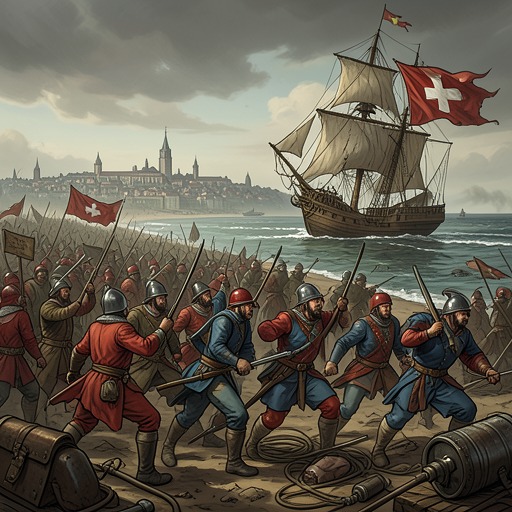
The campaign against La Rochelle is presented as both a military operation and a program of political consolidation. The city is the last remaining refuge granted to the French Calvinists after the destruction or loss of the other fortified Protestant places. Its port is also the last in the kingdom open to England, so its capture would weaken both domestic religious resistance and English intervention. Spaniards, Englishmen, Italian malcontents, adventurers, and soldiers of fortune from many sects gather beneath the Protestant standard, making La Rochelle a focus of international conflict as well as French civil division.
Bassompierre commands an important part of the royal forces, but he does not command the army without restraint. Richelieu fears that a Protestant at heart might press the English and the Rochellais less vigorously because they are his fellow believers. When Bassompierre and Henri de Schomberg claim their right as marshals of France to command under Louis XIII, Richelieu supports the Duc d’Angoulême as lieutenant general. To prevent Bassompierre and Schomberg from abandoning the army, the command is divided rather than entrusted to either marshal alone.
Bassompierre consequently establishes his quarters north of La Rochelle, between Saint-Leu and Dompierre. The Duc d’Angoulême takes the eastern sector from Dompierre to Perigny, while Schomberg occupies the southern area from Perigny to Angoutin. The arrangement is not merely military administration. It is a system of mutual observation: Monsieur watches Bassompierre, Louis XIII watches the Duc d’Angoulême, and Richelieu watches Schomberg. The army is directed against the enemy outside the lines while its leading commanders monitor one another within them.
Warning and Historical Foreshadowing
Bassompierre’s most memorable contribution is a warning voiced in the middle of the campaign. As he charges with other Protestant nobles, he remarks that they will be foolish enough to take La Rochelle. The remark is ironic because he recognizes the historical meaning of the victory even while participating in it. The city’s fall is not treated as an isolated triumph. The cannonade of the Île de Ré anticipates the later dragonnades in the Cévennes, and the capture of La Rochelle is described as a preface to the revocation of the Edict of Nantes.
His warning gives the military action a retrospective political horizon. The immediate objective is to drive the English from the Île de Ré and bring La Rochelle to submission, but the operation also signals the destruction of organized Protestant autonomy in the French kingdom. Bassompierre’s position makes the irony especially sharp: a Protestant commander helps advance a campaign whose consequences will threaten the religious community to which he remains attached by conviction.
Political Significance and Narrative Function
Bassompierre represents the limits of simple labels in a state where military service, confession, birth, and national loyalty do not coincide neatly. The campaign requires men who can serve the crown across those divisions, yet the same divisions justify surveillance and fragmented authority. His command is therefore shaped by an exception-driven political order: formal rank grants him a claim to leadership, while Richelieu’s suspicion determines how far that claim can operate.
His presence also clarifies why the siege is more than a background war for the private adventures of the four musketeers. The conflict links France, England, Spain, Lorraine, the German Empire, and the international Protestant network. Buckingham’s envoy Montague is later captured, and papers found in Buckingham’s abandoned lodging confirm a league involving the German Empire, Spain, England, and Lorraine against France. Against this wider network, Bassompierre’s divided identity becomes a miniature of the war itself: loyalties cross borders and confessions, while the state seeks to force them into a single national and political direction.
Bassompierre does not receive a private transformation or a conclusive personal ending. His significance lies in the contradiction he carries through the siege. He is an experienced marshal whose Protestant conviction cannot be erased by Catholic office, a German-born soldier whose French allegiance is not questioned, and a commander whose very usefulness makes him an object of distrust. Through him, the narrative presents the conquest of La Rochelle as a victory achieved not only over an external enemy but also over the plural religious and political order that had made such divided identities possible.