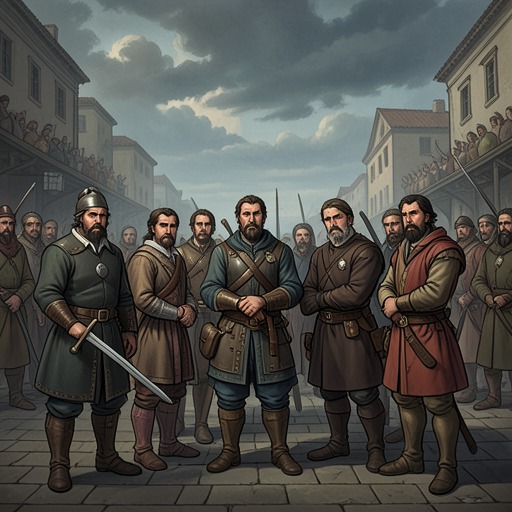
D'Artagnan–Lord de Winter Duel
The Three MusketeersD'Artagnan–Lord de Winter Duel is a carefully staged encounter in which a personal grievance becomes a public contest between French and English gentlemen. D'Artagnan seeks revenge for the Englishman's earlier success against him, yet the decisive outcome is not the baron's death: by sparing Lord de Winter for the sake of his sister, d'Artagnan converts an adversary into a potential patron and gives the duel an ethical dimension beyond victory alone.
Causes and Participants
The quarrel begins when d'Artagnan recognizes the cavalier as the Englishman of Amiens who had won his horse and had nearly won Athos's diamond as well. When the Englishman attempts to follow a carriage, d'Artagnan catches his bridle and prevents him from leaving. The interruption is therefore both immediate and personal: an old humiliation returns in the street, where anger and recognition supply the motive for a new confrontation.
D'Artagnan frames the dispute in the language of play and revenge. He recalls that the Englishman is skilled at the dice box and proposes to discover whether he can handle a sword with equal skill. When the Englishman objects that he is unarmed, d'Artagnan replies that he has two swords and will throw with him for one. He then orders him to choose the longer weapon and meet him that evening behind the Luxembourg, a place he presents as suitable for the proposed amusement. The language makes violence sound like a gentleman's game, but the remembered loss and the promise of revenge give the game genuine stakes.
The Englishman asks who his challenger is, and d'Artagnan identifies himself as a Gascon gentleman serving in the king's Musketeers. His opponent answers that he is Lord de Winter, Baron Sheffield. The encounter might have remained a private duel between two men, but d'Artagnan has already arranged a larger design: Lord de Winter arrives with three English companions, while d'Artagnan brings Athos, Porthos, and Aramis. The resulting contest is not merely personal. It places French and English honor, manners, and military reputation in direct opposition.
The Four-against-Four Combat
At the appointed hour, the four Frenchmen go behind the Luxembourg with their four lackeys. Athos pays the goatkeeper to withdraw, and the lackeys are stationed as sentinels. The precautions give the scene a controlled, almost ceremonial character. A silent party of Englishmen enters the same enclosure, and the formal presentations follow. The Englishmen are all men of rank, so the unusual names of their French opponents surprise and annoy them; social distinction thus sharpens the atmosphere before the swords are drawn.
The duel begins when Athos calls the combatants on guard. Eight swords glitter in the setting sun, and the fight opens with an animosity described as natural between men who are twice enemies. The phrase captures the event's double structure: the opponents are divided both by the immediate quarrel and by the larger national antagonism between England and France. The sunset light gives the violence a theatrical surface, but the results are exact and physical rather than ornamental.
Athos fights with calm method, as though practicing in a fencing school, and kills his opponent with a single thrust through the heart. Porthos, chastened by his earlier adventure at Chantilly, fights with skill and prudence; he wounds his adversary through the thigh, and when the Englishman surrenders his sword, Porthos carries him to his carriage. Aramis presses his opponent so vigorously that the man retreats fifty paces and finally runs away amid the lackeys' hoots. Each Frenchman therefore expresses a different mode of combat: Athos's economy is fatal, Porthos's confidence has become disciplined, and Aramis's haste drives his opponent from the field.
D'Artagnan fights defensively rather than seeking an immediate killing stroke. He waits until Lord de Winter is sufficiently fatigued, then uses a vigorous side thrust to send the baron's sword flying. Lord de Winter retreats two or three steps, slips, and falls backward. D'Artagnan springs over him and points his sword at his throat, possessing the power to end the encounter decisively.
Mercy and Reversal
The duel's decisive turn occurs when d'Artagnan refuses to translate physical advantage into murder. He tells Lord de Winter that he could kill him because the baron is completely in his hands, but adds that he will spare his life for the sake of his sister. This is not simple weakness or hesitation. D'Artagnan has secured revenge, disarmed his enemy, and then chooses mercy according to a personal code of honor and relationship.
The value shift is consequently from revenge to recognition. D'Artagnan begins the encounter eager to settle an old grievance and ends it with his adversary alive. Lord de Winter responds not with resentment but with delight at having encountered a gentleman of such disposition. He embraces d'Artagnan and pays compliments to Athos, Porthos, and Aramis. The Englishman's reaction transforms the duel's meaning: what begins as hostility between national and personal rivals ends in admiration between men who recognize one another's courage and restraint.
The aftermath still contains death. Porthos's defeated opponent has been placed in the carriage, Aramis's adversary has escaped, and the Frenchmen must deal with the man killed by Athos. Lord de Winter treats the death as a trifling matter for the dead man's family, whose inheritance will amount to fifteen thousand louis a year, and tells d'Artagnan to keep the purse for his lackeys. D'Artagnan accepts the purse, an action that leaves the duel suspended between aristocratic ritual, material privilege, and the practical rewards attached to violence.
Alliance and Consequences
Lord de Winter's respect immediately produces a new relationship. He addresses d'Artagnan as a young friend and asks permission to use that name. He then offers to present him that very evening to his sister, Milady Clarik, because she is in good odor at court and might one day speak a useful word on his behalf. D'Artagnan blushes with pleasure and agrees. The duel therefore advances his social and political prospects as well as his reputation as a swordsman.
The offer also creates an important irony in the larger narrative. The woman who may become accessible to d'Artagnan through Lord de Winter's favor is connected to the dangerous English network surrounding Milady the English spy. The act of mercy that wins Lord de Winter's confidence thus carries d'Artagnan toward a relationship that will later expose him to deception, rivalry, and peril. The duel's immediate consequence is friendship with the baron; its wider consequence is to open a door into the world of Milady the English spy.
The event also establishes a contrast between d'Artagnan and the purely destructive logic of revenge. He enters the contest invoking retribution for lost property and injured pride, but he leaves it with a living enemy converted into an admirer. The four combatants display the technical and social codes of the Musketeers, while d'Artagnan's final decision gives those codes a distinctive moral form: victory is complete only when strength can be restrained.
Narrative Significance
As a plot event, the duel combines rivalry, adventure, and social ascent. Its formal challenge gives a concrete outlet to d'Artagnan's Gascon boldness; its four-against-four structure binds his new friendship with Athos, Porthos, and Aramis to a public display of collective loyalty; and its outcome links swordsmanship to courtly opportunity. The scene is therefore more consequential than a detached skirmish. It changes d'Artagnan's position among both French and English gentlemen.
The combat also places private passion inside a wider historical pressure. The English and French will soon confront one another in the campaigns connected with the Siege of La Rochelle, where England, France, French Calvinists, Spain, and other foreign interests intersect. Against that background, the duel is a miniature version of the book's larger pattern: national hostility and personal desire overlap, but individual choices can interrupt the logic of total enmity. Lord de Winter is an English opponent, yet d'Artagnan's mercy creates a temporary bridge between the two sides.
Its lasting importance lies in the reversal from enemy to ally. D'Artagnan's sword wins the encounter, but his decision not to use it fatally wins Lord de Winter. The duel thus defines honor not as the refusal to fight, but as the capacity to fight, prevail, and still recognize a human claim that stands above revenge.