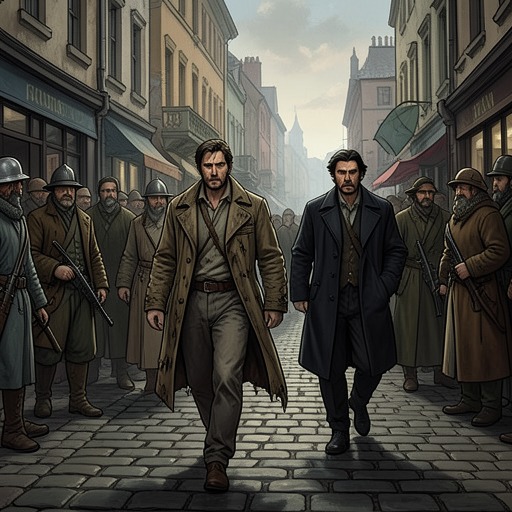
Dessessart's Guards
The Three MusketeersDessessart's Guards are the company of Guards commanded by M. Dessessart and the first military body through which d'Artagnan enters the armed service of the French court. Their importance is less a matter of independent battlefield action than of position: they connect a penniless young adventurer to the machinery of royal authority, provide the costume and access by which he moves through Paris, and place him amid the rivalry between Louis XIII and Cardinal Richelieu. The company therefore represents an early stage in d'Artagnan's passage from outsider to court-connected soldier.
Identity and Institutional Setting
Dessessart's Guards belong to the armed world of France in 1625, a period the narrative presents as saturated with conflict. Nobles fought one another, Louis XIII opposed the cardinal, Spain opposed the king, and robbers, Huguenots, wolves, and other threats made violence an ordinary feature of public life. In that atmosphere, citizens readily took up weapons, while the court organized elite military companies around competing centers of power. The guards commanded by M. Dessessart are part of this broader system of armed service and political allegiance.
Their position becomes clearer by contrast with the King's Musketeers and the Cardinal's Guards. Louis XIII has surrounded himself with a formidable chosen body, and Richelieu responds by maintaining a guard of his own. The two rivals compete over the reputation, courage, and fighting ability of their respective servants, even while publicly condemning duels and brawls. Dessessart's Guards are not presented as the decisive faction in that contest, but their existence shows how a soldier's company could function as both a military affiliation and a sign of political proximity.
D'Artagnan's First Connection
D'Artagnan is identified as a young Bearnais whom M. Dessessart knows as a cadet in the company. This detail places him below the established Musketeers in rank and prestige, but it also gives him a recognizable military identity in Paris. His arrival is marked by poverty, an old-fashioned appearance, a long sword, and an aggressive readiness for combat; service in Dessessart's Guards is the institutional foothold that allows such a young provincial to present himself as a man of arms rather than merely a traveler.
The company's uniform has practical value as well as symbolic value. When d'Artagnan needs to reach M. de Treville at the Louvre, he reasons that his costume as a Guardsman in M. Dessessart's company should serve as his passport. The uniform can therefore authorize movement through guarded political space. It does not make him powerful, but it makes him legible to the authorities as someone attached to a recognized military household.
Connection with the Musketeers
Dessessart's Guards are closely connected to the opening movement of d'Artagnan's career because their cadet is drawn into the circle of the King's Musketeers. When Athos visits d'Artagnan's lodging, bailiffs and soldiers surround the house and break open doors. M. de Treville recounts this incident before Louis XIII and the cardinal as part of the case involving his men. The company is thus present at the point where d'Artagnan's private lodging becomes a contested political and judicial space.
M. de Treville explicitly identifies d'Artagnan as the young man he patronizes and rejects the suggestion that the inexperienced cadet could have given bad counsel to Athos, a man twice his age. He further states that d'Artagnan had spent the evening with him. The exchange demonstrates that membership in Dessessart's Guards does not prevent d'Artagnan from being claimed, defended, and politically interpreted by another military authority. His formal attachment is to Dessessart's company, while his emerging patronage relationship is with M. de Treville and the King's Musketeers.
Military and Judicial Tensions
The episode also reveals how easily the boundaries between military discipline, street violence, and judicial prosecution collapse. Louis XIII insists that an edict remains an edict and that fighting is forbidden. M. de Treville answers that the encounter under discussion was not an ordinary duel but a brawl in which five of the cardinal's Guardsmen confronted three of his Musketeers and Monsieur d'Artagnan. The distinction matters because it allows Treville to defend his men as participants in an unequal confrontation rather than as simple violators of the ban on dueling.
The king orders the case to be sent before judges, while Treville warns that even a pure life and unquestionable virtue cannot protect a man from infamy and persecution in such times. D'Artagnan's affiliation with Dessessart's Guards consequently places him within the reach of official suspicion without giving him full protection from it. The company supplies military standing, but the authority attached to that standing is unstable when royal, cardinal, and judicial interests collide.
Narrative Function and Decline in Prominence
Dessessart's Guards function as a threshold institution in the novel. They introduce d'Artagnan to the formal world of soldiers, uniforms, commanders, and guarded palaces, yet they do not become his final identity. His subsequent importance develops through his association with M. de Treville and the King's Musketeers, whose devotion to Louis XIII is set against the cardinal's rival guard. The company therefore marks a transition: d'Artagnan begins as a cadet within an established guard and moves toward the more intimate, prestigious, and politically charged fraternity of the Musketeers.
That transitional role also gives the organization a broader historical significance. The company is one strand in a military order shaped by patronage and rivalry rather than by an abstract separation between soldiering and politics. Its members serve within a kingdom where uniforms open doors, commanders defend reputations, and a street encounter can become a matter for royal adjudication. Dessessart's Guards are therefore important not because the narrative grants them a separate heroic arc, but because they show the institutional doorway through which d'Artagnan enters a world governed by arms, allegiance, and contested authority.