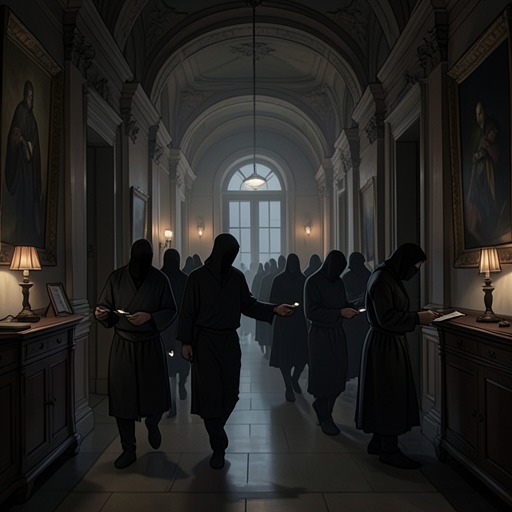
Discovery of Constance Bonacieux's Whereabouts
The Three MusketeersDiscovery of Constance Bonacieux's Whereabouts is the decisive intelligence breakthrough that turns the musketeers' uncertainty into a defined rescue mission. After Constance Bonacieux has vanished, the revelation that she is alive and hidden in a convent at Bethune restores hope while placing her fate within reach of d'Artagnan and his companions. The discovery is conveyed through a letter associated with Marie Michon, whose carefully veiled language conceals the location and circumstances from hostile readers while making the essential message legible to the intended recipients.
The Letter and Its Disguised Message
The information arrives in a letter addressed to a cousin. Its surface account concerns a young servant placed by the writer's sister in the convent of the Carmelites at Bethune. The girl is said to be resigned because she cannot live elsewhere without endangering the salvation of her soul, yet the letter also suggests that she may leave if the family's affairs are settled. The disguise turns a political and personal communication into apparently domestic correspondence, using convent life, family arrangements, and religious language to pass information through a dangerous network. The letter adds that the hidden woman most desires a letter from her intended, even though such provisions pass with difficulty through convent gratings. The writer claims competence in arranging such communications and undertakes the commission. This detail does more than identify a hiding place: it establishes Constance Bonacieux's continuing emotional connection with d'Artagnan and shows that the convent is both a refuge and a barrier. She is protected from immediate pursuit, but separated from the person whose knowledge of her survival matters most. The letter bears the signature Marie Michon. In context, the signature confirms that the message has passed through the circle surrounding Aramis and that its cautious wording is deliberate rather than accidental. The news therefore arrives not as an open announcement but as an act of secret correspondence, requiring recognition, trust, and interpretation.
Recognition at Bethune
D'Artagnan immediately understands the hidden reference. He declares that he now has intelligence of Constance Bonacieux and that she lives safely in a convent at Bethune. The movement from disappearance to survival is the event's central reversal: the woman whom the companions had been unable to find is no longer an abstraction or a lost trail, but a living person located in a specific institution. Athos identifies Bethune geographically as lying on the frontiers of Artois and Flanders. That answer converts the emotional revelation into practical knowledge. The place is distant, but not inaccessible; Athos immediately frames the end of the siege as an opportunity for the companions to travel in that direction. The discovery thus produces an objective and a timetable. The musketeers cannot yet act freely, but they know where the next stage of their effort must lead. Porthos's response places the private rescue within the pressure of the Siege of La Rochelle. Reports say that the besieged Rochellais have been reduced to eating the leather of their shoes, and he reasons grimly about what could remain after even the soles are gone. His macabre speculation makes the military crisis concrete: the companions' journey toward Bethune is dependent on the siege ending, while hunger and military necessity continue to hold them in place. Athos answers the same news with a mixture of religious polemic, wine, and reluctant admiration. He calls the Rochellais foolish for resisting Catholicism, yet concedes that they are brave. The scene therefore refuses to separate the rescue plot from the surrounding conflict. Constance's safety becomes possible only within a war that is consuming men, exhausting supplies, and determining when the four companions may leave their posts.
War, Hunger, and the Delayed Rescue
The discovery takes place against the larger political purpose of the siege. La Rochelle is described as the last remaining major refuge granted to the Huguenots by Henry IV, and the cardinal seeks to destroy it as the final bulwark of Calvinism. The city has become a meeting point for civil revolt, foreign intervention, religious antagonism, and military ambition. Spanish, English, and Italian opponents, together with adventurers and soldiers of fortune, gather beneath the Protestant cause, making the city's survival a matter of international as well as domestic politics. England's intervention intensifies the delay. Buckingham arrives unexpectedly before the Isle of Ré with ninety vessels and nearly twenty thousand men, surprises the Comte de Toiras, and lands after a bloody conflict. The French response eventually benefits from the deterioration of the English position. Salt meat and poor biscuit weaken the English camp, illness spreads among the troops, and rough seas destroy vessels along the coast, leaving wreckage between the point of l'Aiguillon and the trenches. These logistical pressures make Buckingham's continued presence unsustainable and explain why the companions can hope that the siege will soon be over. The siege also generates an information war. Captured messengers and spies are interrogated, and the cardinal orders them hanged. One captured letter reports that La Rochelle is at the point of exhaustion: if relief does not arrive within fifteen days, the inhabitants will already be dead of hunger. Buckingham has become their only hope, while the cardinal waits anxiously for news that no relief will come. Against this background, the letter about Constance is another fragile intelligence object, but its effect is opposite to the military messages surrounding it. The Rochellais' letter announces a collective crisis approaching death; Marie Michon's letter announces that Constance has survived and can perhaps be reached. The English are ultimately driven from the island, defeated in successive encounters and forced to re-embark, leaving two thousand men on the field, including senior officers, as well as cannon and flags. The military outcome releases the musketeers from the immediate demands of the campaign and makes Athos's proposed journey toward Bethune possible. The rescue is therefore not merely postponed by war; it is structurally enabled by the war's conclusion.
Surveillance, Secrecy, and the Value of the Discovery
The significance of the Bethune intelligence becomes clearer beside the surveillance practices governing the rest of the plot. At M. Bonacieux's apartment, the cardinal's agents create a secret arrest mechanism known as a mousetrap. Suspected visitors are admitted, trapped, and interrogated, allowing the authorities to seize nearly all the regular occupants of a house over several days. Because a separate passage leads to d'Artagnan's room, he avoids detention and turns his chamber into an observatory, watching visitors from above and listening through a removed floorboard to the interrogations below. The questions reveal what the authorities are really pursuing: whether Madame Bonacieux or Monsieur Bonacieux has sent messages, and whether either has spoken of an encounter involving Buckingham and the queen. The state is not simply searching for a missing woman; it is attempting to map a clandestine political network. In that setting, Constance's whereabouts cannot be transmitted plainly. The disguised letter functions as a countermeasure to the mousetrap, preserving information by hiding its meaning inside ordinary family and religious language. The event also clarifies why the discovery carries such emotional force. D'Artagnan has already been involved in a struggle against forces that convert private love into political evidence. The queen is subjected to a royal investigation when the chancellor approaches her with the king's commission, and her tears of rage mark the violence concealed beneath official procedure. Elsewhere, Milady the English spy is confined behind barred windows, bolts, and guarded doors, while her captors attempt to control not only her movement but also her capacity to manipulate those around her. Constance's convent refuge belongs to the same world of enclosure, yet the letter gives the enclosure a new meaning: it is not merely imprisonment, but a precarious shelter from political pursuit.
Consequences and Narrative Significance
The immediate consequence is a change in the musketeers' knowledge. Before the letter, Constance Bonacieux's disappearance leaves d'Artagnan searching without a confirmed destination. After it, three facts become certain: she is alive, she is at Bethune, and she is waiting for a letter from her intended. The emotional value of the event lies in the first fact, while its narrative value lies in the second and third, which turn hope into action. The discovery also strengthens the bond among the companions. D'Artagnan's relief is shared in conversation with Aramis, Athos, and Porthos; Athos supplies the geography, Porthos measures the delay against the siege, and Aramis is connected to the correspondence through Marie Michon. Their responses show the group operating as an intelligence and rescue unit rather than as four isolated swordsmen. The news belongs to d'Artagnan's love, but its consequences belong to all four. At the same time, the letter introduces danger. A message that identifies Constance's refuge could expose her if intercepted, and the very need for disguised language indicates that ordinary communication is unsafe. The convent's gratings, the secretaries who are sent away to prevent surprises, the agents stationed in ambush, and the guarded chambers elsewhere in the narrative all make information a material risk. Knowledge saves Constance only if it remains controlled. The event therefore marks a classic recognition and reversal within the plot. A vanished beloved becomes a living captive under protection; a scattered search becomes a route toward Bethune; and a private longing becomes a mission constrained by the military fate of La Rochelle. The discovery does not end Constance Bonacieux's danger, but it gives the story its first reliable direction for reaching her.