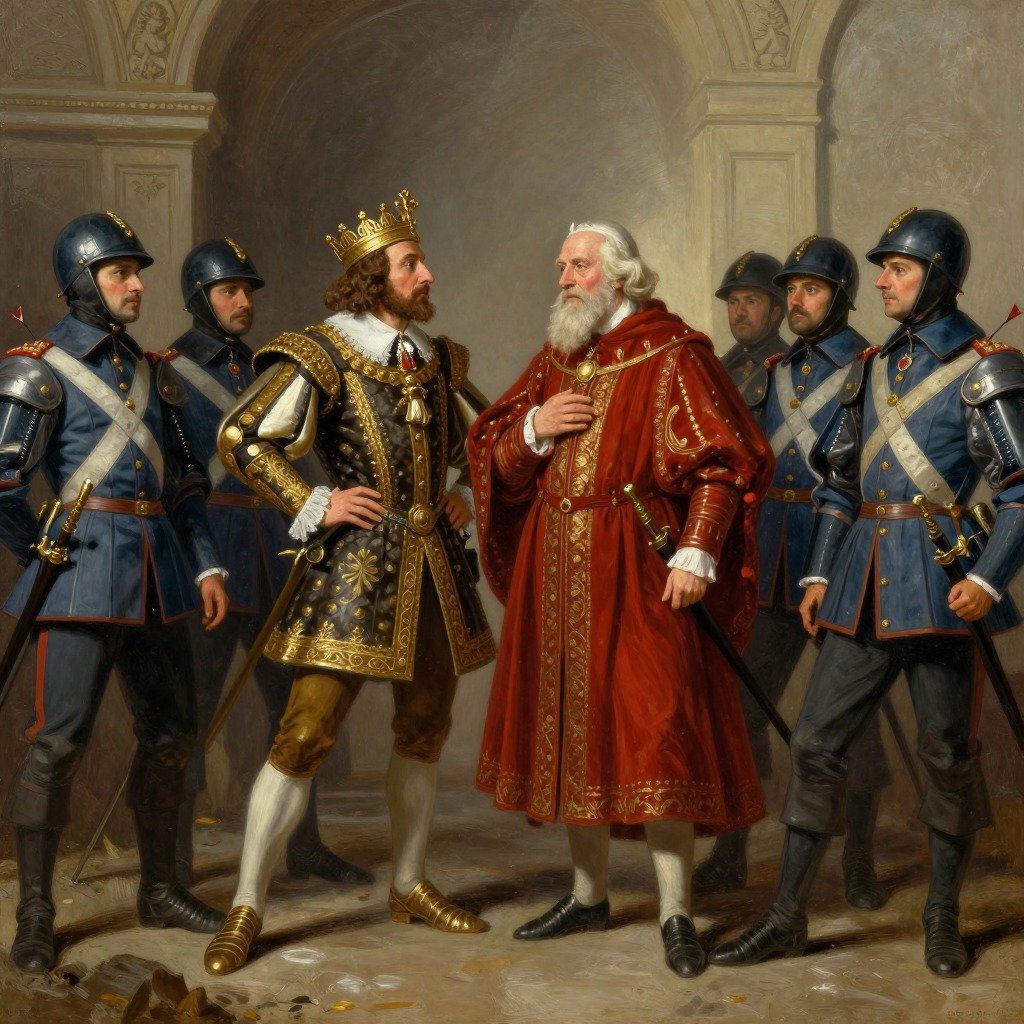
Duel with the Englishmen
The Three MusketeersThe Duel with the Englishmen marks a decisive turning point in the early career of d'Artagnan and the consolidation of the four friends as an inseparable unit. What begins as a private quarrel over a gambling loss escalates into a formal, four-against-four duel behind the Luxembourg palace, a contest that not only demonstrates the individual prowess of each Frenchman but also forges a lasting alliance with Lord de Winter, the brother-in-law of their deadliest enemy, Milady. The outcome—three Englishmen defeated, one spared—transforms a personal vendetta into a political connection that will shape the remainder of the novel.
Causes and Challenge
The duel originates in a series of provocations that began at the tennis court near the Luxembourg stables. D'Artagnan, having recently been promoted into the Guards and still smarting from the loss of his horse to an Englishman at Amiens, found himself taunted by a Guardsman named Bernajoux, who mocked him as a "Musketeer apprentice." D'Artagnan immediately challenged Bernajoux and wounded him in a swift encounter, but the fight escalated when two of Bernajoux's friends rushed to his aid, only to be driven back by Athos, Porthos, and Aramis. The brawl drew in the entire Hotel de la Tremouille and nearly resulted in a fire, but the four friends extricated themselves and, after a tense audience with King Louis XIII, emerged with royal favor and a purse of forty pistoles. The Englishman who had won d'Artagnan's horse—Lord de Winter—was among those who had witnessed the earlier humiliation, and the lingering resentment between the two men now demanded satisfaction. Lord de Winter, accompanied by three English companions, formally challenged the four Frenchmen to a duel, and the terms were set: a meeting behind the Luxembourg, at six o'clock in the evening, with each side bringing three friends.
The Combat
The four friends, accompanied by their lackeys, arrived at the appointed spot—a goat pasture behind the Luxembourg—and found the four Englishmen already waiting. After a brief exchange in which the Englishmen objected to fighting men whose names—Athos, Porthos, Aramis—sounded like shepherds' names, Athos coolly revealed his true identity to his opponent, adding that he would have to kill him to keep his secret. The eight swords glittered in the rays of the setting sun, and the combat began with an animosity born of double enmity. Athos fenced with calm method, killing his adversary with a single thrust through the heart. Porthos, abated of his earlier overconfidence by his wound at Chantilly, played with skill and prudence, stretching his opponent on the grass with a wound through the thigh and then bearing him to his carriage. Aramis, eager to return to his poem, pushed his adversary so vigorously that the Englishman took to his heels and disappeared amid the hooting of the lackeys. D'Artagnan, fighting purely on the defensive, tired out Lord de Winter, then disarmed him with a vigorous side thrust. As the baron slipped and fell backward, d'Artagnan stood over him with his sword at his throat and said, "I could kill you, my Lord, you are completely in my hands; but I spare your life for the sake of your sister."
Consequences and Alliance
This act of clemency transformed the duel from a bloody settling of accounts into the foundation of a powerful friendship. Lord de Winter, delighted to have encountered a gentleman of such generous disposition, embraced d'Artagnan and paid a thousand compliments to the three Musketeers. When a large purse fell from the clothing of the dead Englishman, d'Artagnan offered it to Lord de Winter, who refused it, saying the family would inherit fifteen thousand louis a year and that the purse should go to the lackeys. Athos, however, threw the purse to the English coachman, a gesture of disinterested nobility that struck even Porthos. Lord de Winter then promised to introduce d'Artagnan to his sister, Milady Clarik, that very evening, an introduction that would plunge the Gascon into a web of seduction, deception, and mortal danger. The four friends returned to the camp intoxicated with joy, their bond sealed by blood and their reputation enhanced. D'Artagnan, marching between Athos and Porthos, declared, "If I am not yet a Musketeer, at least I have entered upon my apprenticeship, haven't I?"