Edict of Nantes
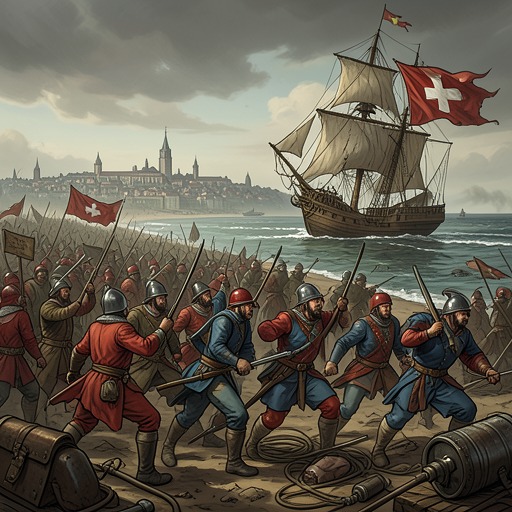
The Three MusketeersThe Edict of Nantes is the legal and political settlement whose existence explains La Rochelle’s exceptional importance in the reign of Louis XIII. By granting the Huguenots places of safety, it left La Rochelle as the last surviving major refuge of French Calvinism. The siege directed against that city therefore becomes both a campaign in the plot and a turning point in the kingdom’s religious and political order.
Protection and the Last Huguenot Stronghold
The novel identifies La Rochelle as the final remnant among the important cities that Henry IV had given to the Huguenots as places of safety. Its continued existence meant that Calvinism retained not only a religious foothold but also a fortified center from which civil revolt and foreign intervention could be connected. La Rochelle had acquired still greater importance after the destruction or weakening of the other Calvinist cities, becoming the focus toward which religious dissension and political ambition converged.
Its port also gave the city an international strategic function. It was described as the last harbor in the French kingdom still open to the English. Closing La Rochelle to England would therefore do more than suppress a domestic Protestant stronghold: it would sever an important channel through which France’s principal external enemy could enter or assist the kingdom’s internal opposition. The Edict’s protection thus appears in the novel not as an isolated legal abstraction, but as the institutional condition behind a city’s military autonomy and foreign connections.
Richelieu’s Campaign Against the Settlement
The siege of La Rochelle is presented as one of the great political events of the reign of Louis XIII and as one of Cardinal Richelieu’s greatest military enterprises. His public objective was to destroy the last bulwark of Calvinism, which the narrative characterizes as a dangerous mixture of religious resistance, civil revolt, and foreign war. The campaign consequently becomes an effort to simplify and level political authority: a kingdom divided between competing confessions and armed privileges is to be brought under a more centralized royal power.
The threat surrounding La Rochelle was international as well as domestic. Spaniards, Englishmen, Italian malcontents, adventurers from many countries, and soldiers of fortune from different sects gathered under the Protestant standard and formed a broad association whose branches extended across Europe. The city’s survival therefore depended upon networks of military support, maritime access, and political alliance that exceeded the boundaries of France. The Edict of Nantes had permitted a protected Protestant presence; the siege tests whether that protected presence can continue to function as an independent power.
Historical Consequence and Foreshadowed Revocation
The novel gives the siege a distinctly retrospective meaning. Bassompierre, a commander at La Rochelle who is described as Protestant by conviction but Catholic in his official military capacity, recognizes the contradiction of attacking a city associated with the very religious community to which he belongs. His warning that the attackers would be foolish enough to take La Rochelle is followed by the narrator’s larger judgment: the cannonade of the Île de Ré foreshadowed the later dragonnades in the Cevennes, while the city’s capture became the preface to the revocation of the Edict of Nantes.
This formulation makes the Edict a measure of historical change. At first, it represents a political arrangement that leaves room for a Protestant community, protected cities, and a degree of confessional plurality. The fall of La Rochelle signals the destruction of the last major military guarantee of that arrangement. The later revocation is therefore foreshadowed not as an unrelated act, but as the eventual completion of the policy begun at the siege.
Private Motives Within Public Policy
Although the campaign is explained through state security, religious conflict, and the danger of English intervention, the narrative refuses to separate public policy entirely from private passion. Alongside Richelieu’s broad political designs, it places the lesser but consequential motives of the amorous man and jealous rival. Richelieu had loved Anne of Austria, while the Duke of Buckingham possessed an advantage over him in the queen’s affections; the earlier diamond-stud episode had further humiliated the cardinal through the devoted action of the three Musketeers and the courage of d'Artagnan.
The Edict’s fate is consequently embedded in a political world where religious legislation, military strategy, court rivalry, and personal resentment reinforce one another. The siege can be justified as a campaign against rebellion and foreign influence, yet its narration also suggests that state power is never wholly purified of private desire. The destruction of La Rochelle serves both the public program of centralization and the intimate struggle surrounding Anne of Austria, Buckingham, and Richelieu.
Law, Exception, and State Power
The surrounding episodes clarify the kind of political order into which the Edict is absorbed. Police authorities use a “mousetrap” by secretly arresting a suspect in a house and ambushing everyone who enters, turning ordinary hospitality into a mechanism of collective detention. M. de Treville protests that police officers have arrested Athos, carried him through the streets, and thrown him into Fort l'Eveque without producing the order authorizing the arrest. When Louis XIII demands the queen’s letters, the cardinal answers that the mission must be entrusted to the keeper of the seals because it belongs to that office’s duties; elsewhere, a written order issued in the cardinal’s name authorizes an act carried out “for the good of the state.”
These episodes place the Edict within a broader tension between formal law and exceptional command. The settlement offers a legal framework for confessional protection, but the political machinery surrounding La Rochelle increasingly treats religious difference, foreign alliance, and suspected disloyalty as grounds for extraordinary coercion. Even the cardinal’s later rebuke to those who have made themselves judges insists that punishment without lawful authority turns punishers into assassins, revealing how urgently the narrative distinguishes legitimate sovereignty from unauthorized violence while showing how often power approaches that boundary.
The Edict of Nantes therefore functions as the hidden legal background of the La Rochelle narrative and as its historical horizon. Its protection creates the last Protestant refuge; its defense draws together Huguenots, foreign allies, and competing state interests; and its destruction anticipates the later suppression of French Calvinism. Through the siege, the novel transforms a religious settlement into a symbol of the passage from negotiated pluralism to centralized, coercive monarchy.