Horse
The Three MusketeersThe Horse is d'Artagnan the younger's old Bearn pony and the most visible emblem of his difficult entrance into the world. Worth twenty livres but outwardly ridiculous, it is at once a family inheritance, a practical means of travel, and the object through which strangers first judge its rider. Its apparent absurdity helps provoke the encounter at the Jolly Miller Inn in Meung, making the animal an unlikely threshold between d'Artagnan's provincial past and the dangerous social world he seeks to enter.
Appearance and Condition
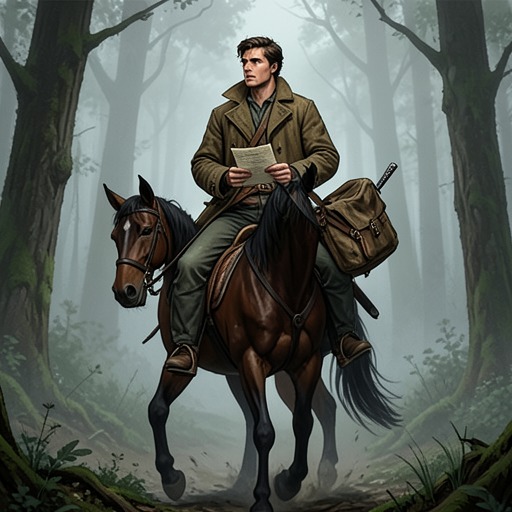
The pony is between twelve and fourteen years old, yellow-coated, and without a hair in its tail. Windgalls mark its legs, and its peculiar gait keeps its head lower than its knees, making a martingale unnecessary. Despite these defects and its strange coloration, it can travel eight leagues a day. Its practical endurance is therefore concealed beneath a spectacle that invites contempt: the very qualities that make it useful are obscured by the features that make it look comical.
The horse's appearance produces an unfavorable impression when it enters Meung through the gate of Beaugency. In a society described as highly knowledgeable about horseflesh, its observers read its body as evidence of low worth, and that judgment extends immediately to d'Artagnan. The long sword striking against the pony's side reinforces the incongruity. A young gentleman arrives with the equipment and bearing of a swordsman, but on an animal that makes him resemble a farmer's son rather than a courtier.
Inheritance and Family Meaning
The pony was given to d'Artagnan by M. d'Artagnan the elder, who explains that it was born in the family household and has remained there for about thirteen years. The father's instructions transform an apparently embarrassing gift into a moral inheritance. He tells his son never to sell the animal, to let it die peacefully and honorably of old age, and, if it accompanies him on campaign, to care for it as he would for an old servant.
That comparison gives the Horse a place within the family's code of loyalty. It is not merely transport to be exchanged for a better mount when fortune improves; it is a surviving member of the household and a material link to the father's house. The gift also carries the weight of d'Artagnan's claimed antiquity. His father connects the animal with a gentlemanly name borne by his ancestors for five hundred years, so the pony becomes a humble vessel for aristocratic memory. Its poverty of appearance contrasts with the symbolic capital that the family attaches to it.
The Road to Meung and the First Conflict
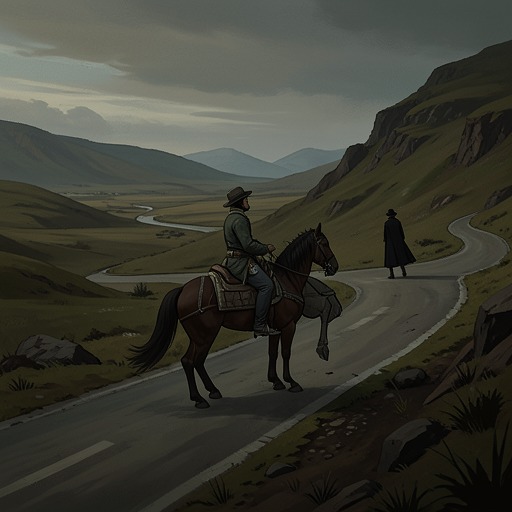
On the journey from Tarbes to Meung, the Horse travels beneath a rider whose sensitivity is already primed for affront. d'Artagnan treats every smile as an insult and every look as a provocation, while passers-by struggle not to laugh openly at the pony. The animal thus intensifies the young man's self-consciousness, even as its sword-bearing rider prevents most observers from testing his temper. The journey establishes a recurring contrast between what the Horse appears to be and what its owner believes himself entitled to be.
The contrast becomes explosive at the Jolly Miller Inn. As d'Artagnan dismounts, he notices that no host, waiter, or hostler comes to hold his stirrup or take the Horse. Through a ground-floor window he then sees a stern, well-made stranger describing the animal's qualities to two respectful listeners, who repeatedly burst into laughter. Although the stranger is discussing the pony rather than d'Artagnan himself, the rider interprets the scene as a personal insult. The Horse is the immediate subject of the mockery, but its humiliation becomes d'Artagnan's provocation.
The resulting quarrel leaves d'Artagnan injured and disoriented. When he recovers, his head is bound in linen and his doublet is missing; the innkeeper, believing the stranger to be a great lord, warns that the police will treat d'Artagnan severely for challenging him and urges him to leave. The Horse has therefore done more than attract laughter. It has helped expose the young Gascon to the unequal power of the road, where a gentleman's pride cannot protect him from the authority suggested by another man's appearance and connections.
Recognition, Status, and Narrative Function
The Horse's significance lies in its double role as a burden and a credential. It marks d'Artagnan as poor, provincial, and socially vulnerable, yet it is also the faithful means by which he reaches the encounters on which his future depends. The animal's endurance gives substance to the journey even when its appearance undermines the rider's dignity. Its apparent inferiority becomes the first test of whether d'Artagnan can convert inherited honor into action rather than relying on outward signs of status.
The narrative repeatedly places human expertise and vanity beside the animal's material usefulness. The people at Meung consider themselves connoisseurs, yet their judgment reduces the Horse to its comic surface. The same culture that reads a mount as a sign of rank also laughs at the mismatch between a respectable sword and a shabby pony. In this way the animal exposes a social field in which recognition depends on visible tokens, while genuine value may remain hidden beneath them.
The Horse also foreshadows d'Artagnan's larger trajectory. He arrives at Meung with an inherited name, an old servant, a sword, and an appetite for distinction; he leaves the opening encounter wounded and dispossessed of his immediate security, but still driven toward the court and the royal world. Later, when d'Artagnan's future appears to depend on royal favor, the memory of this first humiliating arrival remains structurally important: the road to advancement begins not with a triumphal mount but with an animal whose ridicule forces its rider into conflict. The Horse is thus both comic object and narrative vehicle, the modest creature that carries an aspiring gentleman across the threshold of his story.