Jean de Saint-Bonnet, Seigneur de Toiras
The Three MusketeersJean de Saint-Bonnet, Seigneur de Toiras, known in the narrative as the Comte de Toiras, is the French commander responsible for the royal defense of the Île de Ré. His importance lies less in private characterization than in the pressure his command exerts on the entire political and military plot: the English capture the island and establish an immediate advantage, but Toiras preserves the citadel of St. Martin and Fort La Pree long enough for the French response to gather. His resistance turns a rapid invasion into a siege, giving the cardinal time to mobilize the forces that will eventually drive the English from the island.
Command on the Île de Ré
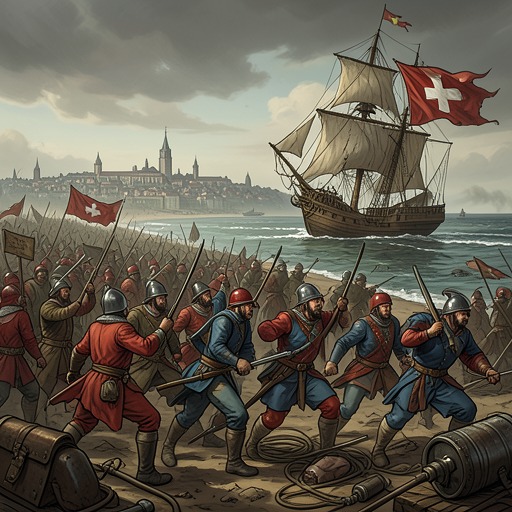
Toiras commands for the king on the Île de Ré when the Duke of Buckingham arrives unexpectedly with ninety vessels and nearly twenty thousand men. The landing takes the French by surprise and follows a bloody conflict in which the Baron de Chantal is killed. Buckingham therefore begins the operation with the appearance of overwhelming momentum, while Toiras is forced to respond to an enemy that has already secured a foothold.
Rather than abandon the island after the landing, Toiras withdraws with his garrison into the citadel of St. Martin. He also places one hundred men in a smaller defensive position, Fort La Pree. This division of the defense is strategically important: the English control the island in practice, but they do not possess its principal fortified positions. Toiras's retreat is consequently not a simple defeat. It preserves organized resistance and compels Buckingham to spend time and lives reducing strongholds instead of advancing directly toward the wider French objective.
The Siege and the French Counterstroke
The English, masters of the Île de Ré, continue to besiege the citadel of St. Martin and Fort La Pree, but without success. Their failure gives Toiras a role in the larger French strategy even while the narrative shifts its attention toward the royal camp before La Rochelle. The unresolved island defenses hasten the cardinal's decisions and contribute to the concentration of French troops for the coming operations.
Toiras later reports that preparations in the enemy camp indicate a fresh assault. His intelligence changes the French calculation. Although the English are already weakened by poor provisions, sickness, and rough seas that destroy their smaller vessels, the possibility of another attack makes delay dangerous. The king therefore orders a decisive action rather than relying solely on attrition. Toiras's report thus helps transform a waiting campaign into an immediate military response.
Relation to the Wider Campaign
The defense of the Île de Ré is inseparable from the political purpose of the siege of La Rochelle. La Rochelle is the last major stronghold left to the French Huguenots and the last French port open to the English. The English expedition is therefore not merely a local assault, while Toiras's command is not merely a provincial defense. His citadel stands at the point where English intervention, French royal consolidation, Protestant resistance, and the cardinal's larger state policy meet.
The French vanguard moves toward the theater of war while the king is delayed by fever at Villeroy. The royal Musketeers halt when the king halts, leaving d'Artagnan separated from Athos, Porthos, and Aramis before he reaches the camp before La Rochelle. Against this background, Toiras's position helps sustain the military emergency during the king's absence. The English remain committed to the island, Buckingham refuses to withdraw, and the French have time to bring their forces into a coordinated offensive.
Defeat of the English Expedition
The French counterattack succeeds. The English are repulsed step by step, defeated in successive encounters, and beaten during the passage of the Isle of Loie. They are forced to re-embark, leaving two thousand men on the field, including five colonels, three lieutenant colonels, two hundred and fifty captains, and twenty gentlemen of rank. The French also capture four cannon and sixty flags, which are carried to Paris and displayed with ceremony in the arches of Notre Dame.
Toiras is not presented as the sole author of this victory, but his earlier defense explains why the English army has been held in place long enough to become vulnerable. The citadel and Fort La Pree deny Buckingham a quick triumph; the delay exposes his army to hunger, illness, maritime losses, and the mounting difficulty of sustaining an overseas operation. The eventual French success therefore completes a process in which Toiras's resistance is the first decisive obstruction.
Narrative and Historical Significance
Toiras functions as a strategic rather than psychologically developed character. The narrative identifies him through command, fortification, intelligence, and endurance. His principal dramatic value is the conversion of invasion into siege: Buckingham's spectacular arrival with a vast fleet and army is checked by a commander who retreats without surrendering the defensive core of the island.
His role also reveals how the novel's private adventures depend upon large systems of war. Buckingham's expedition is publicly defended as an English enterprise, yet the narrative associates it with private vengeance and his desire to enter France as a conqueror. The resulting conflict places the four adventurers, the queen, the cardinal, and the English army within the same chain of consequences. Toiras's military stand is one of the points at which those personal and national motives become materially joined.
Even after the English are expelled from the island, the political danger does not disappear. The capture of Buckingham's envoy Montague reveals a league involving the German Empire, Spain, England, and Lorraine, while papers abandoned in Buckingham's lodging implicate Madame de Chevreuse and, consequently, the queen. Toiras's defense therefore belongs to a campaign whose immediate battlefield result produces fresh diplomatic and conspiratorial consequences. His command helps secure the French military position, but the victory also gives the cardinal new evidence and new responsibilities in the struggle surrounding Anne of Austria.