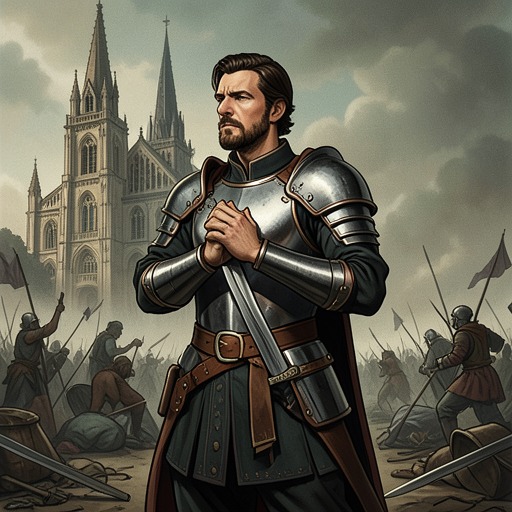
King's royal musketeer corps
The Three MusketeersThe King's royal musketeer corps is the armed household commanded by M. de Treville, a force whose devotion to Louis XIII gives it both royal prestige and political weight. Its members are celebrated as formidable swordsmen, yet their unruly public conduct makes the corps a visible contradiction: an instrument of royal authority that repeatedly turns the streets into a theatre of private violence.
Command and Royal Favor
M. de Treville's authority is the corps's organizing principle. Louis XIII appoints him captain, and the king's esteem for his commander is grounded in Treville's service with his sword and his reputation for faithfulness. The corps is presented as a chosen body of devoted men, its allegiance approaching fanaticism. The king values it; Cardinal Richelieu, who fears the force gathered around his rival, watches it with hostility.
That loyalty is personal as well as institutional. M. de Treville understands how much the king values the courage and martial reputation of his men, and he makes their presence part of court politics. He parades them before Cardinal Richelieu with an insolent air, turning the corps itself into a display of royal strength. He also wields its influence for the king and the king's friends, and then for himself and his own friends. The narrative nonetheless distinguishes political usefulness from personal corruption: despite Treville's skill at intrigue and his command over powerful followers, it reports that he was not accused of exploiting their cooperation for private gain.
A Rival Guard and a Forbidden Practice
The corps exists in an atmosphere of competition. Cardinal Richelieu, seeing the formidable body surrounding Louis XIII, establishes a guard of his own. The two rivals compete to recruit celebrated swordsmen from across France and beyond it, and each takes pride in the bearing and courage of his followers. Their political rivalry is thus made tangible in armed households whose members can meet in the same streets and turn institutional competition into personal combat.
The public rule against dueling does not end the practice. Louis XIII and Cardinal Richelieu denounce duels and brawls, yet secretly encourage their men to quarrel, taking pleasure in their side's victories and regretting its defeats. The corps's violence therefore reflects more than a failure of discipline: it flourishes within a court culture that condemns the conduct in public while rewarding it in private. The prohibition remains formally in force even when the king is eager to honor men who have fought.
Discipline, Violence, and Protection
The King's royal musketeer corps has little discipline toward anyone but M. de Treville. Its members frequent taverns, public walks, and games, where they shout, twist their moustaches, clank their swords, and seek out opportunities to annoy Cardinal Richelieu's Guards. They draw in the open streets as though combat were sport. Some are killed; others kill. Their commander's presence changes the consequences: the men expect to be mourned and avenged if they fall, and believe that they will not simply be left to rot in prison if they are responsible for another man's death.
This protection binds the men to their captain. They adore M. de Treville, fear his rebukes, obey his least word, and stand ready to sacrifice themselves to answer even a small insult. Their unruliness and their obedience are not opposites: violence is tolerated among them, but loyalty to their commander supplies the strict discipline that ordinary military order does not. The corps can consequently function as a force for the king while also serving Treville's network of friends and obligations.
The Corps in Action and at Court
The distinction between royal favor and formal rules becomes visible after a street encounter in which three of Treville's Musketeers and d'Artagnan face five of Cardinal Richelieu's Guards. Louis XIII wants to thank the four men together, but directs Treville to bring them by the back staircase so the cardinal will not learn of the meeting. He immediately acknowledges the countervailing rule: an edict remains an edict, and fighting is forbidden. Treville answers that the encounter was a brawl rather than an ordinary duel, emphasizing the imbalance between the five Guards and the three Musketeers alongside d'Artagnan. The king accepts the distinction and repeats his instruction to come secretly. His response preserves the letter of the prohibition while rewarding the fighters whose conduct it forbids.
The corps's collective identity also shapes the reception of newcomers. When d'Artagnan joins the three Musketeers in facing their opponents, Athos calls the four forward together. The moment anticipates a comradeship formed around shared danger, but it does not make d'Artagnan a member of the corps: M. de Treville later secures him a cadet place in Dessessart's Guards. Although d'Artagnan performs the duties of a Musketeer's companion and is warmly regarded by the three, he must still undergo a two-year novitiate before he can expect the uniform he wants. Treville promises that this period might be shortened if a chance to serve the king conspicuously should arise.
Institutional Significance
The corps embodies the personal character of royal power in the novel. Its prestige derives from service to Louis XIII, but its day-to-day force depends on Treville's command, the men's fierce attachment to him, and the king's selective protection. The parallel guard of Cardinal Richelieu reveals that armed loyalty is also a means of political competition. Meanwhile, the gap between the anti-dueling edict and the rulers' encouragement of combat exposes how authority can enforce a rule in principle while making exceptions for useful violence in practice. The King's royal musketeer corps is therefore both a military household and a political instrument: admired for its courage, feared by the cardinal, and difficult to separate from the personal rivalries that sustain it.