La Rochelle
The Three MusketeersLa Rochelle is the decisive military and political setting of the novel’s second half, a fortified Huguenot city whose resistance draws in the French royal army, English forces, foreign Protestant allies, and the private ambitions of Cardinal Richelieu and the Duke of Buckingham. The city is not merely a distant battlefield behind the adventures of d'Artagnan and the three Musketeers: its port, its alliances, and its eventual surrender determine the conditions under which their friendships, missions, separations, and dangers unfold.
The Last Huguenot Stronghold
La Rochelle acquires its importance from the collapse of the other cities granted to the Huguenots as places of safety under Henry IV. It remains the last great bulwark of French Calvinism, portrayed as a center where religious dissent, civil revolt, and foreign intervention can merge. Spaniards, Englishmen, Italian malcontents, adventurers, and soldiers of fortune from across Europe gather under the Protestant standard, turning the city into the focus of a transnational political and military network rather than a merely local rebellion. La Rochelle is equally valuable because its harbor is the last port in the French kingdom open to England. For Richelieu, closing it would both destroy the remaining organized stronghold of French Calvinism and deny France’s “eternal enemy” a maritime foothold. The siege therefore carries a double purpose: it is an internal operation against the Huguenots and an international operation against English power. Its significance reaches beyond the immediate campaign, since the taking of the city is presented as a prelude to the later revocation of the Edict of Nantes.
The English Landing and the Siege
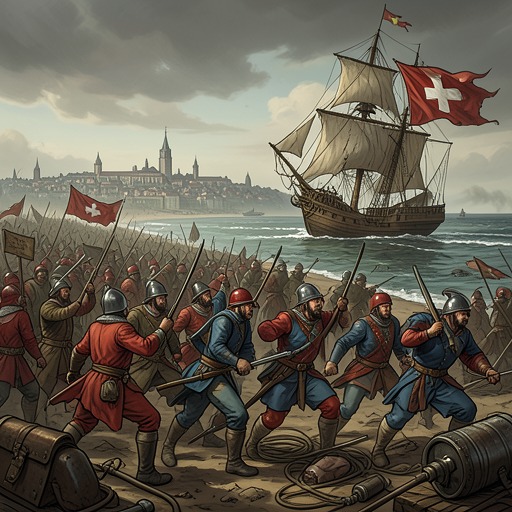
The first major turn in the struggle favors Buckingham. He arrives unexpectedly before the Isle of Ré with ninety vessels and nearly twenty thousand men, surprises the Comte de Toiras, and lands after a bloody conflict. Toiras withdraws into the citadel of Saint-Martin, while a hundred men are placed in the smaller fort of La Prée. The English thus establish themselves as an occupying force close enough to threaten French positions and to support La Rochelle, while the fortified points of the island become an essential military problem in their own right. The campaign is also driven by private motives. Buckingham claims to be defending the honor of England, but he wants to enter France as a conqueror, not as an ambassador, and he is pursuing vengeance as well as strategic advantage. Richelieu and Buckingham therefore turn the resources of two powerful kingdoms toward a contest whose immediate private stake is a favorable look from Anne of Austria. The contrast is central to La Rochelle’s narrative meaning: immense fleets, armies, fortifications, and national policies are placed beside the intimate passions of two men competing for the attention of the same queen. When d'Artagnan reaches the royal camp on September 10, 1627, the English still control the Isle of Ré and continue unsuccessfully to besiege the citadel of Saint-Martin and the fort of La Prée. Fighting around La Rochelle has already begun near a fort constructed by the Duc d'Angouleme. At this stage d'Artagnan is still serving in the Guards, separated from Athos, Porthos, and Aramis because the king’s movements determine those of the Musketeers. The great siege consequently produces a personal separation within the central fellowship even as it gathers the wider forces of France around one military objective.
Logistics, Hunger, and Maritime Power
The campaign turns on material conditions as much as on courage. English forces suffer from salt meat, bad biscuit, and numerous invalids, while rough winter seas destroy small vessels along the coast. The shore between l'Aiguillon and the trenches becomes covered with the wrecks of pinnacles, roberges, and feluccas. Even without a decisive French assault, these conditions make it increasingly clear that Buckingham, remaining in the Isle through obstinacy, will eventually have to raise the siege. Weather, nutrition, disease, and shipping therefore become weapons alongside cannon and cavalry. The French response is timed against the danger of a fresh English assault. Once reports arrive from Toiras that preparations are being made in the enemy camp, the king orders decisive action. The expedition drives the English from the Isle of Ré: they are repulsed step by step, beaten in successive encounters, and defeated at the passage of the Isle of Loix. They re-embark, leaving two thousand men on the field, including five colonels, three lieutenant colonels, two hundred and fifty captains, twenty gentlemen of rank, four cannon, and sixty flags. The captured flags are carried to Paris and displayed with ceremony beneath the arches of Notre Dame, while Te Deums are sung in the camp and throughout France. The victory removes the immediate English threat and leaves Richelieu free to continue the siege, but it does not end the larger international danger. The capture of Buckingham’s envoy Montague reveals a league joining the German Empire, Spain, England, and Lorraine against France. Papers found in Buckingham’s abandoned lodging confirm the alliance and, according to Richelieu’s account, implicate Mme. de Chevreuse and consequently the queen. La Rochelle thus functions as an intelligence center as well as a battlefield: abandoned rooms, intercepted envoys, and maritime movements expose political networks extending far beyond the city.
Hunger, Resistance, and the Human Cost
Inside La Rochelle, resistance persists after the English fleet can no longer provide effective relief. The city’s mayor suppresses an attempted mutiny by hanging the mutineers, after which those who remain opposed to continued resistance choose to die of hunger rather than surrender. The decision makes the siege a contest between military force and the endurance of a starving population, while also revealing how authority operates within the besieged city: discipline is imposed by execution from within just as the French impose it from without. Messages moving between La Rochelle and Buckingham become matters of life and death. The besiegers capture messengers sent by the Rochellais and spies sent by Buckingham, and the cardinal orders them hanged. The king sometimes comes to watch the executions, finding in the spectacle a diversion from the boredom of the siege and his repeated desire to return to Paris. The royal presence therefore appears in sharp contrast to the city’s suffering: the king is weary and entertained by punishment, while the Rochellais face the concrete limit of food. One intercepted letter states that La Rochelle is at the extremity of hunger and that, unless Buckingham’s assistance arrives within fifteen days, the inhabitants will already be dead. Buckingham has become their Messiah, so their hope depends entirely on the belief that he can return. Richelieu correspondingly waits for news that will prove Buckingham cannot come. The city’s strategic fate is consequently translated into a psychological equation: once hope in English relief disappears, courage will collapse with it.
La Rochelle and the Musketeers’ Larger Story
The siege controls the movements of the principal characters even when they are not fighting in its trenches. The king’s illness delays his departure, and whenever the king halts, the Musketeers halt as well. Later, the king plans an incognito journey to Saint-Germain for the festival of Saint Louis with an escort of only twenty Musketeers. M. de Treville selects d'Artagnan, Athos, Porthos, and Aramis for the escort because their return to Paris has become urgent. Their joy is intensified by the fact that they possess an order to withdraw Mme. Bonacieux from the Carmelite convent at Bethune, although the order is of little immediate use while they remain at the opposite end of France. The siege therefore creates both obstruction and opportunity. It separates d'Artagnan from his friends, confines their rescue plans to the distant future, and places the four men within the machinery of royal movement. At the same time, d'Artagnan recognizes the importance of his recent admission to the Musketeers: without that advancement, he would have remained in the camp while his companions departed. La Rochelle is the pressure chamber in which military service, personal loyalty, court favor, and private rescue missions are forced into the same schedule. Its influence also reaches the English coast and the novel’s parallel intrigue. Anne of Austria urges Buckingham to end the armaments being prepared against France, warning that the publicly stated religious cause conceals his love for her and that the war may bring catastrophe to both kingdoms. Buckingham’s preparations, the English fleet, Milady’s mission, and the fate of La Rochelle thus belong to one connected system of ships, letters, money, intelligence, and desire. The city’s siege gives those private communications their dangerous scale: a personal appeal from the queen may alter military policy, while a failure of relief condemns an entire population.
Capitulation and Historical Significance
La Rochelle finally surrenders after a year of siege, deprived of the English fleet and of the diversion promised by Buckingham. The capitulation is signed on October 28, 1628, and the French victory is followed by the king’s triumphant entry into Paris on December 23. The public ceremony treats the conquest as though Louis XIII had returned from defeating a foreign enemy rather than fellow Frenchmen, exposing the political contradiction at the heart of the campaign: a civil and religious conflict is staged as a national triumph. In the novel’s architecture, La Rochelle is the point where the adventure plot becomes historical process. Its harbor links France to England; its defenders connect local resistance to European alliances; its hunger gives abstract policy a bodily cost; and its surrender frees Richelieu to consolidate royal power. The city also marks a reversal in the fortunes of the characters. While armies clash and governments calculate, d'Artagnan’s service advances, the four companions regain a shared route toward Paris, and the personal consequences of the wider conflict continue beyond the battlefield. La Rochelle remains, accordingly, both a place and a mechanism: the fortified center through which war, religion, love, espionage, and the changing political order pass before the story moves toward its conclusion.