Meung-en-Beauce
The Three MusketeersMeung-en-Beauce is the narrative’s first charged threshold, a provincial market town transformed by rumor, armed panic, and the arrival of a young Gascon seeking advancement. At the Jolly Miller Inn, d'Artagnan the younger’s hypersensitive honor turns an ambiguous encounter into the first confrontation of his career, while the stranger’s interest in him announces that this seemingly ordinary roadside place will govern the direction of his future.
Setting and Atmosphere
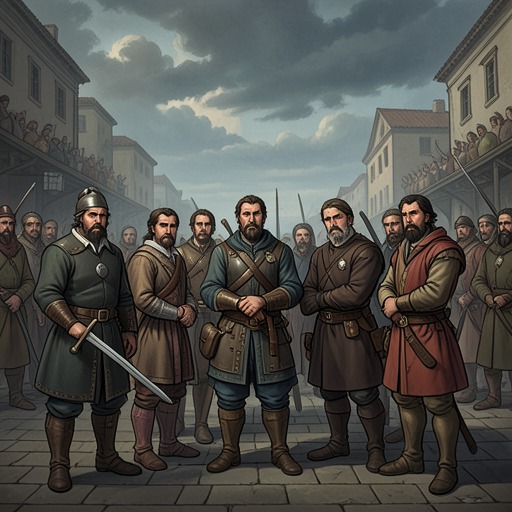
On the first Monday of April 1625, Meung-en-Beauce appears to be in a state of revolution. Women flee toward the High Street, children cry at open doors, and citizens hastily put on cuirasses and seize muskets or partisans before converging on the Jolly Miller Inn. The disturbance belongs to a society accustomed to sudden danger: nobles fight one another, Louis XIII contends with Cardinal Richelieu, Spain makes war on the king, and robbers, beggars, French Calvinists, wolves, and other outlaws threaten everyone alike.
The townspeople’s response also reveals the political reflexes of the period. They readily arm themselves against thieves, wolves, and scoundrels, and may even turn their weapons against nobles or French Calvinists; yet, seeing neither the red-and-yellow standard nor the livery of Cardinal Richelieu, they do not initially identify the disturbance as an official military or political action. Meung-en-Beauce therefore functions as a miniature of the unstable France through which the narrative moves: private alarm, public authority, factional conflict, and popular violence are constantly liable to become indistinguishable.
The Jolly Miller Encounter
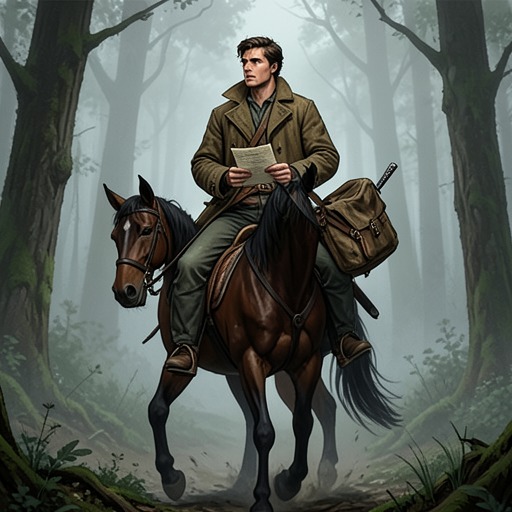
The immediate cause of the uproar becomes clear when d'Artagnan arrives at the Jolly Miller Inn. He is dismounting without host, waiter, or hostler coming to hold his stirrup or take his horse when he notices, through an open ground-floor window, a well-made gentleman speaking with two respectful listeners. The gentleman is describing the qualities of d'Artagnan’s horse, and the listeners repeatedly break into loud laughter.
The incident is trivial in material terms but decisive in its social and psychological effect. D'Artagnan the younger has traveled from Tarbes with every smile already interpreted as an insult and every glance as a provocation. His yellow pony has attracted suppressed amusement from other travelers, but the sword at its side and the rider’s fierce eye have kept open mockery in check. At Meung-en-Beauce, however, the stranger’s laughter reaches him directly. D'Artagnan concludes that he is being ridiculed and fixes the man with a haughty stare.
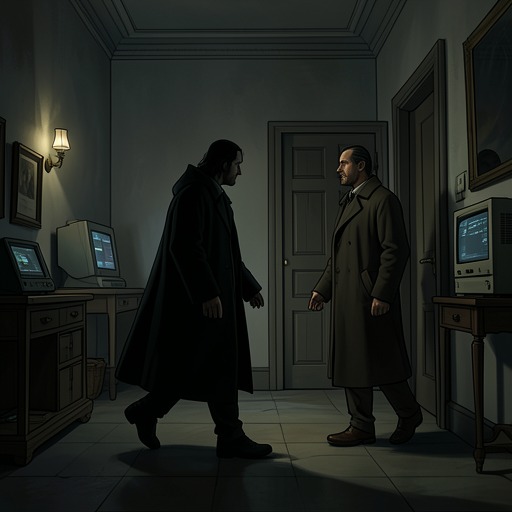
The stranger’s appearance gives the encounter an ominous precision. He is between forty and forty-five, with black piercing eyes, a pale complexion, a strongly marked nose, and a black, well-shaped mustache. His violet doublet and hose are new but creased like traveling clothes long packed in a portmanteau. D'Artagnan observes these details with unusual speed, guided by an instinctive sense that the man will have a great influence over his future. Meung-en-Beauce thus introduces not merely an antagonist but the first visible sign of the hidden forces awaiting the young traveler.
Departure and Consequences
The encounter leaves d'Artagnan injured in pride and convinced that the stranger is connected with the theft of his letter of introduction to M. de Treville. The innkeeper tells him that the gentleman became visibly disturbed when he learned that d'Artagnan was M. de Treville’s protégé and possessed a letter for that influential officer. The stranger then asked where the letter was and went into the kitchen, where he knew d'Artagnan’s doublet had been placed.
D'Artagnan responds by declaring that the man is his thief and that he will complain to M. de Treville, who will in turn complain to Louis XIII. He pays the innkeeper two crowns, receives an escort to the gate, and rides on toward Paris. At the gate of St. Antoine, he sells the yellow horse for three crowns, or nine livres, a price justified only by the originality of its color despite the hard riding it has endured. The sale strips him of his mount but gives him the money needed to continue; the roadside humiliation has become the material beginning of his advancement.
He enters Paris on foot carrying his small packet and finds a garret in Rue des Fossoyeurs near Luxembourg Gardens, choosing a lodging suited to his scant means. He sews ornamental braid onto his doublet and hose using material his mother secretly removed from an almost-new garment belonging to the elder M. d'Artagnan. He then goes to Quai de Ferraille to have a new blade fitted to his sword and asks a Musketeer for the location of M. de Treville’s hotel. The hotel proves to be in Rue du Vieux-Colombier, immediately near his rented chamber, a coincidence he reads as a favorable omen for the success of his journey.
Narrative Significance
Meung-en-Beauce is the birthplace of the book’s central pattern of pursuit, misrecognition, and self-invention. D'Artagnan’s own misreading of the stranger’s laughter provokes the quarrel, yet the innkeeper’s report confirms that the stranger was genuinely interested in his letter and clothing. The scene therefore binds youthful touchiness to a real political danger: what begins as wounded vanity opens onto espionage and a hidden contest over access to M. de Treville and the royal military world.
The location also foreshadows the novel’s larger movement between local disturbance and international conflict. The panic in Meung-en-Beauce evokes a France already divided by wars involving nobles, the king, Cardinal Richelieu, Spain, and the French Calvinists. Later conflicts extend across the same unstable network: the Duke of Buckingham reaches the Isle of Ré with ninety vessels and nearly twenty thousand men; English forces suffer from poor food, sickness, shipwreck, and rough seas; and the siege of La Rochelle becomes a struggle involving England, Spain, Lorraine, German allies, and adventurers of many sects. Meung-en-Beauce is not itself a battlefield of that scale, but its armed citizens and instant panic establish the same world in miniature.
Its lasting importance is consequently less geographical than structural. The town is the point at which d'Artagnan’s private code of honor collides with concealed political action. From the Jolly Miller Inn, through the loss of his horse and letter, to the cramped Paris lodging beside M. de Treville’s hotel, the narrative converts a provincial misunderstanding into a route toward royal service, friendship, danger, and the international struggles that follow. Meung-en-Beauce remains the first place where the hero’s future is glimpsed before he understands what that future will demand.