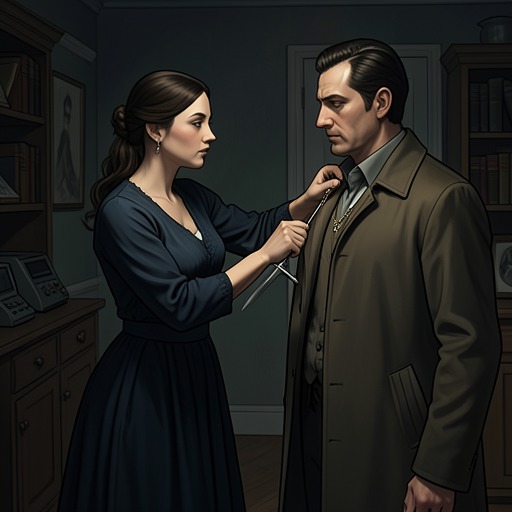
Milady's fleur-de-lis brand
The Three MusketeersMilady's fleur-de-lis brand is both a punishment impressed on her body and the clue that breaks open the identity she has concealed. First seen by d'Artagnan on her shoulder, it changes the balance between them: he recognizes the mark, she realizes that he has discovered her secret, and her hidden connection to Athos becomes legible. Later, Athos names the brand as a truth that wealth, a new name, and an altered appearance cannot erase. Milady, in turn, gives Felton a very different account of its meaning, presenting herself as the innocent victim of a brutal sentence.
The Mark Revealed
The brand comes into view during a private encounter between Milady and d'Artagnan. As she struggles to get away, the fine linen of her dress tears at her shoulder. He sees the fleur-de-lis, described as an indelible mark made by an executioner's hand, and is so astonished that he releases her and stands motionless. The discovery is not a rumor or an inference: it is a visible sign on her body, exposed by the physical struggle.
Milady immediately understands what d'Artagnan's terror means. Until then, she has guarded this secret even from her maid; now she knows that he has seen it and can connect the mark to her past. Her response is not to explain herself but to accuse him of betrayal and threaten his life. The brand therefore functions first as a breach of concealment. It gives d'Artagnan knowledge that Milady regards as dangerous, and turns an intimate encounter into a direct conflict over who controls her story.
Athos Connects the Brand to Her Past
When d'Artagnan later tells Athos about the mark, Athos initially resists the conclusion that Milady is his former wife. The physical sign, however, supplies the detail that makes the resemblance difficult to dismiss: he reasons that she may be an Englishwoman branded in France for a crime. D'Artagnan insists that the woman bearing the fleur-de-lis is Athos's wife. Athos answers that he believes he hanged her, revealing that he had believed her dead just as she had believed him dead.
The subsequent confrontation makes the relationship between the brand and the concealed identities explicit. Athos identifies himself as the Comte de la Fère, while Milady had hidden herself under another name. He tells her that the brand remains on her body even though she has become rich, taken a different name, and almost made herself another face. His accusation treats the mark as a material continuity between the woman he once knew and the figure who now stands before him: outward transformations have not removed the evidence of her earlier life. Milady's suppressed response suggests that his words recall frightening memories, but the scene does not provide a neutral account of the original branding.
Competing Accounts of the Sentence
Milady later describes the branding to Felton as an act of brutality against an innocent young woman. In her account, an executioner seizes and binds her despite her cries and resistance, and the red-hot iron is pressed to her shoulder. She presents the mark as a martyrdom inflicted by a villain and urges Felton to distrust men and their capacity for unjust vengeance. The brand that had exposed her secret to d'Artagnan thus becomes, in her telling, an instrument for persuading another person to see her as wronged and pure.
This account must be distinguished from the earlier scenes. There, the brand is treated as evidence that its bearer had committed a crime in France, and Athos recognizes it as part of the history he shares with her; to Felton, Milady instead supplies a story of innocence and persecution. The reader is therefore shown not only the mark but its political and personal usefulness: its meaning depends on who interprets it and what that interpretation can make another person believe. Milady's version does not undo the physical evidence; it tries to redirect its moral force.
Body, Identity, and Power
The brand is a bodily record that cannot be managed as easily as Milady's name, wealth, or appearance. It is usually concealed, but when the torn linen exposes it, the hidden past becomes immediately visible and dangerous. The episode makes bodily exposure decisive without making the mark a complete explanation of the crime: d'Artagnan sees what it establishes, Athos connects it to their former marriage, and Milady offers Felton a self-serving account of how it was imposed.
Its recurrence also links private recognition to public punishment. The mark first appears as a secret discovered in a bedroom, then becomes evidence in Athos's confrontation with Milady, and finally serves as the centerpiece of her appeal to Felton. At each stage it carries a different claim—criminal history, proof of an old identity, or alleged injustice—while remaining the same scar. Milady's fleur-de-lis brand consequently signifies more than a past sentence: it is the stubborn bodily trace around which concealment, recognition, accusation, and persuasion contend.