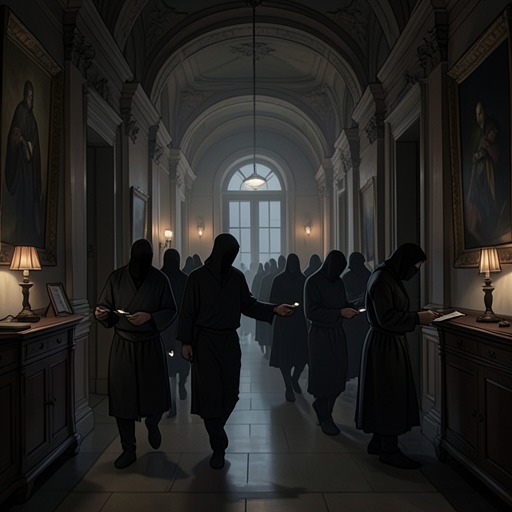
Monsieur Laporte
The Three MusketeersMonsieur Laporte, the queen’s valet de chambre, is a discreet but strategically essential servant of Anne of Austria. His importance lies less in public authority than in trusted access: he can move between the queen’s household, the Louvre, and her endangered confidants, making him one of the practical supports of the court’s hidden political and romantic communications.
Position in the Queen’s Network
Laporte belongs to the intimate service circle surrounding Anne of Austria. Madame Bonacieux identifies him as the queen’s confidential valet and treats contact with him as the key to discovering what has happened at the Louvre. His position gives him knowledge of the household’s movements and the ability to carry information where an outsider could not safely go.
That access also places him in danger. The queen is deprived of her husband’s confidence and pursued by Cardinal Richelieu, who regards her private connections as part of a wider political intrigue. The queen’s closest servants and confidants have already suffered exile or persecution: the Duchess of Chevreuse and Madame de Bernet have been exiled, while Laporte does not conceal from his mistress that he expects arrest at any moment. His loyalty therefore operates under continuous threat rather than in the security of ordinary domestic service.
Role in the Rescue of Madame Bonacieux
When Madame Bonacieux escapes after her abduction, she needs to learn what has occurred at the Louvre during the previous three days and whether it is safe for her to appear there. She explains that she had intended to inform Laporte through her husband, because her husband is known at the Louvre and would be admitted, whereas d'Artagnan is not known and would be stopped at the gate.
The solution depends on controlled recognition. Madame Bonacieux instructs d'Artagnan to present himself at the Louvre wicket on the Rue de l'Échelle side and ask for Germain. When Germain asks what he wants, d'Artagnan is to answer with the passwords “Tours” and “Bruxelles”; Germain will then place himself at d'Artagnan’s orders. The specific command is to fetch Monsieur Laporte, the queen’s valet de chambre. Laporte is thus not merely a messenger but the authorized intermediary through whom the queen’s household can be reached without exposing Madame Bonacieux.
The plan succeeds exactly as Madame Bonacieux predicts. D'Artagnan reaches the Louvre just as ten o’clock strikes, only half an hour after the preceding events. Germain bows on hearing the passwords, and within minutes Laporte arrives at the lodge. D'Artagnan tells him twice where Madame Bonacieux is, and Laporte verifies the address before setting off at a run. His immediate return with a suggestion shows both his urgency and his caution: even in a rescue that depends on speed, information must be checked and movement carefully managed.
Connection with Buckingham’s Secret Visit
Laporte’s role extends beyond the rescue itself. Madame Bonacieux’s recovered contact with him allows the interrupted plan for the Duke of Buckingham to resume. The queen had decided that Buckingham must see her and then leave Paris immediately, but Madame Bonacieux had been abducted while charged with fetching and conducting him to the Louvre. For two days no one knew where she was, and the entire arrangement remained suspended. Once she is free and again in communication with Laporte, the dangerous enterprise can proceed.
Madame Bonacieux ultimately guides Buckingham through the Louvre’s servants’ passages, locks him in a lamp-lit apartment, and tells him that someone will come. The episode reveals the kind of operational world in which Laporte functions: secret doors, passwords, household corridors, concealed rooms, and rapid personal messages replace official channels. Buckingham has entered Paris because of a forged letter that lured him there, while the queen’s servants attempt to turn the trap into a meeting. Laporte stands at the center of the communications that make this reversal possible, even when he is not physically present in every stage of it.
Political Pressure and Narrative Function
The king and Cardinal Richelieu suspect that Laporte is the “mainspring” of the queen’s intrigues. The accusation is politically revealing. Laporte’s influence does not come from rank, wealth, or military command; it comes from proximity to the queen and from his ability to connect people whom the court’s surveillance is intended to isolate. To Richelieu, that practical capacity makes a valet a dangerous agent.
His narrative function is consequently that of a hidden hinge. The visible drama belongs to Anne of Austria, Buckingham, Madame Bonacieux, and d'Artagnan, but their movements depend on servants who know doors, passwords, schedules, and safe contacts. Laporte embodies the political power of confidential service: a person apparently beneath the notice of grandees can become indispensable because information and access matter more than ceremony in a persecuted household.
Characterization and Significance
The evidence presents Monsieur Laporte as loyal, alert, and exposed rather than as a fully developed independent protagonist. His actions are brief but concrete: he is the person Madame Bonacieux must reach, he responds immediately to the password arrangement, he verifies her location, and he runs to her aid despite expecting arrest. His courage is practical and disciplined, expressed through dependable service rather than theatrical combat.
Laporte also helps define the contrast between official power and covert fidelity. Cardinal Richelieu commands surveillance and political authority, while Anne of Austria survives through a network of personal trust that includes a valet, a mercer’s wife, a messenger, and an adventuring soldier. Because Laporte belongs to that network, his apparently modest office becomes politically charged. He is one of the quiet agents through whom the queen’s private loyalties resist the cardinal’s attempt to make every relationship visible, controllable, and punishable.