Reign of Louis XIII
The Three MusketeersThe Reign of Louis XIII is the historical framework that makes the novel’s apparent succession of duels, love missions, arrests, and military exploits politically intelligible. It is presented not as a stable background but as a contested order in which the king, Cardinal Richelieu, nobles, foreign powers, soldiers, courts, and secret agents compete to direct events. Personal courage can open a path through this world, yet it remains dependent on letters, uniforms, patronage, legal authority, and the shifting favor of the crown.
Historical Setting
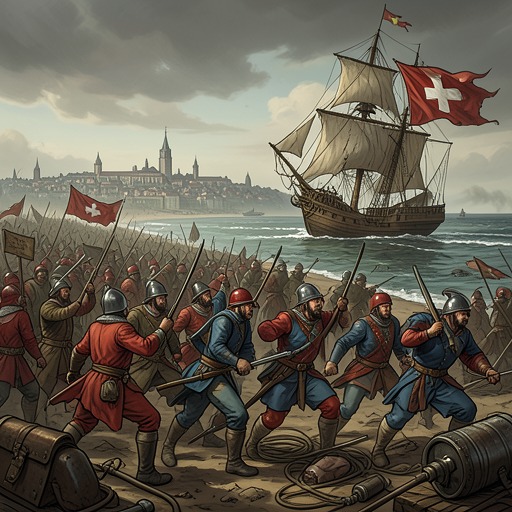
The narrative places its opening in 1625, during the reign of Louis XIII, when France is represented as a society saturated with conflict. Nobles wage private wars, the king struggles with the cardinal, Spain opposes the king, and robbers, beggars, French Calvinists, wolves, and other outlaws threaten the population. This catalogue makes disorder structural rather than exceptional: the citizens of Meung are accustomed to taking up arms, though their political loyalties are selective. They readily oppose thieves and criminals, may fight nobles or French Calvinists, sometimes resist the king, but never turn against the cardinal or Spain.
The period is therefore defined by overlapping and unequal authorities. Public government coexists with private violence, while political allegiance is shaped by fear, habit, and the visible symbols of power. The citizens rushing toward the Jolly Miller Inn distinguish danger partly through banners and liveries, expecting the red-and-yellow standard or the livery associated with the Duc de Richelieu. Authority is encountered materially, through clothing and insignia, before it is understood intellectually.
Crown, Cardinal, and Military Power
Louis XIII and Cardinal Richelieu embody the central rivalry of the period. The king surrounds himself with the King's Musketeers, while the cardinal establishes his own Cardinal's Guards. Each seeks the most celebrated swordsmen from France and abroad, and their competition extends even to private amusement: they dispute over the courage and bearing of their servants during chess games. Although both publicly condemn duels and brawls, they secretly encourage their retainers to quarrel and take pleasure or disappointment in the results.
The King's Musketeers are consequently more than an ordinary military unit. Louis XIII regards them with devoted, nearly fanatical loyalty, and their captain, M. de Treville, is valued as both commander and political instrument. M. de Treville had been the king’s childhood companion; their games sometimes became fights, and the blows Louis XIII received increased his esteem for him. His later record of repeated combats—five during his first journey to Paris, seven between the death of the previous king and Louis XIII’s majority, and perhaps a hundred thereafter—establishes the martial reputation that leads to his captaincy.
The king’s attitude toward the prohibition of dueling reveals the contradiction at the heart of the regime. After a confrontation involving d'Artagnan the younger and three of the King's Musketeers against five of the Cardinal's Guards, Louis XIII insists that an edict remains an edict and that fighting is forbidden. Yet he also orders M. de Treville to bring the men to him by the back staircase because he wants to thank them secretly. Royal power thus condemns violence in law while rewarding the same violence when it strengthens the king’s faction.
Patronage, Documents, and Access to Power
Under Louis XIII, social advancement depends upon a mixture of inherited status, personal valor, and documentary authorization. M. d'Artagnan the elder sends his son toward Paris with fifteen crowns, an old family horse, a sword, and a letter for M. de Treville. His counsel presents courage as the young man’s principal resource, but it also directs him toward a patron whose position was itself created by royal favor. The father points to M. de Treville as a model: a man who began with comparable advantages and rose to become captain of the King's Musketeers and a wealthy nobleman.
The recommendation letter becomes a small but important instrument of institutional entry. When M. de Treville prepares an additional letter for the director of the Academy, d'Artagnan the younger promises to guard it carefully and threatens anyone who attempts to take it. The scene joins the culture of honor to the material vulnerability of writing: a document can translate private trust into public access, but only if it survives theft, interception, and the volatility of personal conflict.
The same political world gives extraordinary force to apparently simple papers. A forged message lures the Duke of Buckingham to Paris, while another letter carried by the queen is taken to Louis XIII. The king reads it and discovers that it contains a plan to attack Richelieu’s political position by encouraging the King of Spain and the Emperor of Austria to oppose France and demand the cardinal’s dismissal. Crucially, the letter contains no declaration of a love affair. Its discovery changes the king’s understanding of the queen’s danger and converts a suspected private scandal into a political conspiracy.
Later, a paper extracted from Milady the English spy by Athos and entrusted to d'Artagnan the younger serves as a safeguard when d'Artagnan confronts Richelieu. The document’s power lies not merely in its content but in the fact that the cardinal recognizes his own handwriting. In this reign, writing travels through clandestine networks, acquires authority from seals and handwriting, and can protect a soldier as effectively as a sword.
War and International Pressure
The Reign of Louis XIII is also marked by the pressure of international conflict. The opening account places France between Spain and internal religious and political divisions, while the Duke of Buckingham’s movement between England and France demonstrates how quickly court intrigue becomes an international affair. Buckingham comes to Paris after trusting a false message associated with Anne of Austria, and even after recognizing the trap he refuses to leave without seeing the queen. His boldness reflects both personal romantic ambition and the dangerous mobility of aristocratic power across borders.
D'Artagnan the younger’s journey to England turns royal and romantic urgency into a logistical adventure. After being wounded, he reaches Dover at ten o’clock the following morning, lands in England, and immediately continues toward London with Planchet. He knows neither the capital nor the English language, so he writes Buckingham’s name on a piece of paper and relies on strangers to direct him to the duke’s hotel. The scene shows the practical infrastructure behind political action: ships, harbors, post horses, postillions, written names, and rapid travel allow a French mission to cross the Channel before its political opportunity disappears.
The siege of La Rochelle later exposes the material limits of royal power. Although the city is invested and the dyke prevents vessels from entering, the blockade may last a long time. Its endurance becomes an affront to the king’s army and an inconvenience to Richelieu, who must manage not only the siege but also disputes involving M. de Bassompierre and the Duc d'Angouleme. The city’s hunger and internal unrest demonstrate that warfare is governed by logistics as much as by courage: a mayor hangs mutineers, the attempted surrender is suppressed, and the population resolves to endure starvation rather than submit.
Justice, Loyalty, and Political Consequences
Judicial authority remains another unstable component of the reign. When accusations threaten a soldier’s honor, Louis XIII declares that the case should be sent before the judges and that judgment is their business. M. de Treville replies that even an uncontested life and unquestionable virtue cannot protect a man from infamy and persecution. His warning identifies a central danger of the period: legal institutions may claim impartiality while remaining vulnerable to factional pressure and police manipulation.
The tension between formal justice and political loyalty recurs throughout the narrative. The king values devoted men, but he must acknowledge that edicts prohibit the violence through which those men serve him. Richelieu commands formidable forces while operating through secret papers, agents, and surveillance. The queen’s letter is examined as evidence, d'Artagnan the younger’s safeguard is read as a political threat, and the fate of individuals depends on whether a document is treated as private correspondence, proof of treason, or royal protection.
The reign’s political structure therefore absorbs the very adventurers who appear to challenge it. D'Artagnan the younger’s boldness brings him into conflict with guards, courts, and ministers, but his survival depends on access to M. de Treville, the king, and finally a document capable of restraining Richelieu. The Musketeers’ independence is real only within a system that can alternately criminalize, reward, imprison, or pardon them.
Narrative Significance
The period is introduced through layers of historical mediation. The narrator claims to have found the story in the Memoirs of d'Artagnan and to have encountered the names of Athos, Porthos, and Aramis in a manuscript entitled Memoirs of the Comte de la Fere, Touching Some Events Which Passed in France Toward the End of the Reign of King Louis XIII and the Commencement of the Reign of King Louis XIV. This framing presents the reign as an archival world in which manuscripts, printed memoirs, court records, and contested testimony preserve competing versions of political reality.
As a result, the Reign of Louis XIII operates on two levels. It is the historical time in which the characters act, and it is the institutional pressure that shapes what action can mean. A duel may be a criminal breach of an edict, a proof of military value, or a royal service depending on who interprets it. A letter may be an innocent political appeal, a forged lure, a recommendation, or a safeguard against a cardinal. The period’s decisive significance lies in this instability: private adventure becomes the form through which the novel tests the relations among honor, force, bureaucracy, and power.