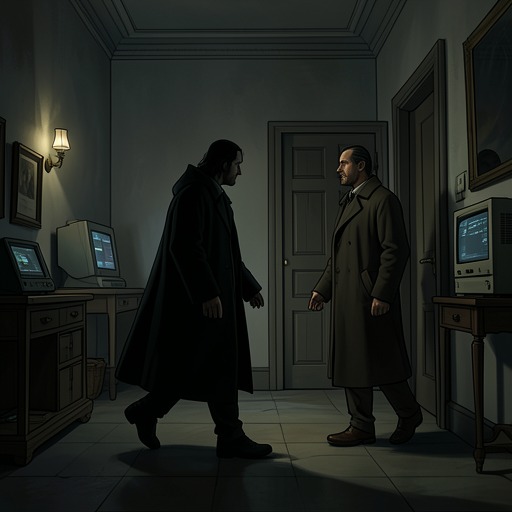
Richelieu and Rochefort relationship
The Three MusketeersRichelieu and Rochefort relationship is one of the clearest instruments of political power in the novel. Richelieu operates through information, surveillance, and indirect command; Rochefort is the mobile agent who carries those commands into Parisian houses, military circles, and the wider conflict surrounding La Rochelle. Their connection is therefore more than that of master and subordinate. It is a working alliance between strategy and execution, in which Richelieu’s intelligence becomes Rochefort’s mission and Rochefort’s reports continually refine the cardinal’s next move.
Hierarchy and Mutual Utility
Richelieu’s authority over Rochefort is immediate and unquestioned. When the cardinal wants information about the concealed movements of the Duchesse de Chevreuse and the Duke of Buckingham, he summons Rochefort and orders him to take ten of the cardinal’s Guardsmen and search the two suspected houses thoroughly. Rochefort leaves at once, without debate, because the relationship depends on speed as much as obedience. Richelieu does not need to explain the political stakes at length; Rochefort already understands that the command concerns a hidden connection among the court, the queen, Buckingham, and the cardinal’s opponents.
The arrangement is effective because Rochefort is not merely a messenger. He is an investigator capable of organizing force, interpreting what he discovers, and returning with usable intelligence. His report identifies the occupants of the houses and the timing of their departures: a young woman had left the previous night, while a man had left that morning. The information does not produce a complete victory, but it confirms that Richelieu’s suspicions are grounded in fact and allows him to revise his methods rather than continue searching blindly.
Intelligence, Surveillance, and Control
Rochefort’s role becomes especially important in Richelieu’s dealings with Monsieur Bonacieux. After Bonacieux is removed from the cardinal’s presence, the newly introduced agent observes that Bonacieux and his wife have seen one another. When Richelieu asks who supplied the information, Rochefort names Madame de Lannoy, a court insider devoted to the cardinal. The exchange reveals a chain of surveillance rather than a single act of spying: Madame de Lannoy observes, Rochefort reports, and Richelieu converts the report into political control.
Richelieu’s most revealing statement about Bonacieux is that he has made the man a spy upon his own wife. This is the relationship’s characteristic method in miniature. Rochefort does not need to extract every secret personally, because Richelieu can manipulate a frightened or ambitious subordinate into gathering information for him. Rochefort’s task is to verify, extend, and operationalize the network. The cardinal’s power thus reaches people who believe they are acting independently, while Rochefort remains the visible instrument of an intelligence system whose real design belongs to Richelieu.
The episode also shows that Rochefort understands the value of partial information. He does not pretend that the search has achieved more than it has. His report distinguishes between the woman who has already departed and Bonacieux, who has left later. Richelieu accepts this information and continues working, writing a sealed letter after Rochefort’s withdrawal. Their cooperation is built on concise reporting and calculated response, not on theatrical displays of loyalty.
From Secret Houses to Strategic War
The same relationship extends beyond domestic surveillance into the larger political and military conflict. Richelieu’s struggle against the remaining Huguenot stronghold at La Rochelle is presented as a national and religious campaign, but the siege also contains private motives and international rivalries. La Rochelle is the last major refuge granted to the Huguenots by Henry IV, a center where civil revolt, foreign intervention, and military adventurism converge. Its port remains open to England, making the city both a religious bulwark and a strategic gateway.
Rochefort belongs to the apparatus through which Richelieu manages this convergence of dangers. The cardinal’s methods in Paris and at the siege are structurally alike: identify hidden movement, isolate the enemy, control communication, and turn delay into pressure. The English intervention under the Duke of Buckingham demonstrates the scale of the threat. Buckingham arrives unexpectedly near the Isle of Ré with ninety vessels and nearly twenty thousand men, defeats the forces commanded by the Comte de Toiras in a bloody landing, and drives the defenders into the citadel of Saint-Martin and the smaller fort of La Prée.
Yet the campaign is decided not only by courage. The English camp suffers from salt meat, bad biscuit, and many invalids, while rough seas destroy vessels and cover the shore with wreckage. These logistical conditions make it increasingly difficult for Buckingham to continue the siege. Richelieu’s strategic power lies in recognizing and exploiting such pressures. Rochefort’s investigative work in the capital belongs to the same political logic: both men treat war as a contest over movement, supply, information, and endurance.
Enemies, Reports, and the Cardinal’s Reach
The relationship also clarifies Richelieu’s opposition to the circle surrounding the queen and Buckingham. When Rochefort confirms that the suspected woman and man had lodged in the indicated houses but had escaped, Richelieu does not blame the agent for arriving too late. Instead, he acknowledges that Bonacieux has already been used as effectively as possible—as a spy upon his wife. Rochefort responds with a deferential bow, recognizing the superiority of the master’s maneuver, and retires. The gesture is important: Rochefort’s loyalty is not sentimental or equal; it is expressed through recognition of Richelieu’s political intelligence.
Rochefort’s missions therefore help transform Richelieu from a distant authority into an active presence everywhere his enemies feel watched. His orders reach private residences, military searches, sealed correspondence, and the policing of messengers and spies during the siege. At La Rochelle, captured messengers and spies are subjected to immediate punishment, and the cardinal’s control of communication becomes part of the city’s strangulation. The besieged inhabitants have no hope except the Duke of Buckingham, while Richelieu waits anxiously for news that Buckingham will not return. The contrast between the cardinal’s command of information and the besieged city’s dependence on a single outside rescuer makes surveillance a military weapon as well as a domestic one.
Political Counterpoint to the Musketeers
Rochefort’s relationship with Richelieu also forms a counterpoint to the bond among d'Artagnan the younger, Athos, Porthos, and Aramis. The four companions act through personal loyalty and mutual risk, whereas Richelieu and Rochefort act through hierarchy, secrecy, and delegated force. The cardinal’s network can penetrate households and redirect the actions of people such as Bonacieux; the Musketeers’ fellowship instead depends on open solidarity, even when they are threatened by the law against dueling.
That contrast is sharpened by the rivalry between Louis XIII and Richelieu. Louis XIII has made M. de Treville captain of the King's Musketeers, a devoted body gathered around the king, while Richelieu maintains his own Guardsmen and competes with the king over the quality and courage of their followers. Both rulers publicly condemn duels and brawls while privately taking satisfaction in the victories of their combatants. Rochefort functions within Richelieu’s side of this rivalry: he is not simply a fighter but the cardinal’s chosen extension into contested spaces, able to investigate, command guards, and report directly to the man who directs the larger political game.
The relationship’s significance lies in this fusion of personal loyalty with state power. Rochefort gives Richelieu reach, mobility, and immediate intelligence; Richelieu gives Rochefort purpose, authority, and access to the machinery of government. Their partnership demonstrates how the novel’s private adventures are governed by a larger system in which love, espionage, military action, and judicial threat are linked. Richelieu thinks in networks and consequences, while Rochefort makes those networks visible in action. Together they embody the cardinal’s preferred form of rule: indirect, informed, rapid, and capable of turning another person’s fear or devotion into an instrument of policy.