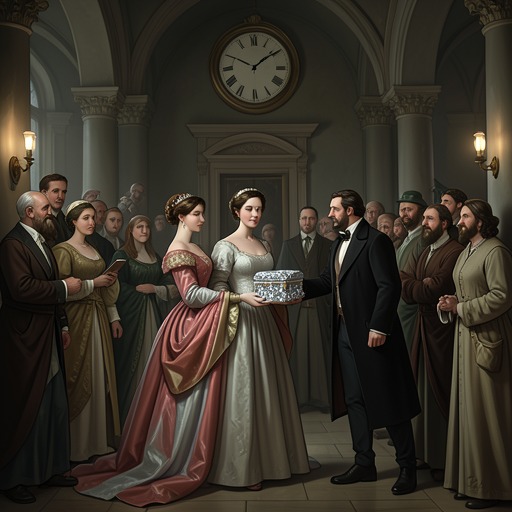
Richelieu's discovery of the Queen's meeting with Buckingham and diamond-seizure plot
The Three MusketeersRichelieu's discovery of the Queen's meeting with Buckingham and diamond-seizure plot is the decisive conversion of a hidden love affair into a political operation. Cardinal Richelieu does not merely learn that Queen of France and Duke of Buckingham have met: he turns fragments of household observation into a chain of surveillance, pursuit, deception, and planned theft. The rosewood casket, bearing the Queen's cipher, becomes the material clue that allows private intimacy to be translated into evidence and then into state action.
Discovery Through Surveillance
The discovery begins when an informant follows Monsieur Bonacieux out of the Cardinal's presence and reports that Bonacieux and his wife have seen the Queen and Buckingham together. Richelieu reacts with immediate alarm, asking whether the pair are indeed the Queen and the Duke. The report is not based on a single confession but on the accumulated observations of servants and informers around the Queen's apartments.
The Queen had taken precautions against observation. By chance or mistrust, she arranged for Madame de Surgis to sleep in her chamber and kept her there throughout the day, limiting the opportunities for others to approach or report on her movements. Even so, a handkerchief brought from her laundress produced a visible emotional reaction: despite the rouge on her face, she turned pale. That response alerted the watchers that the object carried unusual significance.
The surveillance then identifies the decisive object. Donna Estafania was the only person admitted after the handkerchief arrived. The Queen soon returned to her chamber, took a rosewood casket marked with her cipher in gold, and left again almost immediately. When she finally came back, the casket was absent. Madame de Lannoy therefore concludes, and declares herself certain, that the Queen gave it to Buckingham. The casket's disappearance supplies the material link between the observed meeting and the suspected political intimacy.
From Knowledge to Retaliation
Richelieu's response is explicitly retaliatory. Once informed that the Queen and Buckingham have met, he acknowledges that his side has been outmaneuvered and immediately proposes revenge. The event thus shifts the value of the meeting: what might have remained a secret exchange between lovers becomes, in Richelieu's interpretation, an attack on his political authority and an opportunity for counteraction.
He also learns that Buckingham and the Duchesse de Chevreuse are no longer in the places where his agents expect them. The Cardinal claims to know where they have been concealed and sends Rochefort with ten Guardsmen to search the two houses thoroughly. The order shows how rapidly private intelligence becomes official coercion. The search is conducted not as an open inquiry but as a secret operation, relying on armed men and the authority of the Cardinal's command.
The search arrives too late. Richelieu is told that the woman had left the previous night and the man that morning. He identifies them as the Duchess and the Duke, then places their movements on a wider political map: the Duchess is at Tours, Buckingham at Boulogne, and London is the place where Buckingham must ultimately be found. His instructions are equally revealing. The Queen must remain secure and ignorant that her secret has been discovered; she must believe that the authorities are pursuing some other conspiracy. Concealment is therefore part of the operation's design, not merely a consequence of failed pursuit.
The Diamond-Seizure Plot
After ordering Rochefort's search, Richelieu writes a sealed letter and summons Vitray to prepare for a journey. The immediate operational purpose appears in the message addressed to Milady. She is instructed to attend the first ball at which Buckingham appears, approach him closely, and cut two diamond studs from his doublet. Buckingham is expected to wear twelve diamond studs, and Milady is to report as soon as the two stolen pieces are in her possession.
The plan depends on the public ceremony of the ball. A courtly display of wealth becomes the cover for covert intelligence and theft, while Buckingham's clothing turns a sign of status into a vulnerability. The diamonds are not treated simply as jewels. Their value lies in their connection with the Queen's secret, Buckingham's presence, and the possibility of exposing or compromising the relationship. Richelieu therefore attacks the affair through an object that can be counted, recognized, removed, and used as proof.
The plot also demonstrates the Cardinal's method of indirect power. He does not openly accuse the Queen or confront Buckingham. Instead, he preserves the Queen's ignorance, deploys Rochefort for physical searches, sends Vitray on a journey, and assigns Milady the intimate and dangerous task of moving close enough to Buckingham to steal the studs. The operation distributes responsibility across agents while keeping its political source concealed.
Objects, Gifts, and Political Debt
The rosewood casket and the diamond studs establish a sequence in which gifts create obligations and objects carry hidden histories. Queen of France personally gives Buckingham the casket as a remembrance, and Buckingham receives it on his knees. The gesture is intimate, but the casket's disappearance makes it legible to surveillance. Once Richelieu learns of it, a token of affection becomes an index of forbidden contact.
The diamonds undergo an opposite transformation. Buckingham's original studs are later imitated so perfectly that even he cannot distinguish the new ones from the old, allowing the political crisis to continue through substitution as well as theft. The duplicate studs preserve the outward appearance required by the court while separating visible ceremony from the hidden truth of possession. In this sense, the plot is governed by objects that can conceal, reveal, replace, or transfer allegiance.
The larger story repeatedly gives material form to power. The Queen's casket, Buckingham's studs, royal money, and later commissions all move between people while creating consequences beyond their immediate exchange. The Cardinal's attempt to seize the diamonds is therefore a struggle over who can control the meaning of a gift: whether it remains a private remembrance, becomes evidence of intimacy, or is transformed into an instrument of political accusation.
Consequences and Narrative Significance
The discovery sets the central diamond-stud affair in motion and makes the Queen's danger more precise. Richelieu knows enough to act but chooses not to reveal the full extent of his knowledge. His secrecy gives the Queen a false sense of security while allowing him to prepare a trap around the next public appearance of Buckingham. The resulting conflict joins court ceremony to espionage and turns the lovers' private exchange into a matter with international implications.
The episode also clarifies the political structure surrounding the principal characters. In the unsettled France of 1625, nobles, the King, Spain, Huguenots, robbers, and other forces are represented as being in conflict with one another, while Cardinal Richelieu exercises a distinctive capacity to convert disorder into organized surveillance. His power rests not only on formal office but on information, secrecy, armed agents, and the ability to make private conduct serve the language of state security.
Finally, the event establishes the pattern of conflict between Richelieu and the four Musketeers. The Cardinal's covert diamond operation ultimately collides with d'Artagnan's mission, Buckingham's efforts to replace the missing studs, and the Queen's attempt to preserve her reputation. Later, when Richelieu confronts d'Artagnan, he condemns those who punish without authorization as assassins, yet he himself has already organized secret arrests, searches, and theft in the name of the state. The discovery is therefore both a plot mechanism and a study in exceptional power: the same political world that treats unauthorized violence as criminal permits authorized manipulation to appear as policy.