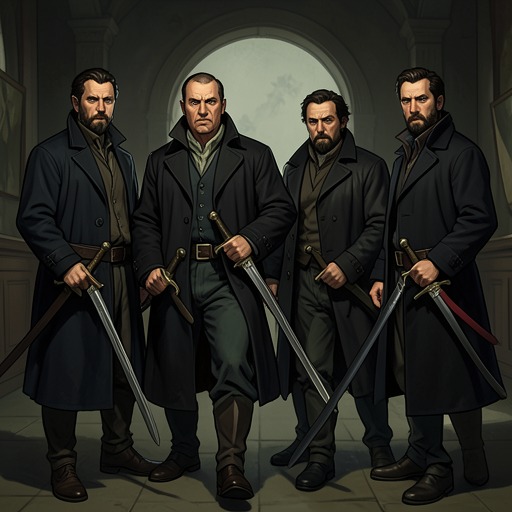
Richelieu's cardinal's guard
The Three MusketeersRichelieu's cardinal's guard is the armed company Cardinal Richelieu established to match the force surrounding King Louis XIII. Its significance lies not only in its military strength but in the way it embodies the rivalry between the cardinal and the king: encounters between the two companies expose how courtly power, public law, and personal combat overlap in the novel.
Formation and Court Rivalry
King Louis XIII made M. de Treville captain of the King's Musketeers, a company distinguished by its devotion to the king. Seeing the formidable body around his rival, Cardinal Richelieu formed a guard of his own. The two rulers competed to recruit celebrated swordsmen not only from across France but from foreign states, making military reputation a matter of courtly prestige as well as practical force.
The rivalry was sustained by a contradiction. In public, the king and the cardinal denounced duels and brawls; in private, they encouraged their followers to quarrel and took pleasure in the victories of their own men. They even disputed over the merits of their respective servants during chess games. The Guards therefore belonged to a political contest in which combat was officially condemned but privately cultivated as proof of a company’s and its patron’s standing.
The Guards in Encounters with the Musketeers
The company enters the story as both a recruiting pool and a force in direct opposition to the King's Musketeers. At a courtly exchange relayed by M. de Treville, the king is reported to have proposed recruiting future Musketeers from the cardinal’s Guards. The suggestion is framed as an insult to the royal company, whose supposed deficiencies are contrasted with the Guards’ quality. The episode makes clear that the rivalry includes contests over reputation and recruitment, not simply clashes in the street.
At the convent, a company of the Guards commanded by M. de Jussac turns up as d'Artagnan and Athos are crossing swords. Aramis and Porthos urge the combatants to sheathe their weapons, but the Guards have already seen enough to identify an intended duel. M. de Jussac invokes the prohibition on fighting and orders the men to follow him. The scene places the Guards in the role of immediate enforcers of a rule that their own company’s wider political environment treats inconsistently.
That encounter is part of a broader pattern of open factional conflict. After d'Artagnan wounds Bernajoux, the injured man’s side brings in reinforcements, and the three Musketeers come to d'Artagnan’s aid. The resulting melee draws in the people of M. de la Tremouille’s household and soldiers from another company. The cardinal’s Guards retreat into the hotel with M. de la Tremouille’s men, while soldiers outside their faction join the Musketeers. The fight thus shows how quickly a private quarrel can become a collective clash organized by company allegiance.
Law, Authority, and Political Meaning
The Guards’ enforcement of the prohibition on dueling sits uneasily beside the court’s behavior. King Louis XIII acknowledges that an edict forbids fighting even while arranging to receive the Musketeers discreetly after their confrontation with the cardinal’s men. M. de Treville argues that the clash was a brawl rather than an ordinary duel, emphasizing that five of the cardinal’s Guards had faced three Musketeers and d'Artagnan. The distinction offers a way to negotiate around the law without removing the political stakes of the violence.
The surrounding institutions sharpen this tension. When M. de Treville later protests the arrest of Athos by police officers and officials, he insists that the case should be judged by the king’s judges; the king agrees that the matter belongs before them. That arrest is not described as an operation by the Guards, but it takes place in the same world of competing military and judicial authority. The Guards’ role in enforcing the dueling edict belongs to a wider struggle over who may act, under whose authority, and whether formal law will restrain or serve political power.
Place in the Wider Conflict
The company’s rivalry with the King's Musketeers develops against a political landscape marked by war, religious division, and the cardinal’s expanding authority. The crown’s struggle to contain the Huguenot stronghold of La Rochelle and the danger of English intervention give military force a national as well as courtly significance. The available scenes do not establish a specific campaign role for the Guards in the siege; their clearest function is as the cardinal’s armed counterpart to the king’s company and as participants in the volatile culture of factional combat.
As a result, the Guards are more than a background uniform or a simple band of antagonists. Their discipline can appear as the enforcement of public order, while their rivalry with the Musketeers reveals how readily that order yields to patronage and private competition. The company gives the novel a concrete form for the contest between the cardinal and the king: their authority is expressed through followers whose swords make political rivalry visible.