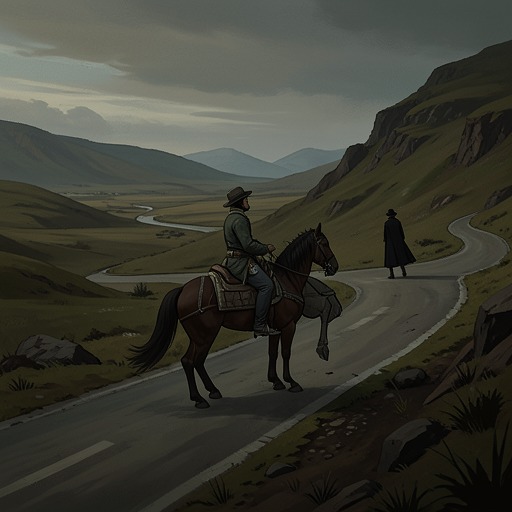
Road to Chaillot
The Three MusketeersThe Road to Chaillot becomes a brief but decisive theater of secrecy in the relationship between d'Artagnan and Madame Bonacieux. There, an unsigned letter directs d'Artagnan to watch passing carriages without speaking or moving, warning that any recognition could endanger both his life and the woman who has risked everything to see him. The road therefore turns an apparently open public route into a controlled space of surveillance, coded affection, and political danger.
The Summons and Its Conditions
The scene begins before d'Artagnan reaches the road itself. He recognizes the handwriting on a small letter, although he has seen it only once, and opens it eagerly because the writing remains associated with a powerful emotional memory. The message appoints Thursday evening as the meeting time, between six and seven o'clock, and names the road to Chaillot as the place where he must wait and inspect the passing carriages. Its instructions are unusually strict: he must neither speak nor make a movement suggesting that he has recognized the woman. The letter has no signature, leaving its authority dependent on d'Artagnan's recognition of the handwriting and his faith in the sender.
Athos immediately interprets the letter as a snare and advises d'Artagnan not to go. His warning establishes the central tension of the location: the road promises contact, but the promised contact may itself be bait. D'Artagnan nevertheless proceeds, accepting the danger because the possibility of seeing Madame Bonacieux outweighs Athos's prudence.
The Road as Rendezvous
After leaving M. de Treville, the four friends reach the road by a short gallop. The day is declining, and carriages pass in both directions while twilight begins to thicken. D'Artagnan keeps apart from his companions so that he can examine each carriage closely. The physical openness of the road does not make the meeting easy; instead, its traffic provides concealment for the person he seeks and uncertainty for the watcher.
The location's narrative function depends on this contrast between movement and stillness. Carriages hurry past, while d'Artagnan must remain watchful and restrained. He is not sent to approach a known person but to identify a fleeting sign within a stream of strangers. The road thus converts romantic anticipation into an exercise in disciplined observation, with the danger of recognition hanging over every glance.
The Passing Carriage
After roughly a quarter of an hour, a carriage approaches rapidly along the road from the direction of Sevres. D'Artagnan immediately feels that it contains the person who arranged the rendezvous, and his sudden awareness is accompanied by violent emotion. A woman's head appears at the window. She places two fingers upon her mouth, a gesture that may command silence or send him a kiss. The carriage passes so quickly that the woman seems less a stable presence than an apparition, yet d'Artagnan identifies her as Madame Bonacieux.
His instinct is to pursue her. Despite the warning, he urges his horse forward and overtakes the carriage within a few strides, but the window has already been closed and the fleeting vision has vanished. The encounter therefore grants him only a face, a gesture, and the possibility of a kiss; it withholds conversation, explanation, and physical reunion. The road offers contact only in its most compressed form, making absence part of the meeting itself.
Danger, Doubt, and Disappearance
D'Artagnan stops when he remembers the letter's command to remain motionless as though he had seen nothing. His fear is directed less toward himself than toward Madame Bonacieux, whose appearance has evidently exposed her to serious danger. The carriage continues at great speed into Paris and disappears, carrying the woman away before the meeting can become an exchange.
The disappearance leaves the meaning of the scene unresolved. If the woman was truly Madame Bonacieux and was returning to Paris, d'Artagnan cannot explain why she arranged such a fugitive rendezvous, why she offered only a glance, or why the possible kiss was lost. He must also consider that the dim light may have caused a mistake and that the entire episode could be a plot exploiting his known love for Madame Bonacieux. Athos believes the woman was indeed Madame Bonacieux, but he also thinks he saw a man's head inside the carriage. The road consequently produces recognition without certainty: it confirms the emotional bond while deepening the practical mystery.
Narrative Significance
The Road to Chaillot is important not because a long encounter takes place there, but because the location concentrates the novel's recurring conditions of clandestine attachment. A private message leads to a public place; love requires silence; recognition becomes dangerous; and the desired person appears only long enough to disappear. The road's traffic makes concealment possible, while twilight makes perception unreliable, allowing hope and suspicion to occupy the same scene.
For d'Artagnan, the rendezvous changes anticipation into renewed responsibility. He has seen Madame Bonacieux, or believes he has, but the sight does not reassure him. Instead, it reveals how exposed she is and how little control he possesses over her movements. The Road to Chaillot therefore marks a point at which romantic devotion and political peril become inseparable: a glance functions as a message, silence becomes protection, and departure becomes the scene's lasting result.