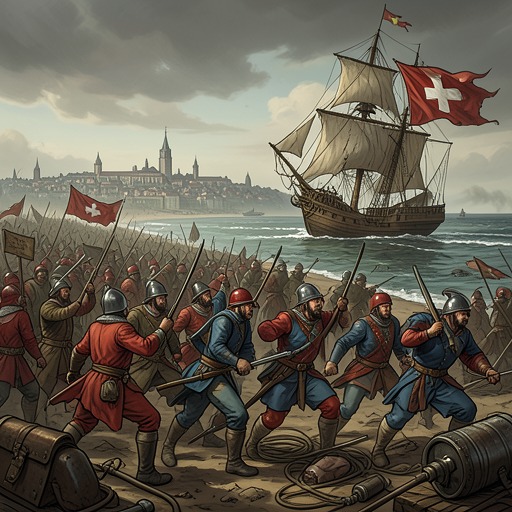
Siege and surrender of La Rochelle
The Three MusketeersThe Siege and surrender of La Rochelle is the military and political climax of the campaign surrounding the Four Musketeers. La Rochelle, the last major refuge of the French Calvinists, becomes the point at which the French monarchy confronts religious resistance, English intervention, international alliances, and the private passions of Buckingham and Cardinal Richelieu. Its surrender after a year of siege, formally signed on October 28, 1628, marks the collapse of the city’s resistance and the failure of the English diversion on which its survival depended.
Causes and Political Stakes
La Rochelle had acquired exceptional importance because the other fortified cities granted to the Huguenots by Henry IV had fallen away, leaving it as the last great bulwark of Calvinism. Cardinal Richelieu presents its destruction as necessary because religious dissent was entangled with civil revolt and foreign war. The city was not merely a local stronghold: Protestants, Spaniards, Englishmen, Italian malcontents, adventurers, and soldiers of fortune gathered around the wider Protestant cause, forming an international network whose branches extended across Europe.
The city’s harbor gave the conflict an additional strategic dimension. La Rochelle was the last port in the French kingdom open to the English, so closing it would both weaken the French Calvinists and deny England a foothold on the French coast. The siege therefore served the consolidation of royal authority as well as the suppression of religious opposition. Richelieu’s victory would complete, in the narrative’s historical framing, a long national struggle associated with Joan of Arc and the Duc de Guise.
The campaign also exposes the unstable boundary between public policy and private desire. Buckingham claimed to defend the honor of England, yet he was driven by a personal vengeance and wished to enter France as a conqueror rather than as an ambassador. The vast military contest between the two kingdoms is consequently reduced to an intimate emotional stake: the favorable glance of Anne of Austria. Buckingham’s intervention in support of La Rochelle thus joins international strategy to his secret love for the queen and his rivalry with Richelieu.
The English Relief Expedition
Buckingham gained the first advantage when he appeared unexpectedly before the Isle of Ré with ninety vessels and nearly twenty thousand men. He surprised the Comte de Toiras, who commanded for the king, and landed after a bloody engagement. The Comte de Toiras withdrew into the citadel of St. Martin with his garrison while placing one hundred men in the smaller fort of La Prée, creating a defensive obstacle that the English had to overcome before their assistance could effectively reach La Rochelle.
The English position was weakened by conditions that no act of heroism could permanently overcome. Their soldiers, dependent on adequate provisions, were reduced to salt meat and poor biscuit, and illness spread through the camp. Rough winter seas destroyed small vessels daily, while the shore between l'Aiguillon and the trenches became covered with the wrecks of pinnaces, roberges, and feluccas. The siege was therefore being decided not only by assaults and fortifications but also by food, shipping, weather, and disease. Even without a major French attack, Buckingham’s persistence on the island was expected eventually to force him to withdraw.
The French command nevertheless chose a decisive engagement when the Comte de Toiras reported that the English were preparing another assault. The resulting operation drove the English back step by step and defeated them in repeated encounters, including the passage of the Isle of Loix. The English were forced to re-embark, leaving approximately two thousand men on the battlefield, among them five colonels, three lieutenant colonels, two hundred and fifty captains, and twenty gentlemen of rank. They also lost four cannon and sixty flags, which Claude de Saint-Simon carried to Paris and displayed with ceremony beneath the arches of Notre-Dame. Te Deums were sung first in the camp and then throughout France, turning a battlefield success into a public celebration of Richelieu’s military authority.
International Conspiracy and Continuing Siege
The expulsion of the English fleet temporarily freed Richelieu to continue the siege without immediate fear of another English intervention. That relief proved incomplete when Montague, an envoy of Buckingham, was captured and evidence emerged of a league directed against France involving the German Empire, Spain, England, and Lorraine. Papers discovered in Buckingham’s abandoned lodging confirmed the alliance and, according to Richelieu’s account, implicated Madame de Chevreuse and therefore Anne of Austria.
This discovery widened the meaning of the siege. The city’s walls held out against a French army, but the royal government also interpreted the campaign through intercepted letters, diplomatic networks, and suspected treason. Richelieu’s responsibility increased with every report from abroad, and his political surveillance became as important as his military command. The siege thus links the battlefield at La Rochelle with the secret circulation of envoys, papers, promises, and accusations across the kingdoms of Europe.
Inside the city, resistance continued despite mounting deprivation. The Rochellais attempted a mutiny in favor of surrender, but their mayor hanged the mutineers, an act that temporarily silenced opposition. The besiegers also captured messengers sent between La Rochelle and Buckingham, as well as spies traveling in the opposite direction. Richelieu ordered such prisoners hanged, and Louis XIII sometimes watched the executions, using the spectacle to endure the otherwise tedious siege. Military blockade, starvation, espionage, and exemplary punishment became parts of the same machinery of pressure.
The last captured spy carried a letter reporting that La Rochelle was at the point of collapse. It did not say that the city would surrender if help failed to arrive within fifteen days; it warned that the inhabitants would already be dead of hunger by then. Buckingham had become their Messiah, and their courage depended upon the belief that he might still come. Richelieu therefore awaited English news with unusual impatience, knowing that confirmation of Buckingham’s failure would break not only the city’s material resistance but also the hope sustaining it.
Buckingham’s Death and the Collapse of Hope
The siege’s private and public conflicts converge when Anne of Austria attempts to prevent the war from reaching its most destructive conclusion. In a letter read by Laporte, she urges Buckingham to cancel the great armaments being prepared against France and end a war publicly justified by religion but widely believed to conceal his love for her. She warns that the conflict may bring catastrophe to both England and France and places Buckingham’s life itself in danger. Her appeal reveals how directly the military campaign has been shaped by their concealed relationship.
Buckingham is killed before the promised relief can save La Rochelle. The first fear of Charles I is that the news will discourage the Rochellais, so he tries to conceal the duke’s death, closes England’s ports, and prevents vessels from sailing until the army Buckingham had been assembling has departed. The order comes too late to stop two ships, one of which carries Milady the English spy. The black flag flying from the admiral’s ship confirms the disaster to her before the English government can fully suppress the news.
The death also transforms Milady the English spy’s position. She had been commissioned to destroy the preparations at Portsmouth and imagines herself as Judith entering the Assyrian camp, a lone woman confronting an enormous concentration of ships, soldiers, horses, and weapons. Yet the failure of Buckingham’s expedition and the exposure of her own schemes leave her defeated by d'Artagnan, who has deceived her, humiliated her, damaged her plans, deprived her of liberty, and threatened her life. The military collapse at La Rochelle therefore accelerates a parallel personal collapse, while the duke’s death removes the force on which the besieged city had pinned its final expectation.
Surrender and Aftermath
With the English fleet absent and the diversion promised by Buckingham abandoned, La Rochelle finally surrendered after a siege lasting a year. The capitulation was signed on October 28, 1628. The ending confirms the importance of logistics and alliance: the city does not fall because its defenders suddenly cease to resist, but because hunger, isolation, and the destruction of external relief make continued resistance impossible.
The victory magnifies Richelieu’s authority and strengthens the French monarchy’s control over a city that had represented the remaining organized resistance of French Calvinism. The campaign’s political effects extend beyond the walls. England’s intervention has failed, the international league against France has been exposed, and the royal government can present the surrender as both a military triumph and a restoration of internal order.
The epilogue places the siege within the personal destinies of the principal figures. D'Artagnan takes possession of his command, while Porthos leaves the service and marries Madame Coquenard; the coveted coffer contains eight hundred thousand livres. Louis XIII enters Paris in triumph on December 23, 1628, received as though he had conquered an external enemy rather than fellow Frenchmen. The surrender of La Rochelle thus closes the military plot while leaving the novel’s private loyalties, ambitions, and rewards unevenly distributed among the survivors.