The Journey to England
The Three MusketeersThe Journey to England is the decisive expedition in which d'Artagnan and his three companions leave Paris under orders they cannot fully disclose, cross a country filled with ambushes and treachery, and reach London with a letter from Queen Anne of Austria for the Duke of Buckingham. What begins as a covert errand for love becomes a sequence of separations, wounds, disguises, and forced improvisations, revealing that the fate of a queen, a threatened alliance, and the ambitions of France and England can depend upon the stamina of four adventurers.
Causes and Secret Objective
The journey arises from the political danger surrounding Anne of Austria and the Duke of Buckingham. Buckingham has come to Paris because of a forged message purporting to come from the queen, and he discovers that the summons was a trap. Yet his appetite for adventure and romance prevents him from simply returning to England: instead, he insists on seeing Anne of Austria. When Madame Bonacieux, who has been charged with bringing him safely to the Louvre, is abducted, the planned meeting is delayed for two days. Once she is freed and put in communication with Monsieur Laporte, she resumes the dangerous undertaking and conducts Buckingham through the Louvre, ultimately leaving him locked in an apartment while awaiting further instructions.
The political stakes are therefore inseparable from the emotional ones. Buckingham refuses to depart without seeing the queen, while Anne of Austria fears that his frustration may lead him into some reckless act. The queen's peril is not merely personal: the Duke of Buckingham is a powerful Englishman, and his presence in Paris gives Cardinal Richelieu an opportunity to connect courtly intimacy with national danger. D'Artagnan understands that the cardinal's agent will soon be warned, and he goes directly to M. de Treville because he believes there is no time to lose. For him, the mission promises glory and money, but its strongest attraction is the chance to serve the woman he adores and to enter more closely into the crisis surrounding her.
D'Artagnan asks M. de Treville to obtain from Monsieur Dessessart a fifteen-day leave of absence, effective that very night. He does not initially reveal the destination or purpose. When Athos, Porthos, and Aramis learn that the destination is London, Porthos demands to know what they are to do there, but d'Artagnan can only tell them that he is not at liberty to explain and that they must trust him. Their agreement converts a private commission into a collective oath of action. Each of the three Musketeers takes seventy-five pistoles from the traveling fund and prepares to depart at the appointed hour.
Departure and the First Separations
At two o'clock in the morning, d'Artagnan, Athos, Porthos, and Aramis leave Paris through the Barrière Saint-Denis. Darkness makes them silent and suspicious; they fear ambushes on every side. With the first light, however, their spirits rise. The journey takes on the exhilaration of a campaign, with the travelers treating the possibility of death as part of the freedom and gaiety of the enterprise. The expedition's emotional energy thus begins in fellowship, even though its practical conditions are already precarious.
The first major setback occurs at Beauvais, where they stop for two hours to rest the horses and wait for Porthos. Porthos does not appear, and no news of him arrives. The others are forced to resume the journey without him. The separation is not a voluntary abandonment but the first sign that the mission will be accomplished through successive reductions of the original company. The group that leaves Paris together will not remain intact as it crosses France.
A league beyond Beauvais, on a road confined between two high banks, the travelers encounter eight or ten men apparently repairing the road. Aramis objects sharply to the condition of the path, and the laborers answer with jeers. Before the travelers can recognize the danger, the men retreat to the ditch and draw concealed muskets. The apparent roadwork has been an ambuscade. The attackers outnumber the travelers in firearms, and the opening volley wounds both Aramis and Mousqueton. A ball passes through Aramis's shoulder; another lodges in the fleshy part of Mousqueton's lower back. Mousqueton falls from his horse because he cannot see the wound and imagines it more serious than it is.
D'Artagnan identifies the attack as an ambush and orders the others not to waste a charge but to press forward. Aramis, despite his wound, clings to his horse's mane and continues with the company. Mousqueton's horse rejoins the travelers, but the attack has altered the expedition's balance: one companion is missing, another is injured, and the mission must proceed at speed rather than pause for recovery. The scene establishes the journey's governing pattern, in which courage does not prevent loss but determines whether loss will halt the travelers.
Wounds, Exhaustion, and Concealed Hostility
The remaining travelers continue for two hours at their best speed, although the horses are so fatigued that they may soon refuse to go on. At Crevecoeur, Aramis declares that he can proceed no farther. His polished manners and elegant appearance have concealed extraordinary courage, but the wound has exhausted him; he grows paler by the minute and must be supported on his horse. The party lifts him off at the door of a cabaret and leaves Bazin with him. D'Artagnan and Athos then continue, hoping to sleep at Amiens, while the expedition is reduced still further.
Athos recognizes the danger in the accumulating accidents. With only two masters, Grimaud, and Planchet remaining, he suspects that the repeated losses may be the products of a plot rather than chance. His suspicion gives the journey a new dimension: the road is not simply difficult, but actively organized against them. The companions are being separated by attacks, delays, and engineered obstacles that exploit their need for fresh horses, money, and shelter.
At an inn, D'Artagnan, Athos, and Planchet find two fresh and fully equipped horses whose owners have spent the night there and are settling their bill. The horses appear to offer precisely the relief the travelers need. Athos goes inside to pay the reckoning while D'Artagnan and Planchet wait at the door. The apparent convenience becomes another trap. The host asks Athos to enter a back room, where Athos offers two pistoles for the bill. The innkeeper examines the coins repeatedly, then suddenly declares them counterfeit and threatens to have Athos and his companions arrested as forgers.
Athos answers the accusation with a threat to cut off the host's ears, but four men armed to the teeth immediately rush in through side doors. The episode confirms that hospitality along the route can conceal judicial intimidation and physical violence. A forged accusation is used to create a pretext for arrest, while armed accomplices wait to overwhelm the traveler. The expedition's progress therefore depends not only on fighting enemies in the open but also on recognizing the institutions and transactions that enemies can manipulate.
The Journey to England is the decisive expedition in which d'Artagnan and his three companions leave Paris under orders they cannot fully disclose, cross a country filled with ambushes and treachery, and reach London with a letter from Queen Anne of Austria for the Duke of Buckingham. What begins as a covert errand for love becomes a sequence of separations, wounds, disguises, and forced improvisations, revealing that the fate of a queen, a threatened alliance, and the ambitions of France and England can depend upon the stamina of four adventurers.
Causes and Secret Objective
The journey arises from the political danger surrounding Anne of Austria and the Duke of Buckingham. Buckingham has come to Paris because of a forged message purporting to come from the queen, and he discovers that the summons was a trap. Yet his appetite for adventure and romance prevents him from simply returning to England: instead, he insists on seeing Anne of Austria. When Madame Bonacieux, who has been charged with bringing him safely to the Louvre, is abducted, the planned meeting is delayed for two days. Once she is freed and put in communication with Monsieur Laporte, she resumes the dangerous undertaking and conducts Buckingham through the Louvre, ultimately leaving him locked in an apartment while awaiting further instructions.
The political stakes are therefore inseparable from the emotional ones. Buckingham refuses to depart without seeing the queen, while Anne of Austria fears that his frustration may lead him into some reckless act. The queen's peril is not merely personal: the Duke of Buckingham is a powerful Englishman, and his presence in Paris gives Cardinal Richelieu an opportunity to connect courtly intimacy with national danger. D'Artagnan understands that the cardinal's agent will soon be warned, and he goes directly to M. de Treville because he believes there is no time to lose. For him, the mission promises glory and money, but its strongest attraction is the chance to serve the woman he adores and to enter more closely into the crisis surrounding her.
D'Artagnan asks M. de Treville to obtain from Monsieur Dessessart a fifteen-day leave of absence, effective that very night. He does not initially reveal the destination or purpose. When Athos, Porthos, and Aramis learn that the destination is London, Porthos demands to know what they are to do there, but d'Artagnan can only tell them that he is not at liberty to explain and that they must trust him. Their agreement converts a private commission into a collective oath of action. Each of the three Musketeers takes seventy-five pistoles from the traveling fund and prepares to depart at the appointed hour.
Departure and the First Separations
At two o'clock in the morning, d'Artagnan, Athos, Porthos, and Aramis leave Paris through the Barrière Saint-Denis. Darkness makes them silent and suspicious; they fear ambushes on every side. With the first light, however, their spirits rise. The journey takes on the exhilaration of a campaign, with the travelers treating the possibility of death as part of the freedom and gaiety of the enterprise. The expedition's emotional energy thus begins in fellowship, even though its practical conditions are already precarious.
The first major setback occurs at Beauvais, where they stop for two hours to rest the horses and wait for Porthos. Porthos does not appear, and no news of him arrives. The others are forced to resume the journey without him. The separation is not a voluntary abandonment but the first sign that the mission will be accomplished through successive reductions of the original company. The group that leaves Paris together will not remain intact as it crosses France.
A league beyond Beauvais, on a road confined between two high banks, the travelers encounter eight or ten men apparently repairing the road. Aramis objects sharply to the condition of the path, and the laborers answer with jeers. Before the travelers can recognize the danger, the men retreat to the ditch and draw concealed muskets. The apparent roadwork has been an ambuscade. The attackers outnumber the travelers in firearms, and the opening volley wounds both Aramis and Mousqueton. A ball passes through Aramis's shoulder; another lodges in the fleshy part of Mousqueton's lower back. Mousqueton falls from his horse because he cannot see the wound and imagines it more serious than it is.
D'Artagnan identifies the attack as an ambush and orders the others not to waste a charge but to press forward. Aramis, despite his wound, clings to his horse's mane and continues with the company. Mousqueton's horse rejoins the travelers, but the attack has altered the expedition's balance: one companion is missing, another is injured, and the mission must proceed at speed rather than pause for recovery. The scene establishes the journey's governing pattern, in which courage does not prevent loss but determines whether loss will halt the travelers.
Wounds, Exhaustion, and Concealed Hostility
The remaining travelers continue for two hours at their best speed, although the horses are so fatigued that they may soon refuse to go on. At Crevecoeur, Aramis declares that he can proceed no farther. His polished manners and elegant appearance have concealed extraordinary courage, but the wound has exhausted him; he grows paler by the minute and must be supported on his horse. The party lifts him off at the door of a cabaret and leaves Bazin with him. D'Artagnan and Athos then continue, hoping to sleep at Amiens, while the expedition is reduced still further.
Athos recognizes the danger in the accumulating accidents. With only two masters, Grimaud, and Planchet remaining, he suspects that the repeated losses may be the products of a plot rather than chance. His suspicion gives the journey a new dimension: the road is not simply difficult, but actively organized against them. The companions are being separated by attacks, delays, and engineered obstacles that exploit their need for fresh horses, money, and shelter.
At an inn, d'Artagnan, Athos, and Planchet find two fresh and fully equipped horses whose owners have spent the night there and are settling their bill. The horses appear to offer precisely the relief the travelers need. Athos goes inside to pay the reckoning while d'Artagnan and Planchet wait at the door. The apparent convenience becomes another trap. The host asks Athos to enter a back room, where Athos offers two pistoles for the bill. The innkeeper examines the coins repeatedly, then suddenly declares them counterfeit and threatens to have Athos and his companions arrested as forgers.
Athos answers the accusation with a threat to cut off the host's ears, but four men armed to the teeth immediately rush in through side doors. The episode confirms that hospitality along the route can conceal judicial intimidation and physical violence. A forged accusation is used to create a pretext for arrest, while armed accomplices wait to overwhelm the traveler. The expedition's progress therefore depends not only on fighting enemies in the open but also on recognizing the institutions and transactions that enemies can manipulate.
Duels, False Passes, and the Crossing to England
The travelers' resistance turns the inn's attempted arrest into another violent delay. D'Artagnan and Athos must fight their way free, and the journey's political secrecy becomes embodied in a document: passage into England depends on obtaining the order belonging to the Comte de Wardes. In the ensuing struggle, d'Artagnan defeats a young gentleman who has already been wounded but still retains enough strength to thrust at him. The gentleman cries that he has one stroke for d'Artagnan; d'Artagnan answers with a final thrust that leaves the man senseless or possibly dead, then searches his pockets and takes the passage order.
The document bears the name of the Comte de Wardes, making the travelers' passage possible through an act of impersonation and appropriation. D'Artagnan nevertheless pauses over the moral cost of the encounter. He sees the handsome young man lying in his blood and reflects on the strange destiny that makes men destroy one another for the interests of people who are strangers to them and may not even know that they exist. The reflection does not stop the mission, but it exposes the distance between the private violence on the road and the remote courtly interests that have set it in motion.
D'Artagnan's wound is serious enough to demand attention but fortunately not dangerous: the sword point strikes a rib and glances along the bone, costing him only a few drops of blood. Exhausted, he sleeps on a mattress laid upon the deck while the vessel makes slow progress in a light breeze. At daybreak the ship is still three or four leagues from the English coast; it reaches Dover harbor at ten o'clock, and half an hour later d'Artagnan sets foot on English land.
The crossing does not end the expedition. D'Artagnan and Planchet immediately take post horses, with a postillion riding before them, and reach London within a few hours. D'Artagnan knows neither the city nor its language, so he writes Buckingham's name on a piece of paper and follows the directions given by those who recognize it. The hero's arrival is therefore practical rather than triumphant: he enters England wounded, linguistically helpless, and still dependent on improvisation, but he has carried the mission across the Channel.
The Letter and the Enlarged War
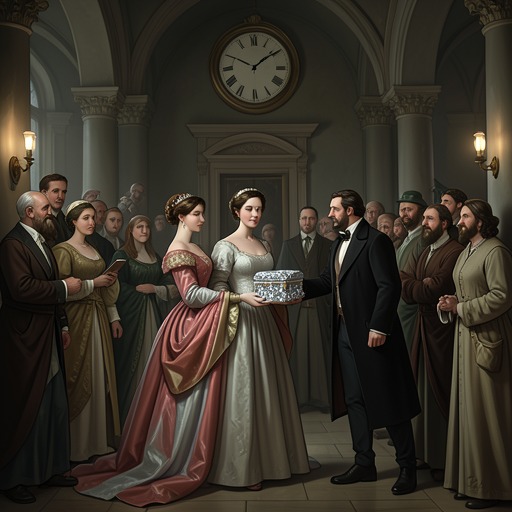
At Buckingham's hotel, d'Artagnan presents the letter entrusted to him by Anne of Austria. Buckingham asks whether the queen is in danger, and d'Artagnan replies that he believes she faces a great peril from which the duke alone can extricate her. When Buckingham eagerly asks how he can serve her, d'Artagnan gives him the letter and identifies its source as the queen. The journey thus culminates not in a battle or public ceremony but in the successful transfer of a secret message whose contents transform private devotion into political communication.
The expedition's meaning expands after the travelers reach England. La Rochelle remains the last major stronghold granted to the Huguenots by Henry IV, and Cardinal Richelieu regards its destruction as necessary because Calvinist resistance is entangled with civil revolt and foreign war. Spaniards, Englishmen, Italian malcontents, adventurers, and soldiers of fortune from many sects gather beneath the Protestant standard, turning the city into a node in a trans-European network. Its harbor is also the last port in France open to England, so closing it would both isolate the Huguenots and complete a strategic work against England.
Buckingham's intervention is likewise driven by more than national policy. He arrives unexpectedly before the Isle of Ré with ninety vessels and nearly twenty thousand men, surprises the Comte de Toiras, and lands after a bloody conflict. The military enterprise is connected to his personal desire for Anne of Austria: the two kingdoms' immense resources are placed behind the competing purposes of two powerful men, while the emotional stake is reduced to the possibility of a favorable look from the queen.
The broader campaign also reveals the material limits behind grand strategy. English troops suffer from salt meat and bad biscuit, illness spreads through the camp, and rough seas destroy vessels along the coast, leaving the shore covered with wrecks. These conditions make it increasingly evident that Buckingham will eventually have to raise the siege. When the French forces finally act, the English are beaten in successive encounters and forced to re-embark, leaving two thousand men on the field, including five colonels, three lieutenant colonels, two hundred and fifty captains, twenty gentlemen of rank, four cannon, and sixty captured flags. The return journey of the four adventurers therefore opens onto an Anglo-French conflict governed by food, weather, shipping, intelligence, and disease as much as by courage.
The political danger intensifies when Montague, an envoy of Buckingham, is captured and evidence is found of a league joining the German Empire, Spain, England, and Lorraine against France. Papers abandoned in Buckingham's lodging further compromise Madame de Chevreuse and, consequently, the queen. The private letter carried by d'Artagnan becomes part of a continental crisis in which movements of couriers, ships, armies, gold, and written messages connect London, Paris, the Protestant stronghold of La Rochelle, and the courts allied against France.
The siege continues even after English relief is removed. La Rochelle's inhabitants refuse to surrender, while the city suffers extreme hunger; a captured letter tells Buckingham that if help does not arrive within fifteen days, the Rochellais will already be dead from starvation. Their hope rests on Buckingham, making the duke both military commander and imagined savior. Richelieu waits anxiously for news that Buckingham will not come, because the failure of English assistance may break the city's courage as surely as its food supply has broken its bodies.
Consequences and Narrative Significance
The journey changes the balance between concealment and exposure. D'Artagnan has delivered Anne of Austria's appeal, but the expedition has also produced evidence that can be used against Buckingham, Madame de Chevreuse, and the queen. The same networks that carry a secret letter can carry intercepted envoys, incriminating papers, and military intelligence. Communication is therefore both rescue and danger: every successful passage may open another route for surveillance.
The expedition also establishes d'Artagnan as an agent capable of converting private loyalty into public consequence. He begins with a request for leave and a destination he cannot explain; he ends as the bearer of a royal letter whose reception may influence the conduct of an English expedition and the fate of France. Yet the route has not made him independent of authority. His mission depends on M. de Treville's permission, the money taken by the three Musketeers, the service of Planchet, the passage order taken from the Comte de Wardes, and the improvisations forced by wounds and arrests.
Its pattern of separation anticipates the larger logic of the novel. The four companions depart together, but Porthos disappears at Beauvais, Mousqueton is wounded and left behind, Aramis is forced to remain at Crevecoeur with Bazin, and only d'Artagnan, Athos, Grimaud, and Planchet continue toward the coast before the company is narrowed again by circumstance. Their fellowship is not proved by uninterrupted unity; it is proved by the determination to advance through successive losses and by the shared purpose that remains when the original formation has broken apart.
The Journey to England is consequently an adventure plot, a rescue mission, and a military prelude at once. Its road scenes translate court intrigue into bodily risk; its sea crossing turns a French emergency into an international movement; and its letter links romantic devotion to the machinery of war. The travelers reach London, but the mission's true endpoint is not geographical arrival. It is the revelation that, in this world, a queen's fear, a lover's insistence, a forged passport, a wounded shoulder, a ruined fleet, and a starving city belong to the same chain of cause and consequence.