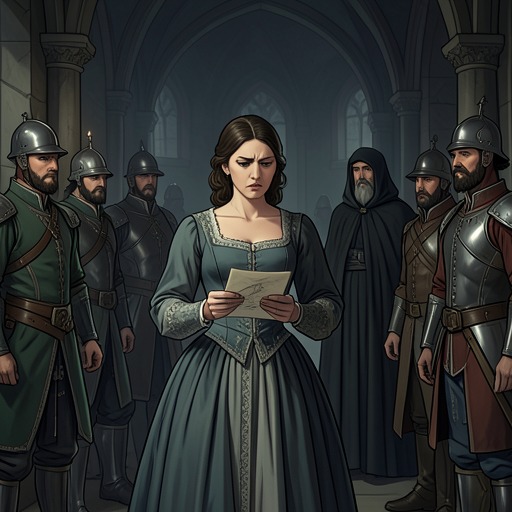
The Musketeers' journey to Bethune
The Three MusketeersThe Musketeers' journey to Bethune is the four friends' determined attempt to reach the Carmelite convent at Bethune and remove Constance Bonacieux from the path of Milady the English spy. The journey turns military leave into a rescue operation: the men must cross France quickly, while the danger posed by Milady transforms distance, delay, and even ordinary travel into matters of life and death.
Causes and Political Background
The mission arises during the siege of La Rochelle, where the royal army has invested the city and the dyke prevents vessels from entering. The blockade may last a long time, creating an affront to the king's army and an inconvenience to Cardinal Richelieu. Against this military background, the king decides to leave the camp incognito for the festival of Saint Louis at Saint-Germain with an escort of only twenty Musketeers. M. de Treville uses the occasion to include the four friends in the escort, giving them the movement they need without requiring d'Artagnan the younger to request a separate leave of absence.
Their urgency has a more private cause. Aramis has written to Marie Michon, the seamstress at Tours whose connections reach the queen, seeking permission for Constance Bonacieux to leave the convent at Bethune and retire either into Lorraine or Belgium. A letter signed Anne authorizes the withdrawal of the young woman from the Carmelite convent. The order would have been of little immediate use while the four men remained at La Rochelle, at the other end of the kingdom, but the king's projected journey suddenly supplies them with a protected route toward Paris and a chance to act.
The Return from La Rochelle
The four friends set out with the royal escort on the morning of the sixteenth, after sending their lackeys ahead with the baggage. The cardinal accompanies Louis XIII from Surgères to Mauzé, and then the king and his minister separate with outward demonstrations of friendship. The king's haste toward Paris is interrupted by his fondness for flying the magpie, a diversion that delights most of the escort but exasperates the four Musketeers, whose thoughts are fixed on Bethune and Constance Bonacieux rather than on courtly recreation.
When the escort passes through Paris on the night of the twenty-third, Louis XIII thanks M. de Treville and permits him to distribute furloughs of four days, provided that the recipients appear in no public place on pain of the Bastille. The first four furloughs go to the companions. Athos secures six days instead of four and adds two nights by arranging for the leave to be post-dated to the morning of the twenty-fifth. This small administrative favor becomes decisive: it gives the party enough time to turn toward Bethune before continuing the larger rescue plan.
The Decision to Travel Together
D'Artagnan the younger initially believes that the expedition is simple. With Planchet, money, and two days of hard riding, he thinks he can reach Bethune, present Anne's authorization to the superior, and bring Constance Bonacieux to Paris, where she would be safer while Cardinal Richelieu remained at La Rochelle. He proposes that the others remain behind rather than waste their strength on a mission requiring only one man and his servant.
Athos rejects this calculation. He reminds d'Artagnan the younger that the friends still possess money from their share of the diamond: he has not drunk all of his portion, while Porthos and Aramis have not eaten all of theirs. More importantly, Athos distinguishes between ordinary opponents and Milady the English spy. He says that he would permit d'Artagnan the younger to travel alone if the danger involved only four men, but Bethune is where Cardinal Richelieu has arranged for a woman to meet who brings misery wherever she goes. The four will therefore go together, accompanied by their four lackeys, and Athos can promise no more than the hope that this number will be sufficient.
The warning changes the emotional temperature of the journey. D'Artagnan the younger examines the faces of Athos, Porthos, and Aramis and sees in each the same deep anxiety. They continue as quickly as their horses can carry them, without adding another word. Their silence is not indecision but recognition: the authorization from the queen is powerful, yet it cannot neutralize a hidden enemy whose designs have already endangered them repeatedly.
The Road to Bethune and the Sign of Armentieres
At Arras, on the evening of the twenty-fifth, the party encounters a sign that confirms Athos's fears. As d'Artagnan the younger dismounts at the inn of the Golden Harrow, a horseman leaves the post yard after taking a fresh relay and gallops toward Paris. The wind opens his cloak and lifts his hat; when the traveler hurriedly pulls it down over his eyes, d'Artagnan the younger recognizes him and turns pale, dropping the glass in his hand.
The companions then obtain a paper bearing the name Armentieres in Milady's hand. Porthos does not know the place, but Athos immediately understands the importance of the handwriting. D'Artagnan the younger insists that the paper be kept, noting that he may not have wasted even the half-pistole paid for it, and orders the party back onto the road. The four friends then gallop toward Bethune. The direction of their movement is now governed not merely by the queen's authorization but by pursuit: they must reach the convent before Milady's route can bring her into contact with Constance Bonacieux.
Stakes and Narrative Significance
The journey is a hybrid of quest, pursuit, and rescue. Its official circumstances depend on institutions: the king's escort, M. de Treville's authority, royal furloughs, and Anne's written permission. Yet the decisive force is personal loyalty. The same monarchy that forbids fighting while privately relying on armed retainers also makes the rescue possible by moving the Musketeers out of the camp. The journey therefore exposes the dependence of private courage on unstable systems of royal and military privilege.
Its central reversal lies in the contrast between d'Artagnan the younger's practical confidence and Athos's foreboding. Horses, money, and a letter appear sufficient until Milady the English spy enters the calculation. The mission's danger is not measured by the number of visible opponents but by the unpredictable consequences associated with her presence. That recognition binds the four companions more tightly: they do not merely accompany d'Artagnan the younger out of affection, but accept the same risk because Constance Bonacieux's safety has become their common responsibility.
The road also prepares the next stage of the conflict at the convent. By the time the party races toward Bethune, Milady has already been associated with persecution, concealment, and destructive calculation, while Constance Bonacieux remains dependent on others for escape. The journey's ending is thus a threshold rather than a resolution. The friends have secured the means to intervene, identified the enemy's direction, and converted royal permission into action; what awaits them at Bethune is the confrontation that will determine whether the rescue succeeds.