The Queen's Diamond Studs Affair
The Three MusketeersThe Queen's Diamond Studs Affair turns twelve diamond studs into the most dangerous objects in the court of Louis XIII. Given by Anne of Austria to the Duke of Buckingham as a token of their secret attachment, the jewels become evidence that can expose the queen, embarrass the king, and strengthen Cardinal Richelieu. When two studs disappear and Anne must wear the complete set at the royal ball, d'Artagnan's mission to recover them becomes a race against surveillance, distance, and political catastrophe.
Origins: A Private Gift Becomes a Political Weapon
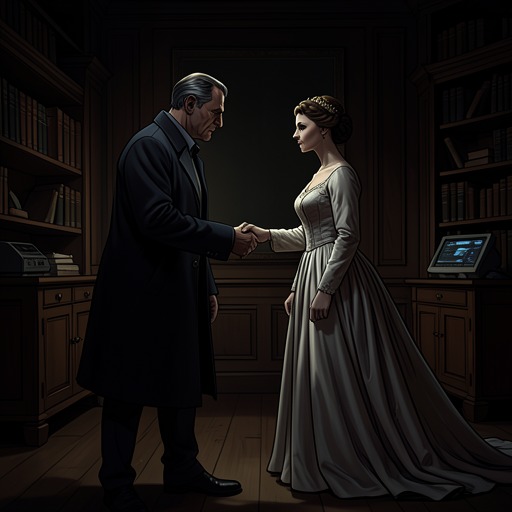
Anne of Austria gave Buckingham the jewels as part of the clandestine bond linking the Queen of France and the English duke. When Buckingham later opened the rosewood casket in his private chapel, he treated the studs not as ordinary ornaments but as sacred tokens of the queen's confidence. He knelt before the altar beneath her full-length portrait, declared that she had given them to him, and said that her will required him to return them. The casket itself bore Anne's cipher in gold, while the studs were mounted on a large blue ribbon sparkling with diamonds.
The affair is therefore driven by the social force of a gift. Anne's present creates an obligation of remembrance and return, but it also leaves Buckingham holding material proof of a relationship that both courts would regard as explosive. The object moves between private devotion and public danger: its emotional value belongs to the lovers, while its political value belongs to anyone able to display, count, steal, or withhold it.
The Missing Two Studs and Richelieu's Trap
Buckingham discovered that only ten of the twelve studs remained. He immediately recognized deliberate theft: the ribbons had been cut with scissors. The last occasion on which he had worn the jewels was a ball at Windsor, where the Comtesse de Winter had apparently reconciled herself with him after their quarrel. Buckingham concluded that the reconciliation had been an act of vengeance by a jealous woman and identified her as an agent of Cardinal Richelieu.
The missing studs convert the queen's gift into a timed political trap. Richelieu arranged for two diamonds to reach the king in a small casket before the ball. Louis XIII was instructed to count Anne's studs and, if she wore only ten, ask who had stolen the missing pair. The cardinal's method depended on public ceremony: an intimate secret would be transformed into a visible discrepancy before the court. The queen's body and clothing would become the evidence against her.
The danger was sharpened by the antagonism between France and England. La Rochelle remained the last major Huguenot stronghold and the last French port open to English forces, while Buckingham sought to enter France not as an ambassador but as a conqueror. The military conflict gave Richelieu's suspicion its national language, even though the immediate stake was the queen's favor. Buckingham's later arrival near the Île de Ré with ninety vessels and nearly twenty thousand men shows how quickly the private rivalry surrounding Anne could become a war between kingdoms.
Buckingham's Countermeasure and d'Artagnan's Mission
Buckingham summoned a goldsmith and learned that each stud was worth fifteen hundred pistoles. Because ordinary reproduction would take eight days, he offered three thousand pistoles apiece for replacements delivered by the day after tomorrow. The demand reveals the affair's compressed timetable: money could accelerate craftsmanship, but it could not erase the consequences of delay. Buckingham also ordered the harbor closed to vessels bound for France, including the packet boat carrying letters, an act understood publicly as a declaration of war.
The two replacement studs were completed by eleven o'clock on the appointed day. They were so exact that Buckingham himself could not distinguish them from the originals, and experts would have been deceived as well. He gave the completed set to d'Artagnan and asked him to testify that everything humanly possible had been done. Buckingham retained the rosewood casket because it was the more precious remnant of what Anne had given him, while d'Artagnan carried the jewels toward France.
The courier's success rests on more than speed. d'Artagnan had reached England after the devotion of Athos, Porthos, and Aramis left his three friends scattered and bleeding on the road, while he himself escaped with only a sword thrust. Buckingham was astonished that such prudence, courage, and devotion could belong to a young man who appeared scarcely twenty. The diamond mission thus confirms the partnership of d'Artagnan and the three Musketeers: the political rescue is accomplished by collective sacrifice even though only one man arrives with the object.
The Royal Ball and the Reversal of the Trap
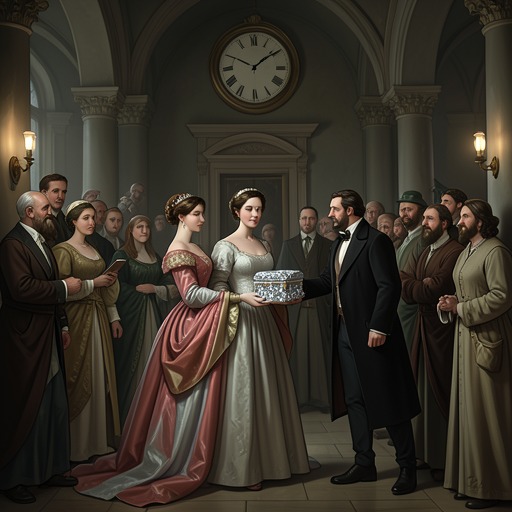
At the royal ball, Cardinal Richelieu placed the small casket containing the two replacement studs in the king's hand. Louis XIII opened it and received the instruction to count the queen's jewels. The cardinal's plan was designed to force a contradiction into the center of ceremony, where the king, queen, nobles, and court could all witness the result.
The ballet lasted an hour and contained sixteen entries. Throughout it, the king watched the studs anxiously, while a cold sweat covered the cardinal's brow. When the dance ended, Louis approached Anne and said that she seemed to be missing two studs and that he had brought them back to her. Anne answered with calculated surprise, suggesting that the king was giving her two more and that she would then possess fourteen. When Louis counted them, all twelve studs were on her shoulder.
The public value of the jewels shifted in an instant. What Richelieu had presented as proof of theft became, through the arrival of d'Artagnan's replacements, proof that the queen had obeyed the king's command. Richelieu claimed that he had merely wished to present Anne with two studs and had lacked the courage to offer them directly. Anne accepted the explanation while making its cost unmistakable: she remarked that the two studs alone had cost the cardinal as much as all the others had cost the king. Her reply preserved decorum while exposing the maneuver.
Consequences for Trust, Patronage, and Political Power
The affair establishes d'Artagnan as a trusted agent of the queen. When M. de Treville learned that a diamond came from Anne herself, d'Artagnan insisted that it was not a gift from an enemy but from the queen. The jewel therefore carries a second transfer of trust: Anne's private confidence passes through d'Artagnan, and his successful delivery makes that confidence politically effective.
The episode also links favor to material reward. After the king heard the Musketeers' account of their conflicts with the cardinal's men, Louis XIII gave d'Artagnan forty pistoles as a visible proof of satisfaction. The payment did not humiliate a gentleman in this period; d'Artagnan accepted it without scruple and thanked the king. The court thus answers one dangerous gift with another, converting service into royal patronage while leaving the deeper secret of the queen's relationship with Buckingham concealed.
The affair's consequences extend beyond the ball. Buckingham's personal attachment to Anne remains entangled with the Anglo-French conflict, and Richelieu's political hostility continues to find private instruments such as the Comtesse de Winter. Later, the siege of La Rochelle is presented as both a major national enterprise and a contest colored by the desires of two powerful men whose public war is connected to a private longing for Anne's favor. The diamond studs are the miniature form of that larger pattern: love, national policy, espionage, and military action occupy the same chain of exchange.
Narrative Significance
The Queen's Diamond Studs Affair is a classic reversal built around counting. Two missing objects threaten to expose Anne; two fabricated objects restore the appearance of order. Yet the replacements do not make the danger unreal. They show that courtly truth can be manufactured, transported, and publicly authenticated by courage before the authorities can establish their own version of events.
The event also gives material form to the novel's recurring logic of loyalty. Anne's rosewood casket, Buckingham's vow to return the studs, the three Musketeers' sacrifices, d'Artagnan's journey, the cardinal's planted evidence, and the king's gold all make allegiance visible through objects. A jewel may be a love token, a diplomatic secret, a weapon of accusation, or a reward. Its meaning changes according to who holds it and who is able to make the court look at it. In that instability lies the affair's decisive significance: d'Artagnan does not merely transport diamonds; he interrupts Richelieu's attempt to turn private intimacy into public condemnation.