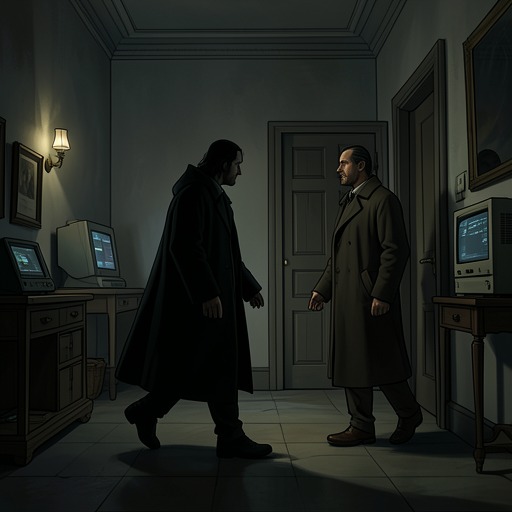
The abduction of Madame Bonacieux
The Three MusketeersThe abduction of Madame Bonacieux is a decisive turning point in the story because it reveals that an apparently domestic disappearance is part of a political operation against the queen and her confidential circle. Constance Bonacieux is taken not merely as a wife or witness but as a vulnerable link in the queen's communications, while her rescue brings d'Artagnan into direct contact with the hidden struggle among the queen, Cardinal Richelieu, and the Duke of Buckingham.
Causes and Political Background
The immediate explanation of the abduction comes through Monsieur Bonacieux, a tradesman who seeks out d'Artagnan because the young Musketeer is reputed to be brave. He explains that his wife is the queen's seamstress, that she is the goddaughter of Monsieur Laporte, the queen's cloak bearer and confidential servant, and that Laporte placed her near the queen so that Anne of Austria would have someone she could trust. The marriage itself had been encouraged by this connection: Constance possessed little dowry, but her relationship to the queen's household gave her unusual political importance.
Monsieur Bonacieux reports that his wife was abducted while leaving her workroom. He believes that the crime has less to do with romantic jealousy than with politics. Constance had learned from Monsieur Laporte that the queen feared a forged letter written in her name had been sent to the Duke of Buckingham to lure him to Paris and draw him into a trap. Her devotion to the queen therefore made her a target: the abductors might remove her from her mistress, intimidate her into revealing secrets, or corrupt her into becoming a spy.
The suspected abductor is described as a nobleman of lofty bearing, with black hair, a swarthy complexion, a piercing eye, white teeth, and a scar on his temple. D'Artagnan immediately recognizes this description as belonging to the man of Meung, the unresolved enemy whose earlier appearance had first drawn him into the larger web of intrigue. The kidnapping thus joins two apparently separate mysteries: the stranger's pursuit of d'Artagnan and the political danger surrounding the queen.
The Discovery and Immediate Rescue
Monsieur Bonacieux hesitates repeatedly, fearing that he is committing an imprudence, but finally identifies himself and explains his connection to the missing woman. The conversation is interrupted when a cloaked man is seen in the street facing d'Artagnan's window. D'Artagnan and Bonacieux recognize him at the same moment. D'Artagnan springs to his sword and rushes after him, only to pass Athos and Porthos on the staircase as he begins the pursuit. The scene gives the abduction an immediate physical form: the unseen political scheme suddenly produces a recognizable enemy outside the lodging.
D'Artagnan does not initially witness the first seizure itself. Instead, he later hears a woman resisting below and declaring that she is the mistress of the house, Madame Bonacieux, and that she belongs to the queen. He realizes that the agents searching the house are not ordinary robbers but men acting for the cardinal. The violence is therefore presented through a collision between household space and state power: four men attempt to overpower a woman whose authority rests not on force but on her service to the queen.
D'Artagnan intervenes and frees Constance. He insists that he has done only what any gentleman would have done, but the rescue immediately establishes a bond between them. Constance is terrified and asks what has become of her husband. D'Artagnan tells her that Monsieur Bonacieux has been taken to the Bastille and suggests that his misfortune lies in being her husband, since her political importance has drawn danger upon him. He also confirms that he knows she was abducted and identifies the man responsible by the same physical marks that Bonacieux had given him.
Constance explains how she escaped from captivity. She had learned the reason for her abduction during the morning and took advantage of a moment when her captors left her alone. Using sheets, she lowered herself from a window and hurried to her home, believing that her husband would be there to protect her. Her escape is therefore an act of practical courage rather than a passive release: she converts the domestic objects available to her into the means of flight, then seeks safety in the very household that the cardinal's agents have invaded.
The Abduction as a Political Mechanism
The episode establishes Constance's captivity as part of a wider system of surveillance. Her access to the queen makes her valuable, but it also makes her disposable to the powers attempting to penetrate the queen's confidence. The cardinal's agents treat her body and knowledge as instruments of political control; the purpose is not simply to punish her but to extract information, sever her connection with the queen, or turn her into an unwilling intermediary.
The larger political stakes become clearer through the forged communication intended for the Duke of Buckingham. The alleged letter would bring Buckingham to Paris under false pretenses, where he could be caught in a snare. Constance's knowledge of this design places her close to the secret at the center of the queen's danger. Her abduction consequently threatens both personal safety and international consequences, since Buckingham's relation to Anne of Austria is entangled with the hostility between England and France.
The surrounding military situation enlarges the significance of the kidnapping. La Rochelle remains the last major bulwark of French Calvinism, and its port is the last in France open to the English. Buckingham later lands on the Isle of Ré with ninety vessels and nearly twenty thousand men, while the cardinal's campaign seeks to close the port and destroy the remaining center of Calvinist resistance. The private struggle over the queen's secrets thus unfolds against a war in which diplomatic messages, personal loyalties, and military movements continually overlap.
Later Consequences and Renewed Captivity
The rescue does not end Constance's danger. Cardinal Richelieu later tells d'Artagnan that he had summoned him through Cavois, and d'Artagnan realizes that the very evening of that summons was the evening of Madame Bonacieux's abduction. He also recalls that Constance had passed close to him during her disappearance, evidently carried away by the same power responsible for her vanishing. This retrospective recognition makes the event more disturbing: d'Artagnan had been near the suffering he was trying to understand without being able to identify it.
A later letter found on a wounded agent confirms that Milady had organized or financed a further attempt against a young woman. The unsigned message threatens the recipient over one hundred louis and orders him to pursue the woman who has reached safety in a convent. The wounded man admits that he and his dead companion had been hired to carry off a young woman leaving Paris by the Barrière de La Villette and deliver her to a hotel in the Place Royale, which d'Artagnan recognizes as Milady's residence. Although this evidence belongs to a subsequent stage of the conflict, it reveals the recurring structure established by Constance's abduction: women connected to political secrets are tracked, transported, hidden, and used as leverage.
The later evidence also reveals that Anne of Austria has discovered the prison in which Madame Bonacieux was held and has secured her release. D'Artagnan interprets Constance's letter and her strange appearance along the road to Chaillot through this new knowledge. The recovery of the queen's captive changes the emotional direction of the pursuit, restoring clemency to d'Artagnan's heart and confirming Athos's prediction that a convent is not impregnable. Captivity remains dangerous, but it is not treated as an unbreakable condition; information, loyalty, and coordinated action can reopen the locked spaces into which political power has forced its victims.
Narrative Significance
The abduction transforms d'Artagnan's motivation. Before meeting Monsieur Bonacieux, his pursuit of the man of Meung is primarily a matter of personal honor and vengeance. The kidnapping gives that pursuit a larger cause: finding the scarred nobleman may reveal who is attacking the queen's network and why. D'Artagnan's intervention also changes his relation to Constance from curiosity to protective attachment, while her reliance on him draws him into the dangerous movement of messages between the queen, Buckingham, and their allies.
The event further exposes the unstable boundary between love and statecraft. The cardinal's policy toward Buckingham and the queen is expressed through arrests, forged letters, intimidation, and abductions, yet the political conflict is driven in part by private passion. The military contest around La Rochelle is similarly described as a public struggle whose real stake includes a favorable look from Anne of Austria. Constance's kidnapping is the human-scale expression of this contradiction: a seamstress is seized because courtly love and international rivalry have made her knowledge strategically valuable.
Finally, the episode establishes a repeated pattern of concealment and revelation. Constance knows more than her social position suggests; Bonacieux understands only fragments; d'Artagnan reconstructs the scheme through descriptions, sightings, and later documents; and the reader learns the political design in stages. The narrative delays certainty, then collapses distance when the cloaked man appears at the window and when Constance's voice identifies her below. Abduction is therefore not only an action within the plot but also a device for reorganizing knowledge: it removes a trusted person from view, scatters the facts surrounding her disappearance, and makes rescue depend upon recovering the hidden connections among domestic life, royal service, and political conspiracy.