The cardinal's political persecution
The Three MusketeersThe cardinal's political persecution is the pressure system through which Cardinal Richelieu protects his political supremacy and punishes those who interfere with it. It is not limited to one arrest or one revenge: it joins secret surveillance, concealed detention, court intrigue, military rivalry, and formally sanctioned punishment. The state of persecution begins in a kingdom already accustomed to overlapping wars, where nobles, the king, Spain, Huguenots, robbers, and other enemies seem to contend at once, and it culminates in a politics where the cardinal can make private loyalty appear criminal and can present extraordinary coercion as service to the state.
Political Setting and Instruments
In the world of the novel, political persecution grows from the rivalry between Louis XIII and Cardinal Richelieu. The citizens of Meung understand authority through competing forces: the king makes war upon the cardinal, Spain makes war upon the king, and public disorder permits almost anyone to be treated as an enemy. Yet the cardinal possesses a distinctive advantage: his power operates not only through open conflict but also through agents, intelligence, and procedures that conceal their own operation. The resulting danger is difficult to meet because the threatened person may not know whether he faces a duel, a police arrest, a royal command, or a private vendetta disguised as public business.
The cardinal's political machine is mirrored by the rivalry between the King's Musketeers and the Cardinal's Guards. Louis XIII made M. de Treville captain of the Musketeers, surrounding himself with a devoted body whose loyalty was almost fanatical. Cardinal Richelieu responded by creating his own guard and competing for the most celebrated swordsmen in France and abroad. Although both rivals publicly condemned duels and brawls, they secretly encouraged their men to fight and took pleasure or offense in the result. Persecution therefore emerges from a political culture in which official restraint coexists with covert provocation, and in which the sovereign's and the cardinal's servants become instruments of a larger contest.
Secret Police and Exceptional Rule
The clearest institutional expression of this persecution is the mousetrap, a police method based on secrecy and accumulation. When a person suspected of a crime is arrested inside a house, the arrest is concealed; men hide in the first room, admit everyone who knocks, close the door behind them, and gradually seize nearly all the regular visitors. The procedure transforms an ordinary residence into an information trap. It does not merely capture an accused individual. It produces a network of captives, witnesses, and suspects by suspending the normal expectation that a visitor may enter and leave freely.
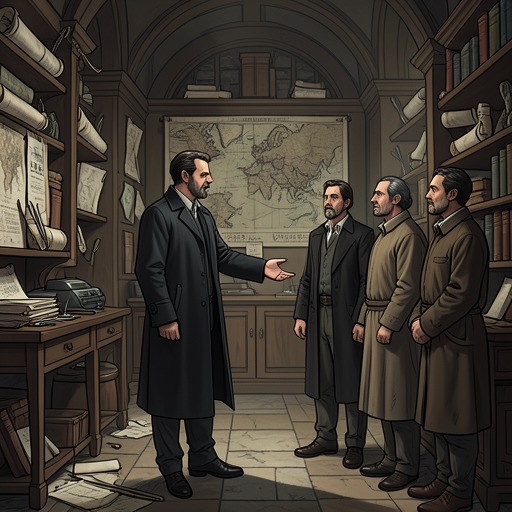
The arrest of Athos demonstrates how this machinery threatens even a soldier whose reputation should protect him. Procureurs, commissaries, and police officers seized him in a house, led him through the open street, and threw him into Fort l'Eveque on an order they refused to show M. de Treville. Treville stresses that Athos is one of the King's Musketeers, a man of irreproachable conduct and an almost illustrious reputation, but official status does not prevent arbitrary treatment when the cardinal's political interests are involved. The refusal to disclose the order is itself part of the coercion: authority acts first, while explanation and defense are postponed.
The confrontation at court exposes the conflict between formal law and practical power. Louis XIII insists that an edict remains an edict and that fighting is forbidden, while Treville answers that the encounter involving his men was not an ordinary duel but a brawl in which five of the Cardinal's Guards confronted three Musketeers and d'Artagnan. When Athos's case is raised, the king orders it sent before the judges, declaring that judgment belongs to them. Treville accepts the language of judicial procedure while warning that even the purest life and the most incontestable virtue cannot protect a man from infamy and persecution. The episode shows how persecution works through legal forms without being contained by them: judgment is invoked, but the accused has already been publicly disgraced and imprisoned.
Pursuit of the Queen's Agents
The persecution becomes personal when d'Artagnan undertakes the mission to London. After Madame Bonacieux has been abducted and the queen's plans are endangered, d'Artagnan realizes that the cardinal will soon be warned by the stranger who appears to be his agent. The mission offers him glory, money, and closer intimacy with the woman he loves, but it also places him directly against Richelieu. He recognizes that the cardinal would give the world to prevent his arrival in London, and he declares that he will go alone. The political conflict thus enters a private adventure without ceasing to be political: d'Artagnan's love and ambition become the means by which he is drawn into the queen's dangerous network.
The journey itself shows the reach of the threat across borders. After a sword wound that proves painful but not dangerous, d'Artagnan reaches the coast of England at daybreak; the vessel anchors at Dover at ten o'clock, and he sets foot on English land at half past ten. He and Planchet immediately take post horses and continue to London, where d'Artagnan, unfamiliar with the city and unable to speak English, uses the Duke of Buckingham's name to find the duke's hotel. The speed and risk of this movement matter because Richelieu's persecution is not confined to Paris. It follows the queen's agents through sea passages, foreign territory, messages, and royal diplomacy.
When the royal ball reveals that Anne of Austria is not wearing her diamond studs, Richelieu's surveillance takes on a theatrical form. Disguised as a Spanish cavalier, he watches the queen from a previously closed gallery, and his face appears at the very moment her missing jewels expose the failure of the scheme against her. His smile expresses not simple curiosity but the satisfaction of an adversary who believes he has caught his opponent. The king, made pale and anxious by the cardinal's presence, demands an explanation from the queen. The ball therefore becomes a political inspection: costume, jewels, entrances, and glances all function as evidence in an invisible struggle.
Vendetta and Threat
M. de Treville understands that the danger does not end with d'Artagnan's successful return. He tells the young Gascon that his return is connected with the king's joy, the queen's triumph, and the cardinal's humiliation, and therefore warns him to protect himself. Richelieu, Treville explains, is not a man who forgets a mystification until he has settled accounts with the person who caused it. D'Artagnan's apparent favor with the king and queen offers no security; it makes him more conspicuous. Treville's warning that the cardinal has a tenacious memory and a long arm condenses the state of persecution into two qualities: persistence over time and the ability to reach beyond the immediate scene.
The threat is practical as well as psychological. Treville predicts that the least to be expected is d'Artagnan's arrest, while the cardinal's agents appear at the young man's lodgings under the pretext that Richelieu wishes him well and wants him to follow them to the Palais-Royal. The honeyed language of the invitation contrasts with its coercive purpose. Because d'Artagnan is absent, the attempt fails, but the scene reveals the characteristic method of political persecution: the arrest is approached as a courtesy, and a summons can conceal a trap.
When d'Artagnan reports the disappearance of Madame Bonacieux, Treville immediately sees that the adventure is more than a love affair. He identifies the affair as bearing the unmistakable mark of the cardinal and advises d'Artagnan to leave Paris as soon as possible. Treville will inform the queen and attempt to obtain intelligence, but he cannot simply confront the machinery that has taken the young woman. The advice to flee shows the asymmetry between personal courage and organized power. A sword may defeat an individual guard; it cannot easily defeat a system that controls information, orders, arrests, and access to the court.
State Authorization and Consequences
The political persecution reaches its most disturbing form when coercion receives written authorization. Athos confronts Milady with a pistol, but she produces a paper that causes him to lower the weapon and examine it by the lamp. The document is dated December 3, 1627, and states that what the bearer has done was done by order and for the good of the state. The paper does not explain the act or establish a transparent judicial process. Instead, it turns state interest into a justification broad enough to suspend ordinary moral and legal judgment. Authority appears not as a public hearing but as a portable certificate capable of interrupting punishment at the instant it is about to occur.
This document also clarifies the relation between Richelieu and the agents who act in his interests. The cardinal's persecution can be delegated, concealed, and later disowned or defended according to political necessity. The agent's violence becomes state service, while the state retains the power to define the meaning of that violence. Such authorization makes the boundary between official justice and private vengeance unstable. A person may be condemned as an assassin by one standard and protected as an instrument of the state by another.
The cardinal himself later invokes that boundary when he confronts the men who have constituted themselves judges. He asks whether they have forgotten that those who punish without a license to punish are assassins, thereby claiming a monopoly on legitimate punishment even while his own political methods rely on secret detention, concealed orders, and indirect violence. He tells d'Artagnan that he will be tried and even condemned, presenting judicial punishment as the proper answer to unauthorized judgment. Yet the threat also demonstrates the cardinal's power to determine when procedure will be applied and when exceptional authority will govern.
The siege of La Rochelle places this persecution within the broader emergency of war. Although the city is invested and the dyke prevents vessels from entering, the blockade may last a long time, embarrassing the king's army and inconveniencing the cardinal. The prolonged siege shows why political actors can describe coercion as necessity: military danger, royal rivalry, and internal disobedience provide an apparently permanent reason to suspend ordinary patience. The cardinal's persecution is therefore not merely a personal vendetta, though it often carries the heat of one. It is a governing condition in which enemies of policy, enemies of the court, and enemies of the cardinal are repeatedly made to overlap.
Narrative Significance
The cardinal's political persecution gives the novel its atmosphere of pursuit and uncertainty. It converts every doorway, summons, uniform, letter, and royal favor into a possible instrument of control. The mousetrap makes hospitality dangerous; Athos's arrest makes reputation insufficient; the missing diamond studs turn a court ball into a surveillance scene; the disguised invitation to the Palais-Royal turns courtesy into threat; and the dated authorization transforms state power into a shield for violence.
At the same time, the persecution establishes the central political paradox of the narrative. Richelieu's authority is formidable because it combines formal institutions with informal reach, but its dependence on secrecy exposes the instability of the order it claims to defend. Louis XIII can invoke edicts and judges, M. de Treville can appeal to military honor, and d'Artagnan and his companions can resist through loyalty and action, yet none of these principles operates outside the cardinal's shadow. The state of persecution therefore supplies both the danger and the dramatic energy of the story: the protagonists fight not only individual enemies but a system capable of making its own exceptions look like law.