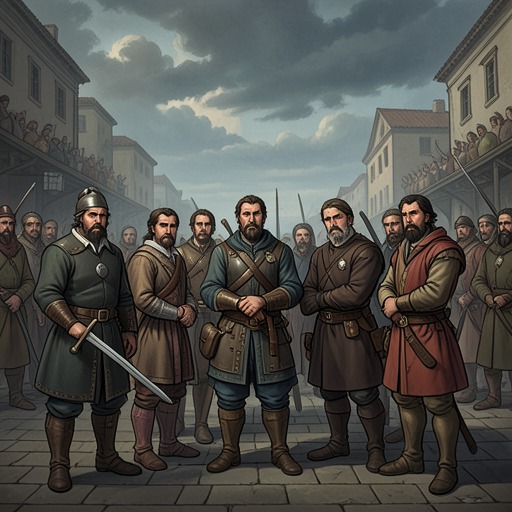
The duel at the Carmes-Deschaux
The Three MusketeersThe duel at the Carmes-Deschaux is the turning point at which d'Artagnan's ambition to become a Musketeer becomes a lived allegiance. What begins as a scheduled fight with Athos, provoked by the young Gascon's collisions with Athos, Porthos, and Aramis, is interrupted by Cardinal Richelieu's Guards and enlarged into a contest between the king's chosen swordsmen and the cardinal's force. d'Artagnan's decision to stand beside Athos, Porthos, and Aramis creates the fellowship that governs the rest of the narrative, while the victory exposes how quickly formal law yields to personal honor, military loyalty, and the rivalry between Louis XIII and Cardinal Richelieu.
Causes and Setting
The encounter is rooted in d'Artagnan's arrival in Paris with a sword, a Gascon confidence, and his father's injunction to endure nothing from anyone except the king, the cardinal, and M. de Treville. After separate confrontations with Athos, Porthos, and Aramis, he arranges to meet Athos at the Carmes Dechausses, a windowless building surrounded by barren fields near the Pre-aux-Clercs, a customary ground for men who had no time to lose. The chosen place gives the episode an atmosphere of legal ambiguity: the duel is private, but it occurs in a city where nobles, Huguenots, robbers, and political factions are accustomed to making war on one another.
Athos arrives punctually despite suffering grievously from a wound recently redressed by M. de Treville's surgeon. His wounded dignity and d'Artagnan's aggressive self-possession make the meeting more than a casual challenge. Yet d'Artagnan also recognizes the possibility of friendship. He hopes that loyal explanations may win Athos over, plans to use Porthos's concealed baldric as a source of ridicule, and intends to confront Aramis's pride if the fight proceeds. Athos, for his part, is pleased when d'Artagnan proposes postponing the duel for three days so that the meeting will not be prevented by the authorities. When d'Artagnan then offers to fight immediately if Athos wishes, Athos recognizes courage and declares that, should they not kill one another, he expects to take pleasure in the young man's conversation.
The Duel Becomes a Political Encounter
The private meeting changes the moment Cardinal Richelieu's Guards, commanded by M. de Jussac, appear around the convent. The two original combatants have barely crossed swords before the Guards see enough to understand their intentions. Aramis and Porthos call for the swords to be sheathed, but the opportunity has passed. Athos counts five opponents against the three Musketeers and refuses the humiliation of returning to M. de Treville as a conquered man.
The interruption turns a personal duel into a choice between the king and the cardinal. D'Artagnan understands that fighting means disobeying the law, risking his life, and making an enemy of a minister more powerful than the king himself. He nevertheless refuses to remain an outsider. He corrects Athos's assertion that only three men stand ready, insisting that there are four. Although he lacks the Musketeers' uniform, he claims to possess their spirit and a heart made for their company. Athos asks his name, and after d'Artagnan identifies himself, Athos calls Athos, Porthos, Aramis, and d'Artagnan forward together. The naming is itself a small investiture: before d'Artagnan wears the uniform, he is admitted through action.
Combat and Victory
The nine combatants rush at one another with fury controlled by method. Athos engages Cahusac, a favorite of the cardinal; Porthos takes Bicarat; Aramis faces two opponents; and d'Artagnan springs directly at Jussac. The young Gascon's heart beats violently not from fear but from emulation. He fights with unorthodox speed, circling Jussac, changing ground and guard repeatedly, attacking from every side while defending himself with equal alertness. Jussac is an experienced swordsman, yet he must use all his skill to withstand an opponent whose energy does not conform to received rules.
The fight is settled when the surviving opponents are unable to continue their resistance. Bicarat, ordered by M. de Jussac to withdraw because four men now confront him, obeys the command of his superior but breaks his sword across his knee rather than surrendering it. The gesture preserves his pride, and the Musketeers salute him for his bravery even though he is their enemy. With Bicarat's assistance, d'Artagnan helps carry Jussac, Cahusac, and a wounded opponent of Aramis beneath the convent porch; another adversary has been killed. The victors carry away four swords out of five and set off for M. de Treville's hotel.
Consequences and Recognition
The return to the hotel becomes a triumphal procession. The four men walk arm in arm, occupy the width of the street, and draw every Musketeer they meet into their march. D'Artagnan moves between Athos and Porthos, pressing his new companions tenderly, and asks whether, even if he is not yet a Musketeer, he has at least entered upon his apprenticeship. The question captures the event's decisive value shift: he arrives as a provincial challenger seeking recognition and leaves as a participant in a brotherhood whose loyalty has been tested in combat.
M. de Treville publicly scolds his Musketeers while privately congratulating them, then hurries to the Louvre to secure the king's favor before the cardinal can shape the story. Louis XIII acknowledges that the encounter was not an ordinary duel but a brawl, since five of the cardinal's Guardsmen faced three of the king's Musketeers and d'Artagnan. He still observes that an edict remains an edict and that fighting is forbidden, but he secretly orders Treville to bring all four men to him by the back staircase so that he can thank them without Cardinal Richelieu's knowledge. The king's response reveals the practical contradiction at the heart of the episode: the law condemns the fight publicly, while royal power rewards the men who fought in its interest.
Historical and Narrative Significance
The duel establishes the king's Musketeers as a chosen body whose devotion to Louis XIII approaches fanaticism, while Cardinal Richelieu maintains a rival corps of his own. The two powerful rivals compete for the most celebrated swordsmen and even dispute, during chess games, over the bearing and courage of their servants. Although they condemn duels and brawls aloud, they secretly encourage their men to quarrel and take pleasure or disappointment from the results. The Carmes-Deschaux fight therefore makes visible a conflict already embedded in the structure of the court: private violence becomes a proxy for public power.
It also supplies the founding pattern for the four companions' later oath and adventures. D'Artagnan's choice is not merely tactical. He accepts danger, legal exposure, and hostility from Cardinal Richelieu in order to join Athos, Porthos, and Aramis. Their victory does not abolish the political order that threatens them; it places them inside its most dangerous fault line. From this point forward, friendship and loyalty are inseparable from faction, and the young Gascon's rise depends on repeatedly proving that he can convert personal courage into collective allegiance.