The mousetrap in the seventeenth century
The Three MusketeersThe mousetrap in the seventeenth century is both a police method and a governing principle of the novel’s world: suspicion converts a private house into a prison, ordinary visitors into captives, and conversation into evidence. The apartment of M. Bonacieux becomes the clearest instance of this mechanism, allowing Cardinal Richelieu’s people to pursue the hidden political connections surrounding Madame Bonacieux, d'Artagnan, Queen of France, and the Duke of Buckingham.
Definition and Method
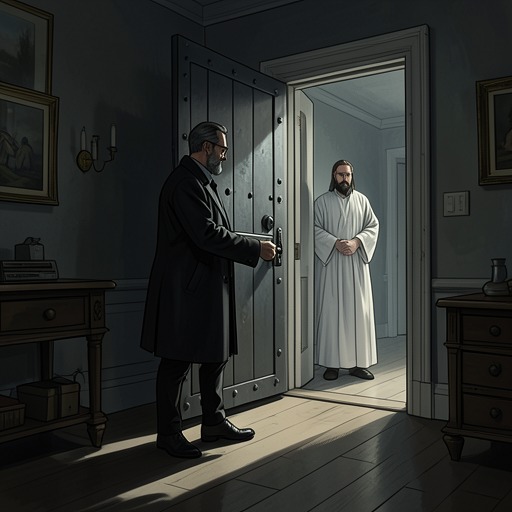
The mousetrap is presented as an old invention rather than a modern novelty. As soon as societies created organized police forces, those forces developed ways of making an arrest without announcing it. The method depends on secrecy and accumulation. When a person suspected of a crime is inside a house, several men hide in the first room, admit everyone who knocks, close the door behind each arrival, and arrest the visitors. After two or three days, the authorities may hold almost all the regular inhabitants and associates of the establishment. The apparent household becomes an enclosure whose hospitality is merely the mechanism of capture.
The procedure is therefore more expansive than the arrest of one suspect. Its real target is the network around that suspect: visitors, messengers, relatives, intermediaries, and anyone who might have received information. The mousetrap replaces open pursuit with controlled access. The police need not know in advance whom they seek; they allow the house itself to identify the circle of association, then transform that circle into a collection of prisoners.
M. Bonacieux’s Apartment as a Trap
The apartment of M. Bonacieux is placed under this system after the arrest of poor Bonacieux. Anyone who appears there is seized and interrogated by Cardinal Richelieu’s agents. The domestic threshold, ordinarily a point of welcome and exchange, becomes the first mechanism of detention: the visitor enters through the door and discovers only afterward that the door has become a lock.
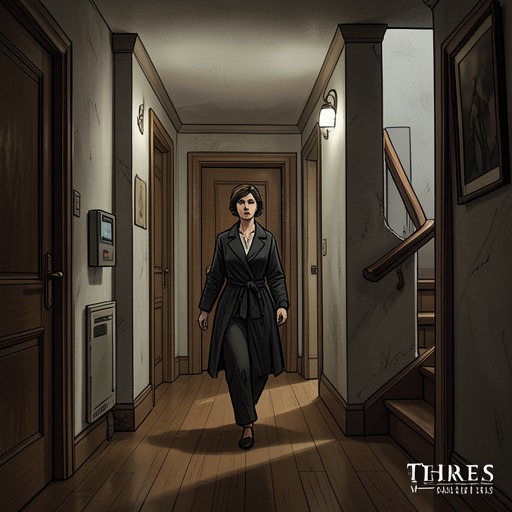
The arrangement is not completely airtight. A separate passage leads to the first floor, where d'Artagnan lodges, and people who visit him are therefore exempt from detention. This architectural distinction matters. The same building contains both the official trap below and a temporary zone of exemption above. The house is divided into different regimes of movement, and d'Artagnan’s room becomes a privileged position from which the operation can be observed without immediately subjecting him to it.
The three Musketeers are nearly the only people who continue to come to the apartment. They are actively searching and making inquiries, but they discover nothing. Athos even questions M. de Treville, whose knowledge is limited to the alarming appearance of the court: Cardinal Richelieu looks thoughtful, Louis XIII uneasy, and Queen of France has eyes reddened by sleeplessness or tears. M. de Treville consequently urges Athos to remain faithful to the king, and especially to the queen, and to communicate that duty to his comrades. The mousetrap thus operates within a larger atmosphere of royal anxiety and concealed political danger.
d'Artagnan’s Counter-Surveillance
Rather than leave the building, d'Artagnan converts his chamber into an observatory. From his windows he watches the visitors who are caught. He then removes a plank from the floor, leaving only a thin ceiling between his room and the room below, where the interrogations take place. The mousetrap’s intended information flow runs upward from the arrested visitor to the inquisitors; d'Artagnan reverses that flow by listening downward from a hidden position.
The physical arrangement produces a contest between surveillance and counter-surveillance. The authorities control the street door, the arrests, the searches, and the questioning, but d'Artagnan controls an unseen aperture into the interrogation room. He cannot openly intervene, yet he can hear what the inquisitors ask and infer what they fear. His vigilance becomes a form of resistance that depends not on force but on occupying the unnoticed space left by the machinery of control.
The interrogations follow a repeated formula. After searching the arrested person, the authorities ask whether Madame Bonacieux has sent anything to her husband or to anyone else, whether Monsieur Bonacieux has sent anything to his wife or another person, and whether either has confided anything by word of mouth. The questions reveal that the investigators are not merely looking for a stolen object or an isolated message. They are tracing communications and attempting to reconstruct a secret chain of contact.
From the pattern of questioning, d'Artagnan concludes that the authorities want to discover whether the Duke of Buckingham is in Paris and whether he has met, or is likely to meet, Queen of France. The mousetrap therefore exposes its political purpose through its interrogation language. The names of M. Bonacieux and Madame Bonacieux are the immediate pretext, but the larger concern is the possible connection between the English nobleman and the queen. The trap continues to operate, and d'Artagnan’s vigilance continues with it; neither side abandons its effort to control or obtain information.
Political Power and the Logic of Secrecy
The mousetrap belongs to a broader system in which authority acts through concealed arrest, restricted movement, and the conversion of suspicion into procedure. M. de Treville later reports that police officials, commissaries, and procurators have taken one of his Musketeers—Athos—out of a house, led him through the open street, and thrown him into Fort l'Eveque on an order they refuse to show. The incident demonstrates how the same political environment can move from secret detention to openly coercive imprisonment while withholding the legal basis for either.
The king’s order to have Queen of France’s letters seized presents the same structure from the perspective of royal power. When she resists the chancellor’s commission, the chancellor approaches her with the fixed purpose of completing it, as though carrying out an execution. The private chamber becomes another disciplinary space, and the queen’s body and correspondence are treated as sites to be searched for political evidence. The mousetrap is consequently not an isolated trick but one expression of a state that treats domestic interiors, letters, and relationships as extensions of political territory.
Later episodes echo the device’s spatial logic. Milady the English spy is transported through successive gates into a dark, enclosed court and placed in a chamber that could belong to either a free person or a prisoner, although barred windows and outside bolts settle the question. She immediately studies the room and its guardians, while her staged wounded posture is designed to influence those who watch her. Her captors try to close every route of escape, including a grating that Lord de Winter has covered with a plank because he fears she may corrupt the guards. In both the Bonacieux apartment and Milady the English spy’s imprisonment, architecture is used to contain bodies and regulate information; in both, intelligence and counter-intelligence determine who truly controls the space.
Consequences and Narrative Significance
The mousetrap makes ordinary sociability dangerous. A knock at the door can initiate an arrest, a visit can become proof of association, and a household can be emptied of its visitors without any public declaration that it has been seized. Its power lies in making the victim participate in the process: people enter because the door still appears to offer access, unaware that admission has become detention.
At the same time, the procedure reveals the limits of coercive knowledge. The cardinal’s agents can gather bodies and repeat questions, but d'Artagnan’s hidden observation shows that surveillance does not guarantee understanding. The authorities know that a secret exists and can identify the network they suspect, yet they must infer the decisive fact from incomplete answers. The trap captures movement more easily than motive, and people more easily than truth.
The event also establishes the political stakes of the surrounding plot. What looks like a domestic arrest operation is directed toward the possible presence of the Duke of Buckingham in Paris and his relationship with Queen of France. The apartment of M. Bonacieux thus becomes a miniature of the novel’s wider conflict between royal authority, Cardinal Richelieu’s political machinery, and the clandestine loyalties of the four Musketeers. Its doors, hidden passage, floorboard, and interrogation room turn the struggle over power into a struggle over who may see, hear, enter, leave, and interpret.