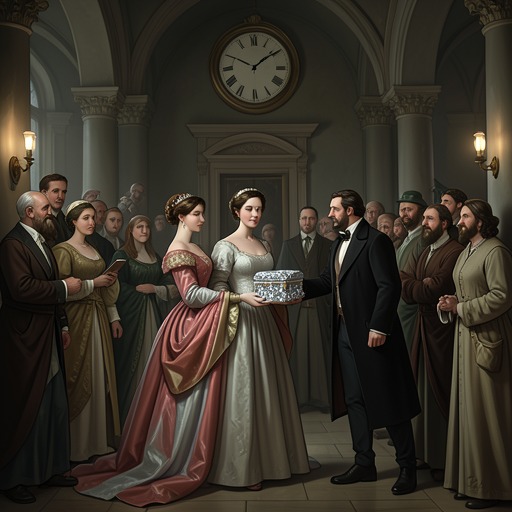
The royal ball and the diamond-stud demand
The Three MusketeersThe royal ball and the diamond-stud demand is the carefully staged court crisis in which Louis XIII announces a public fête and orders Anne of Austria to appear wearing the diamond studs he gave her. What seems to be a ceremonial attempt at reconciliation is in fact a test devised by Cardinal Richelieu: the queen’s possession of the jewels has become the visible measure of whether a dangerous secret can remain concealed. The episode converts private shame, political suspicion, and royal ceremony into one instrument of surveillance.
Political Background
The demand follows the seizure of Anne of Austria’s letter to the King of Spain. Louis XIII discovers that the letter contains a political plan directed against Richelieu, urging the queen’s brother and the Emperor of Austria to oppose the cardinal’s policy and to make his dismissal a condition of peace. The letter contains no declaration of love, but it gives Richelieu abundant grounds for treating the queen as a political danger. Louis XIII is delighted to learn that the document is political rather than amorous, yet he remains enraged by Anne’s opposition and accepts Richelieu’s guidance on how to punish and test her.
Richelieu does not simply advise open prosecution. When the king considers punishing everyone named in the letter, including the queen, the cardinal presents clemency and reconciliation as more useful royal virtues. He proposes that Louis XIII do something Anne will appreciate: give a ball, since she loves dancing. The gesture is designed to soften her resentment while creating a public occasion at which her obedience can be measured. Richelieu’s method is therefore double-edged. He converts an apparent favor into an obligation and turns a social celebration into an instrument of political control.
The Ball as a Delayed Trap
The fête is repeatedly postponed while Richelieu calculates the time required for his larger plan. He counts the days needed for money to reach his agent, for her return, and for delays caused by contrary winds, accidents, and human weakness. On September 20, he fixes the aldermen’s fête for October 3, a date that will make the king appear to be honoring the city rather than arranging a special interrogation of the queen. The delay gives the trap its force: Anne is allowed to believe that reconciliation may be genuine before the demand is finally made.
Richelieu then gives Louis XIII the decisive instruction. On the evening before the fête, the king must say that he wishes to see how the diamond studs become the queen. The jewels are not merely ornaments. They are a visible token of a previous royal gift, and their public appearance will either confirm Anne’s possession of them or reveal that they have passed into other hands. The apparently innocent language of courtly admiration conceals a demand for proof.
Anne of Austria’s Ordeal
Anne, expecting reproaches after the seizure of her letter, is astonished when Louis XIII begins making advances toward reconciliation. Her first response is resistant because both her pride as a woman and her dignity as queen have been wounded. Encouraged by her women, she eventually allows the appearance of forgetting her resentment. When the king announces the fête, the last visible trace of her anger disappears, even if her inward feelings remain unresolved. The celebration seems to restore her place within the courtly order.
That fragile relief collapses when Louis XIII finally states the condition. He tells Anne that there will soon be a ball at the Hôtel de Ville and that she must appear in ceremonial dress, above all adorned with the diamond studs he gave her on her birthday. Anne understands the demand differently from the king. She believes that Louis XIII knows everything, that Richelieu has persuaded him to conceal his knowledge for several days, and that the ball is the final stage of a prosecution already decided. Her body registers the shock: she grows excessively pale, leans her hand on a console, and cannot answer at first.
The king presses her for confirmation. She agrees to attend the ball and, when asked directly whether she will wear the studs, agrees again. Louis XIII retires satisfied, enjoying her embarrassment without understanding its true cause. Anne’s curtsy is less an act of etiquette than a response to weakening knees. Once alone, she concludes that she is lost because Richelieu knows all and is urging the king onward, even though the king himself still lacks the full truth. The scene shifts the value of the fête from apparent reconciliation to imminent danger.
The Jewels and the Political Aftermath
The demand sets in motion the race to recover or reproduce the studs. Buckingham gives d'Artagnan a chamber adjoining his own so that the young man will remain available while Buckingham speaks continually of the queen. England then forbids every vessel bound for France to leave port, including the packet boat carrying letters; to the public, this appears to be a declaration of war between the two kingdoms. The diplomatic crisis and the intimate crisis become inseparable, and the jewels acquire the weight of international evidence.
On the day after the morrow, Buckingham has two replacement studs completed. They are so perfectly imitated that he cannot distinguish them from the originals, and even experts would have been deceived. He gives the new studs to d'Artagnan, while retaining the rosewood casket because it is the more precious object left to him. The casket recalls the earlier exchange between Anne and Buckingham, when Anne of Austria returned to her apartment and brought out a rosewood casket bearing her cipher in gold, giving it to Buckingham as a remembrance. The episode thus makes gifts politically dangerous: affection leaves behind objects that can be displayed, traced, copied, or used as proof.
When d'Artagnan later shows a diamond to M. de Treville, Treville recognizes it as a royal jewel potentially worth a thousand pistoles. D'Artagnan insists that it comes not from an enemy but from the queen, who gave it to him herself. This exchange emphasizes the unusual structure of the mission: a royal gift passes through a young Musketeer, while its safety depends on secrecy, speed, and controlled disclosure. The jewel is both reward and burden, a token of trust that exposes anyone who handles it.
Consequences and Significance
The episode exemplifies the conflict between formal rule and political exception that governs the surrounding court. Louis XIII can insist that an edict forbids fighting and can send cases before judges, yet the king and Richelieu also manipulate arrests, examinations, rewards, and public ceremonies for strategic ends. Richelieu’s power lies not only in issuing commands but in arranging circumstances so that another person appears to choose obedience. The ball is lawful as a fête, respectable as royal reconciliation, and coercive in its actual operation.
Its logic also anticipates the later circulation of other consequential gifts. Louis XIII hands d'Artagnan forty pistoles as proof of satisfaction; Anne of Austria gives Buckingham the rosewood casket; Buckingham supplies the replicated studs; and Richelieu ultimately gives d'Artagnan one carte blanche in exchange for another, allowing him to write his own name on a lieutenant’s commission in the Musketeers. Across these episodes, gifts create obligations, establish allegiance, and alter rank, but they can also become traps or instruments of exposure. The diamond-stud demand is the sharpest example because the object’s public absence threatens to transform private intimacy into political catastrophe.