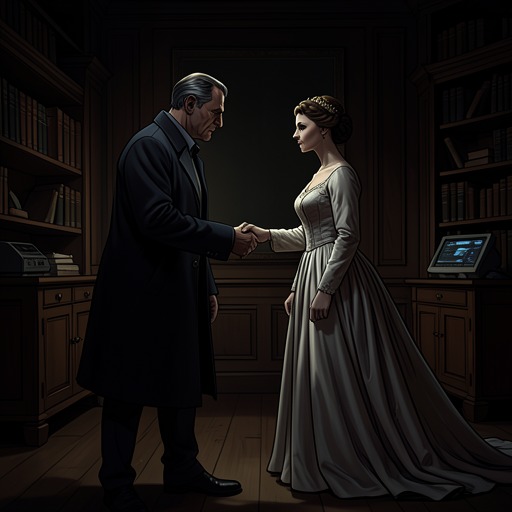
The seizure of Anne of Austria's letter
The Three MusketeersThe seizure of Anne of Austria's letter is a decisive episode in the political and emotional struggle surrounding Anne of Austria, Louis XIII, and Cardinal Richelieu. Sparked by the discovery that Buckingham had recently been in Paris and that the queen had been writing, the episode turns private correspondence into a matter of state security. It begins as an attempt to expose suspected adultery and ends by revealing a political conspiracy against Richelieu, thereby shifting the immediate danger from the queen's alleged infidelity to the wider instability of the French court.
Causes and Political Background
The crisis grows out of the rivalry among Louis XIII, Anne of Austria, Richelieu, and Buckingham. Buckingham's arrival in Paris has intensified the king's jealousy, while Richelieu presents the queen's conduct as a possible act of treason. The cardinal reports that Anne has stayed up late, wept, and written throughout the day, leading Louis XIII to conclude that the writing must be intended for Buckingham. He demands the queen's papers and insists that the letters be obtained regardless of the personal humiliation involved.
The queen's position is already precarious. She is deprived of her husband's confidence and exposed to Richelieu's hostility, which is connected to her rejection of his more personal advances. Her allies and servants have suffered persecution: the Duchesse de Chevreuse and Mme. de Bernet have been exiled, while Laporte expects arrest. The seizure therefore occurs within a pattern in which Anne's friendships and political associations become grounds for suspicion, surveillance, and punishment.
The Order to Search the Queen
Louis XIII asks how the papers can be taken without making either himself or Richelieu the direct instrument of the intrusion. Richelieu proposes sending Monsieur de Seguier, the Keeper of the Seals, because the matter falls within the duties of his office. When Seguier arrives, Louis XIII enters Anne's chamber and tells her that the chancellor will visit her on a matter entrusted to him. Anne, already threatened by the possibilities of divorce, exile, and trial, turns pale and asks why the king cannot address the matter himself.
Seguier's political history makes the search more threatening. After entering the magistracy, he joined Richelieu's party, became chancellor, served the cardinal in his hostility toward the queen-mother and his vengeance against Anne of Austria, and gained Richelieu's complete confidence. His commission is thus formally royal but politically aligned with Richelieu's campaign against the queen. He announces that, in the king's name, he must conduct a close examination of all her papers, presenting coercion as official duty.
The Letter Is Taken
Anne receives the investigation as an indignity and refuses to surrender her authority quietly. When Seguier indicates that he will carry out the king's command, she accuses the cardinal's spies of having served him faithfully and admits that she has written a letter that has not yet been sent. She identifies its location by laying her hand upon her bosom, but insists that she will give it to no one except the king.
The chancellor then reaches toward the place where she has acknowledged the paper is hidden. Anne steps backward, grows so pale that she appears close to collapse, supports herself against a table, and draws the letter from her bosom. She hands it over with a trembling voice and orders him to take it and remove himself from her presence. Seguier leaves without reading it, while Anne sinks half fainting into the arms of her women. The physical handling of the document makes the political violence of the scene unmistakable: the queen's body, dignity, and private writing are all brought under institutional authority.
The Contents and Immediate Reversal
Seguier carries the letter directly to Louis XIII. The king receives it with a trembling hand, notices that it lacks an address, opens it slowly, and becomes pale before reading it rapidly. The first words show that it is addressed to the King of Spain, confirming that the letter belongs to an international political exchange rather than a private message to Buckingham.
Its contents transform the meaning of the entire seizure. The letter contains no declaration of love. Instead, Anne asks her brother and the Emperor of Austria to present themselves as injured by Richelieu's policy, whose aim is described as the abasement of the House of Austria. She urges them to declare war on France and to make Richelieu's dismissal a condition of peace. The document therefore exposes Anne's opposition to the cardinal and her attempt to mobilize foreign pressure against him, but it does not establish the romantic betrayal Louis XIII feared.
Louis XIII is delighted by this discovery and immediately goes to Richelieu, who is waiting in the business cabinet. The king's suspicion of Anne's correspondence has yielded evidence of a political plan against the cardinal, not proof of an affair with Buckingham. The revelation gives Louis XIII temporary satisfaction because the letter clears the queen of the particular accusation that had inflamed his jealousy, even while confirming that she is involved in dangerous opposition to Richelieu.
Consequences and Narrative Significance
The seizure exposes the unstable boundary between marital suspicion and raison d'état. Louis XIII begins with a jealous demand for proof that Anne has corresponded with Buckingham; the official search instead uncovers a plan involving Spain, Austria, and a possible war against France. Private writing becomes an instrument of international politics, and the queen's personal vulnerability is inseparable from the strategic conflict between the House of Austria and Richelieu's ministry.
The episode also establishes the political importance of documents in the novel. The letter is not merely evidence that confirms or disproves an accusation. Its material presence in Anne's bosom, its seizure by the Keeper of the Seals, and its delivery unopened to Louis XIII give it power before its contents are known. Suspense depends upon this interval between possession and reading: the king, the cardinal, and the reader must first confront the letter as a dangerous object, then reinterpret the whole crisis when its words are revealed.
Finally, the incident does not end Anne of Austria's danger. Although the letter contains no declaration of love, it confirms her hostility to Richelieu and links her to a plan for foreign intervention and war. The queen escapes the immediate charge of romantic infidelity, but the evidence seized from her becomes a new source of political peril. In this reversal, the episode condenses the novel's larger pattern: official power searches for one kind of guilt, discovers another, and turns intimate life into the battlefield of competing regimes.