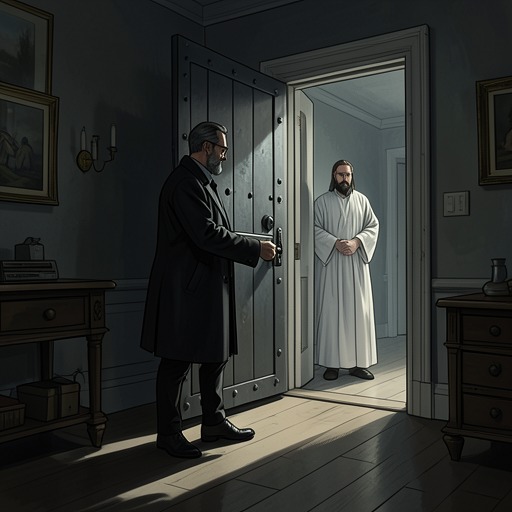
Treville secures Athos's release
The Three MusketeersTreville secures Athos's release is the decisive reversal that frees Athos from the Fort l'Eveque and reasserts the protective bond between the captain and the Musketeers. After Athos is secretly arrested during the police operation at the Bonacieux residence, M. de Treville refuses to let the arrest remain an obscure legal proceeding. He identifies the prisoner, challenges the authority behind the detention, and brings the matter before Louis XIII, forcing the king and Cardinal Richelieu to confront the conflict between formal law and political power.
Causes and Background
The immediate cause of the episode is the secret arrest of Athos. The police method belongs to the seventeenth-century “mousetrap,” a system in which an arrest is concealed while officers wait in ambush for everyone who enters a house; the door is opened to visitors, then closed behind them, allowing the authorities to accumulate prisoners over several days. Athos is therefore caught inside a mechanism designed not merely to seize one suspect but to turn an entire household and its circle of visitors into evidence and custody.
The arrest is especially dangerous because Athos is mistaken for d'Artagnan. When the two captives are confronted, Athos deliberately declares that his name is Athos, not d'Artagnan, and denies knowing M. or Mme. Bonacieux. He explains that he came to visit his friend only at about ten o'clock and that earlier he had been dining and conversing at Treville's residence. His alibi rests on named witnesses, including the Duc de la Tremouille, and on the social standing of those who can attest to it. The statement transforms his defense from a plea for indulgence into a direct challenge to the investigators' account.
The institutional conflict is sharpened by the hostility between the men of the robe and the men of the sword. Athos has already been taken through the examinations imposed on Bonacieux and has been placed in the Fort l'Eveque. Treville understands that the matter is not only the fate of one soldier: if an irreproachable Musketeer can be seized, carried through the streets, and imprisoned on an order that the captain is not even allowed to see, the authority and morale of the entire company are exposed to police power.
Treville's Intervention
When d'Artagnan and Porthos report that Athos has not returned, Treville acts immediately. His concern is not abstract. He is described as the father of his soldiers, extending protection to the least known member of the company as though that man were his own brother. He goes to the office of the lieutenant-criminal, summons the officer commanding the Red Cross post, and follows the successive inquiries until Athos's location in the Fort l'Eveque is established.
Treville then takes the dispute to Louis XIII, who is at the Louvre with Richelieu. He presents the arrest as an assault carried out by procureurs, commissaries, and police officers against the king's own Musketeers. His account stresses the humiliating sequence: Athos was arrested in a house, led away through the open street, and thrown into the Fort l'Eveque under an order that the authorities refused to show him. Treville also insists on Athos's “irreproachable conduct” and “almost illustrious reputation,” making character and military honor central to the case.
Richelieu answers by supplying a rival version. According to the cardinal, Athos had attacked four commissaries of inquiry delegated to investigate an affair of the highest importance. Treville rejects the accusation with Gascon freedom and military frankness, asserting that Athos had been with him, the Duc de la Tremouille, and the Comte de Chalus at the very time when the alleged assault supposedly occurred. The confrontation thus becomes a contest between written police testimony and the captain's personal credibility, supported by aristocratic witnesses.
The King's Decision
Louis XIII initially moves toward procedure rather than immediate judgment. When Treville denies Athos's culpability, the king declares that the case should go before judges, because judging belongs to them. This response appears impartial, but Treville exposes the danger concealed within it: in the present political climate, even the purest life and the most incontestable virtue cannot protect a man from infamy and persecution. He warns that the army will not be pleased if soldiers are subjected to severe treatment for police affairs.
Treville's intervention is deliberately provocative. He wants the conflict brought into the open, where the pressure of military solidarity and royal responsibility can counterbalance the cardinal's police machinery. His language risks displeasing the king, but it also prevents the imprisonment from being treated as an ordinary administrative matter. The value at stake shifts from Athos's private freedom to the public dignity of the Musketeers and the king's command over them.
The immediate breakthrough comes when Treville establishes that Athos is being held in solitary confinement, in a dungeon, “like the lowest criminal.” Louis XIII is shaken by the revelation. Richelieu then proposes the apparently simple remedy: the king should sign an order for Athos's release, since Treville's guarantee is sufficient. The king signs, and Treville carries the order away without delay.
Release and Political Aftermath
Treville enters the Fort l'Eveque triumphantly and delivers Athos from custody. The release restores Athos's physical freedom, but the episode does not produce a clean victory. Athos has maintained his peaceful indifference throughout the imprisonment, while Treville leaves with both joy and apprehension. He would have preferred open resistance from Richelieu to the cardinal's sudden yielding, because a concession from Richelieu is likely to conceal another maneuver.
Treville's suspicion is confirmed almost immediately. As soon as the captain leaves, Richelieu tells the king that Buckingham has been in Paris for five days and departed that morning. The release therefore forms part of a larger struggle over the queen's political and personal danger, rather than standing as an isolated act of justice. Treville has won Athos's freedom, but Richelieu retains the initiative by redirecting the king's attention toward Buckingham and the correspondence surrounding him.
The captain also understands the practical fragility of the victory. He fears that the cardinal will play another trick and remarks that it is harder to replace a man in the Fort l'Eveque or the Bastille once he has escaped than to keep a prisoner who is still inside. His urgency reflects the precarious status of royal soldiers under competing systems of command: a signed order can restore liberty, but only so long as the political will behind it endures.
Narrative Significance
The event establishes Treville as more than a superior officer. He acts as advocate, protector, and political counterweight, converting loyalty to a subordinate into a challenge to the machinery of secret arrest. Athos's release also strengthens the collective identity of the Musketeers: d'Artagnan and Porthos report the disappearance, Treville takes responsibility, and the company appears as a body whose members cannot be quietly removed without consequence.
At the same time, the episode exposes the unstable boundary between legality and exception. The mousetrap operates through concealed arrest, ambush, and accumulated detention; Richelieu invokes an urgent state investigation; and the king's authority is ultimately expressed through a release order rather than through a full determination of guilt. The law is present, but its application depends on who controls the police, whose testimony is believed, and whether the king is persuaded to intervene.
The release also advances the book's recurring opposition between the king's Musketeers and Richelieu's political network. Treville's victory is concrete and immediate, yet it is shadowed by the cardinal's continuing power. The episode ends not with the disappearance of danger but with Athos restored to his companions and the larger conspiracy newly exposed: freedom has been recovered, while the contest that made the imprisonment possible continues.