War
The Three MusketeersWar is the novel’s governing condition rather than a remote historical backdrop. In 1625, Meung appears to be in revolution because conflict has become ordinary: nobles fight one another, Louis XIII struggles against Cardinal Richelieu, Spain opposes the king, and robbers, Huguenots, wolves, mendicants, and other outlaws prey upon everyone. The citizens’ instinctive response is to arm themselves, yet their political loyalties are selective; they will readily oppose thieves or Huguenots, sometimes even the king, but never Richelieu or Spain. War therefore appears from the beginning as both public danger and a social habit, a condition that teaches communities to interpret every disturbance through armed force.
A Political and Religious Order of Conflict
War is inseparable from the consolidation of royal authority. The remaining Huguenot stronghold of La Rochelle is presented as the last major place of safety granted to the Protestants under Henry IV. Richelieu regards its destruction as necessary because Calvinism is entangled with civil revolt and foreign war. La Rochelle’s importance is increased by the collapse of other Calvinist cities, and its harbor remains the last port in France open to England. Closing it would therefore serve both religious centralization and national strategy: the siege is directed against a Protestant political network while also restricting the movements of France’s principal external enemy.
The conflict is international in its composition. Spaniards, Englishmen, Italian malcontents, adventurers, and soldiers of fortune from different sects gather under the Protestant standard and organize themselves as a vast association whose branches extend across Europe. War consequently exceeds the boundaries of the French kingdom. Religious allegiance, military employment, exile, maritime access, and political conspiracy create a network in which foreign personnel and interests flow toward a single fortified city. The siege is thus a struggle over the shape of the French state and over the routes through which foreign influence can enter it.
Royal Guards and the Management of Violence
Within the court, war is also institutionalized through rival military households. Treville rises from poverty through audacity, intelligence, and success in an age when blows fall as heavily as hail. His faithfulness and courage carry him to the captaincy of Louis XIII’s Musketeers, a body devoted to the king with an almost fanatical intensity. The king’s force is not merely a ceremonial guard: it is a personal instrument of royal power, bound to its captain and ready to defend the king’s friends.
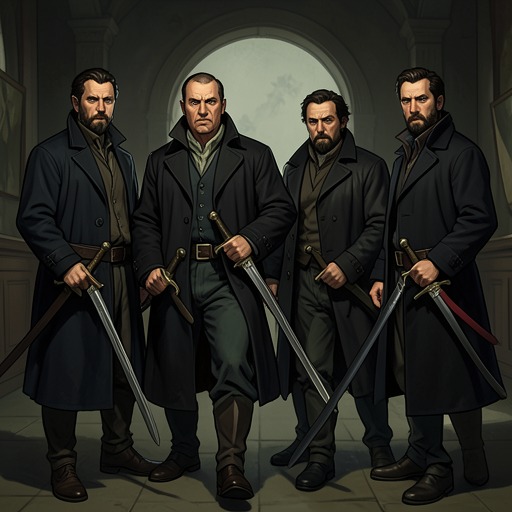
Richelieu responds by creating a guard of his own. The king and the cardinal compete for the most celebrated swordsmen from the provinces of France and from foreign countries, and even their chess games become occasions for debating the merits of their servants. They publicly condemn duels and brawls while privately encouraging rivalry between their combatants, taking pleasure or offense according to the success of their own men. War here becomes a controlled extension of court politics. The state forbids private violence in principle, but its leading figures preserve influence by directing precisely the violence they denounce.
Treville understands this contradiction and turns it into political capital. He parades the Musketeers before Richelieu with an insolence designed to provoke the cardinal, while maintaining strict authority over men who are disorderly toward everyone else. The Musketeers occupy taverns, promenades, and public entertainments; they draw swords in the streets, kill and avenge, and rely on Treville to prevent their imprisonment. Their unruliness is not outside the political system. It is one of the ways royal favor operates, protecting violence when it serves the king and transforming personal loyalty into military power.
Private Adventure Within International War
The novel repeatedly places intimate motives inside public conflict. Buckingham’s intervention against France is connected to his desire to preserve England’s honor, but it is also driven by private vengeance and by his wish to enter France as a conqueror rather than as an ambassador. The apparent stake of the struggle between two powerful kingdoms is consequently reduced, with deliberate irony, to the favor of Anne of Austria. The war’s official language conceals a personal rivalry, while personal desire helps mobilize ships, soldiers, and diplomatic schemes.
Buckingham’s expedition demonstrates the material scale of this private-political entanglement. He arrives unexpectedly before the Isle of Ré with ninety vessels and nearly twenty thousand men, surprises the Comte de Toiras, and lands after a bloody conflict. Toiras withdraws into the citadel of Saint-Martin with his garrison and places a hundred men in the smaller fort of La Prée. The numbers, fortifications, and contested landing show that romantic rivalry is not merely decorative background; it is capable of directing a major military operation.
The war also creates the conditions for rapid movement and danger. After crossing the sea, d'Artagnan reaches Dover and then London with Planchet, riding post horses because England’s postal service is well organized. He knows neither London nor the English language, but the name of Buckingham is enough to direct him to the duke’s hotel. Military and political urgency compresses distance: ships, roads, horses, servants, and written names become parts of the same transnational machinery.
Intelligence, Alliances, and Siege Pressure
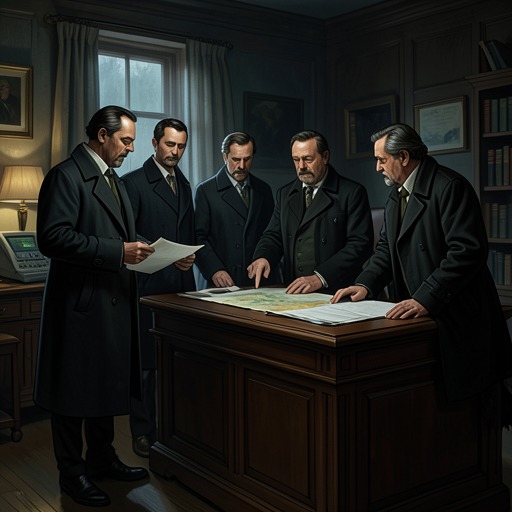
War depends as much on information as on arms. After Buckingham is forced to abandon his lodging, papers found there confirm a league linking the German Empire, Spain, England, and Lorraine against France. The discovery also appears to compromise Madame de Chevreuse and, consequently, the queen. Richelieu must therefore monitor reports from across Europe, because the siege is connected to diplomatic alliances and internal court danger. Intelligence converts a battlefield into a political map, linking foreign armies to suspected domestic conspirators.
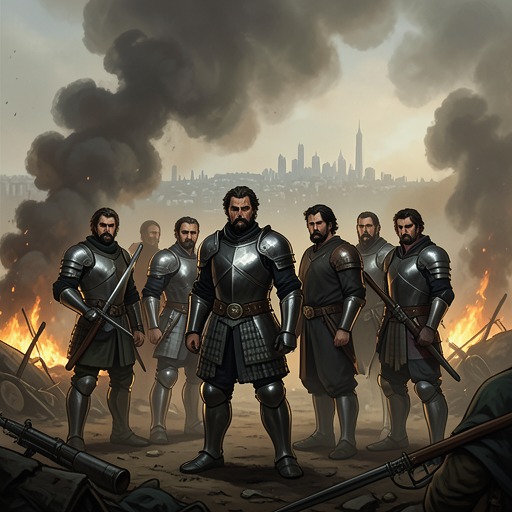
The siege itself is prolonged by logistics and engineering. Although La Rochelle is invested and the dyke prevents vessels from entering the besieged city, the blockade may last a long time. Its duration embarrasses the king’s army and inconveniences Richelieu. Inside the city, the mayor suppresses an attempted mutiny by hanging the mutineers; the remaining inhabitants choose to die of hunger rather than submit to what they regard as the more immediate certainty of strangulation. Hunger, discipline, fortification, and morale become weapons alongside cannon and swords.
The war’s pressure is therefore distributed unevenly across bodies and populations. Soldiers fight, civilians arm themselves, prisoners are restricted, cities are starved, and political figures react to news that may arrive by ship or messenger. Even a document ordering Charlotte Backson, branded by the justice of France and released after chastisement, to remain within three leagues of a designated place under threat of death reveals how wartime authority extends beyond the battlefield into surveillance, movement controls, and the permanent management of dangerous persons.
War as a Test of Loyalty and Legitimacy
For d'Artagnan, war is presented by his father as the arena in which a gentleman must establish himself. The elder d'Artagnan gives his son fifteen crowns, an old Bearn pony, a sword, and advice founded on courage, adventure, and endurance. He instructs him to preserve the family name, to tolerate nothing from anyone except the cardinal and the king, and to seek opportunities because hesitation may allow fortune to escape. The advice treats danger as both social reality and route to advancement: a poor provincial gentleman can convert martial courage into access to court.
The family horse itself carries this military inheritance. It was born in the family home and has remained there for roughly thirteen years, making it an old servant rather than a disposable possession. The father tells his son to care for it in a campaign as he would care for an aged retainer. The instruction joins warfare to memory, household continuity, and honor. Military mobility is sustained not only by splendid cavalry but also by worn animals, inherited weapons, small sums of money, and the codes that give such possessions meaning.
Yet war repeatedly exposes the instability of legal distinctions. When the king learns of a confrontation involving three of Treville’s Musketeers and d'Artagnan against five of Richelieu’s Guards, he acknowledges that the encounter was a brawl rather than an ordinary duel. Even so, he reminds Treville that an edict remains an edict and that fighting is forbidden. Treville answers that the unequal numbers place the event outside the normal conditions of a duel. The king sends the case to judges, formally restoring judicial procedure, while Treville warns that punishing honorable men for police matters may alienate the army. War thus produces a permanent tension between law and the military culture on which royal power depends.
The decisive force of war in the novel lies in this tension. It destroys lives and cities, but it also creates careers, alliances, routes of communication, and forms of political protection. It is religious struggle, international strategy, court theater, private revenge, and social discipline at once. The rivalry between the Musketeers and Richelieu’s Guards, the English assault on the Isle of Ré, and the starvation of La Rochelle all show a world in which public institutions prohibit violence while depending on its organized use. War is consequently the condition that makes the novel’s adventures possible and the measure by which its characters’ courage, loyalty, ambition, and legitimacy are continually tested.