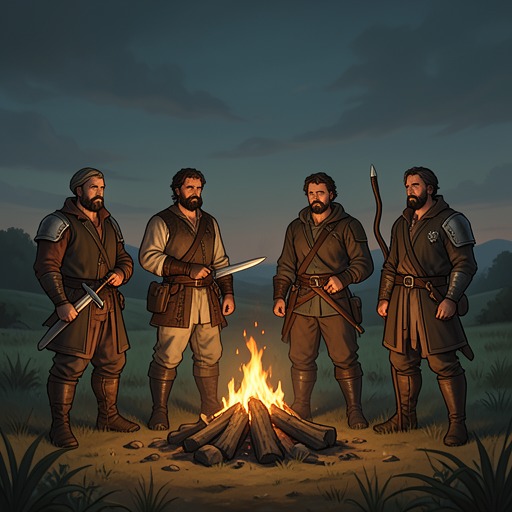
d'Artagnan and Athos
The Three MusketeersThe relationship between d'Artagnan and Athos is one of the novel's decisive transformations from conflict into fellowship. It begins with a collision, becomes a proposed duel, and is sealed in combat when d'Artagnan answers Athos's unspoken appeal for help. What first appears to be a dispute between an impetuous newcomer and an exacting veteran instead becomes the young man's initiation into the ethical and emotional community of the Musketeers.
Collision and Challenge
The relationship is born in the antechamber of M. de Treville's hotel. D'Artagnan, furious and rushing after a man who has escaped him, runs head foremost into Athos, who has just left one of M. de Treville's private rooms after being treated by a doctor. The impact strikes Athos's injured shoulder so violently that he cries out. D'Artagnan apologizes but insists that his haste explains his conduct; Athos, pale with pain and anger, seizes him by the belt and rebukes him for assuming that a hurried excuse is enough. He emphasizes that d'Artagnan is not M. de Treville and therefore cannot expect the same liberties to be granted to him.
D'Artagnan's answer reveals both the source of the tension and the quality Athos will eventually value. He admits that the collision was unintended, repeats his apology, and appeals to his word of honor while asking Athos to release him. Athos lets him go but calls him impolite and marks him as a man who has come from a distance. D'Artagnan stops at the insult rather than continuing down the stairs. The quarrel thus shifts from accidental physical harm to a question of dignity, the central currency of the dueling society in which both men move.
Athos offers to meet d'Artagnan near the Carmes-Deschaux. The challenge retains the formal language of gentlemanly combat, but it also contains the first sign that Athos recognizes something more substantial than provincial rashness in his opponent. D'Artagnan's insistence that Athos can find him without being chased gives Athos a name for him, "Monsieur Man-in-a-hurry," and converts the young man's frantic movement into a memorable mark of character.
From Duel to Recognition
Athos is pleased by d'Artagnan's proposal to fight at once rather than postpone the encounter. He associates the offer with the conduct of the gallant knights of the time of Charlemagne, while observing that the age of Cardinal Richelieu makes secrecy and delay necessary. When d'Artagnan replies that Athos need not inconvenience himself if he truly wishes to dispatch him immediately, Athos hears courage rather than empty bravado. He declares that the remark did not come from a man without a heart, says that he loves men of d'Artagnan's kidney, and foresees pleasure in the young man's conversation if they do not kill one another.
This is the relationship's first reversal. Athos does not simply withdraw his anger; he reclassifies d'Artagnan. The stranger who had seemed rude becomes a possible equal, and the enemy scheduled for a duel becomes a person whose companionship might be desirable. The recognition is not sentimental. It is produced by a test of conduct: d'Artagnan answers humiliation without retreat, and Athos understands that the young man's haste is joined to nerve.
The duel cannot proceed as a private contest. Porthos appears as Athos's witness, and Aramis is also drawn into the encounter. When Jussac and the Cardinal's Guards confront the three Musketeers, d'Artagnan refuses the opportunity to withdraw. Jussac explicitly urges him to save himself, but he does not move. Athos presses the young man's hand and calls him a brave fellow. The gesture makes the bond physical before it is fully verbal: Athos accepts d'Artagnan not as an accidental nuisance but as a comrade willing to share the danger.
Shared Combat and the Birth of Brotherhood
Athos, Porthos, Aramis, and d'Artagnan then advance together. Athos himself is wounded anew by Cahusac and grows visibly paler, yet he refuses to yield ground and changes his sword hand so that he can continue fighting with his left. Under the laws of dueling, d'Artagnan may assist whichever companion most needs help. He is trying to judge where his intervention matters most when he catches Athos's glance.
The glance is crucial because Athos cannot bring himself to ask openly for aid. His courage sustains him, but his eyes make the appeal his pride forbids him to speak. D'Artagnan interprets that silent signal and leaps toward Cahusac, announcing that he will slay the guardsman. The action is neither a calculated bid for recognition nor a formal obligation imposed by command. It is an immediate response to Athos's vulnerable moment, and it converts mutual esteem into practical loyalty.
Athos nevertheless retains control over the meaning of the rescue. When d'Artagnan gains the advantage, Athos begs him not to kill Cahusac, explaining that he has an old affair to settle with the man once he is cured and sound. He asks d'Artagnan only to disarm him and secure his sword. D'Artagnan does exactly that. The scene establishes a distinctive pattern between them: d'Artagnan supplies rapid, forceful action, while Athos supplies judgment, restraint, and the codes governing honorable conduct.
After the battle, the Musketeers salute Bicarat, whose bravery they respect even though he is their enemy. D'Artagnan helps carry the wounded under the convent porch and joins the others in returning four swords out of five. Their return to M. de Treville's hotel becomes a triumphal march. D'Artagnan walks arm in arm between Athos and Porthos, presses them tenderly, and says that although he is not yet a Musketeer, he has at least entered his apprenticeship. Athos is therefore not merely the first man with whom d'Artagnan quarrels; he is one of the men through whom d'Artagnan earns a place in the fraternity he has come to seek.
The Mature Friendship
The early violence gives way almost immediately to habitual companionship. D'Artagnan, arriving from his province without settled habits of his own, falls into the routines of Athos, Porthos, and Aramis. Though he is not yet a Musketeer, he performs a Musketeer's duties with remarkable punctuality and accompanies whichever friend is on guard. He becomes well known at the Hotel of the Musketeers, where he is regarded as a good comrade.
The friendship between the four men is described as fraternal and intensely recurrent. They feel the need to see one another three or four times a day, whether for dueling, business, or pleasure, and are continually running after one another like shadows. They are encountered together from the Luxembourg Gardens to the Place St. Sulpice and from the Rue du Vieux-Colombier to the Luxembourg. Within this larger fellowship, Athos remains the figure who first tested d'Artagnan's manners, courage, and capacity for loyalty; the relationship's later warmth carries the memory of that original severity rather than erasing it.
When d'Artagnan is admitted as a cadet into M. de Chevalier Dessessart's company of Guards, he accepts the uniform with a sigh because he would rather wear that of a Musketeer. M. de Treville promises that a two-year novitiate may be shortened by a signal service or brilliant action. Athos, Porthos, and Aramis then mount guard with d'Artagnan, so that the company receives four men where it had expected one. The arrangement shows that d'Artagnan's connection with Athos is not a temporary reward for a single duel: his new comrades actively accompany him while he remains outside the formal rank he desires.
Narrative Significance
The relationship dramatizes d'Artagnan's passage from outsider to recognized companion. His first movement toward Athos is uncontrolled and almost destructive; his decisive movement beside Athos is disciplined by perception, courage, and obedience to a comrade's need. The change depends on a value shift from injured dignity to shared honor. A collision that could have produced only resentment instead exposes the standards by which Athos judges men and gives d'Artagnan the opportunity to meet those standards.
Athos's silent glance also gives the friendship its deepest form. The older Musketeer does not surrender his pride through a spoken plea, and d'Artagnan does not wait for explicit permission before acting. Their understanding is therefore founded on a reading of conduct rather than on declarations of affection. Athos recognizes the young man's heart; d'Artagnan recognizes Athos's unspoken need. From that exchange comes a partnership in which difference becomes complementary: Athos's wounded self-command and d'Artagnan's impulsive energy combine against a common enemy.
The relationship consequently serves as the first and most concrete instance of the broader fellowship of the four inseparable companions. D'Artagnan's apprenticeship is not granted by title alone. It is enacted when Athos accepts him, tests him, presses his hand after he refuses to retreat, and fights beside him; it is confirmed when d'Artagnan returns in triumph between Athos and Porthos and thereafter shares the daily life of the Musketeers. Their friendship turns the novel's culture of dueling from a mechanism of rivalry into a route toward loyalty.