dyke of La Rochelle
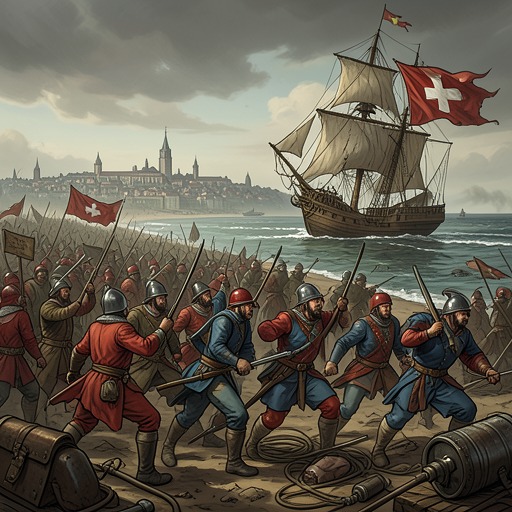
The Three MusketeersThe dyke of La Rochelle is the central military work of the siege, converting a difficult assault into a blockade governed by hunger, navigation, weather, and endurance. Its importance lies not merely in its physical obstruction of the harbor but in the way it allows Cardinal Richelieu to defeat La Rochelle without storming an apparently impregnable city. The dyke makes engineering a form of political power: it isolates the last major Huguenot stronghold, cuts its connection with England, and forces the defenders to choose between surrender and starvation.
Purpose and Strategic Setting
The dyke was constructed during the siege of La Rochelle, the last surviving place of safety granted to the Huguenots by Henry IV. The city had become the principal focus of Protestant resistance, foreign intervention, and civil unrest. Its harbor was also the last port in the French kingdom open to England, so closing it served two purposes at once: it attacked La Rochelle’s religious and political independence and severed the maritime route through which English assistance could arrive.
The work therefore belonged to a wider strategy rather than to a single battlefield maneuver. Spaniards, Englishmen, Italian malcontents, adventurers, and soldiers of fortune had gathered under the Protestant cause, making the conflict an international network of military support. Against that network, the dyke imposed a geographical barrier. It transformed the harbor from a channel of communication into a sealed boundary and made the city’s survival dependent on whether an external fleet could break through.
The Dyke as a Weapon of Blockade
The royal army’s confidence rested above all on the dyke, which prevented any vessel from entering the besieged city. Because La Rochelle appeared impregnable to direct assault, the generals repeatedly rejected the idea of taking it by storm. A frontal attack would have required Frenchmen to fight Frenchmen and might have produced a massacre recalling the Saint Bartholomew’s Day Massacre of 1572. The dyke offered a slower but more controllable alternative: famine could accomplish what artillery and infantry might not.
Cardinal Richelieu continued to press the construction of the famous dyke even while negotiations failed and foreign relief remained possible. Its progress was slow enough to test the patience of the besiegers, yet its strategic effect was cumulative. As the barrier tightened, La Rochelle’s defenders lost access to provisions and hope. A captured letter reported that, unless Buckingham’s succor arrived within fifteen days, the inhabitants would already be dead of hunger. The city’s political resistance thus became a logistical emergency, and the dyke made time itself an instrument of siege.
Conflict with Buckingham’s Relief Expedition
The dyke acquired its full significance when Buckingham attempted to relieve La Rochelle. The Duke of Buckingham arrived unexpectedly before the Isle of Ré with ninety vessels and nearly twenty thousand men, surprised the Comte de Toiras, and secured a landing after a bloody conflict. His expedition represented the maritime power that the dyke was designed to exclude and gave the Rochellais a renewed expectation of rescue.
The physical conditions of the campaign nevertheless favored the work. English troops suffered from inadequate provisions, living on salt meat and poor biscuit, while illness spread through the camp. Rough winter seas destroyed small vessels, and the shore was strewn with the wrecks of pinnaces, roberges, and feluccas. Even without a decisive assault, these pressures made Buckingham’s position increasingly untenable. The dyke did not act alone; it worked together with famine, disease, bad food, storm damage, and the deterioration of maritime supply.
When the French army finally launched a decisive action, the English were beaten in successive encounters and defeated while crossing the Isle of Loix. They were forced to re-embark, leaving two thousand men, five colonels, three lieutenant colonels, two hundred and fifty captains, twenty gentlemen of rank, four cannon, and sixty flags on the field. With the relief expedition expelled, the dyke could perform its intended function without the immediate threat of English intervention. The cardinal was free to continue the siege, while captured English losses were displayed with ceremony in Paris.
Famine, Information, and Political Control
The dyke’s power was also informational and psychological. The besiegers intercepted messengers sent from La Rochelle to Buckingham and spies sent in the opposite direction. Their capture revealed how completely the city’s fate depended on a connection that the dyke was severing. The Rochellais regarded Buckingham as their Messiah; if they learned that he could not come, their courage would collapse along with their hope.
Richelieu combined the blockade with propaganda. Instead of sending food over the walls, as Henry IV had done when besieging Paris, he sent notes accusing La Rochelle’s leaders of keeping abundant grain for the able-bodied while women, children, and old men starved. The notes sought to turn shared suffering against the city’s internal leadership. In this sense, the dyke enclosed more than territory: it created the conditions for a struggle over blame, morale, and obedience. Richelieu’s maxim, “Divide in order to reign,” describes the political use of the siege as well as the physical separation imposed by the barrier.
The royal army, by contrast, could remain comparatively secure behind the siege system. It had provisions and money, and its soldiers entertained themselves with hazardous expeditions against the dyke and the sea, the capture of spies, and daring plans carried out with confidence. The same passage of time that meant famine and anxiety for the Rochellais could appear short and lively to the besieging troops. The dyke thus produced sharply unequal experiences of duration: abundance and diversion on one side, starvation and suspense on the other.
Narrative and Historical Significance
Within the larger story, the dyke connects the private adventures of the characters with the public machinery of war. The struggle over La Rochelle is intertwined with the rivalry between Buckingham and Richelieu, while Buckingham’s military action is itself connected to his private vengeance and his love for Anne of Austria. A work intended to close a harbor consequently becomes part of a conflict in which national honor, religious policy, international alliance, and romantic desire are entangled.
Its importance is finally measured by what it makes unnecessary. The dyke allows Richelieu to avoid the catastrophic assault he fears, to weaken La Rochelle through material deprivation, and to continue the siege while awaiting the failure of foreign relief. It is a triumph of logistics over spectacle, though the narrative repeatedly supplies spectacle around it: fleets, wrecks, military banners, captured spies, and the grand political theater of the camp. The dyke remains the quiet center of that theater, an engineered line whose pressure turns a fortified city’s resistance into a question of hunger, time, and surrender.