the quarry
The TrialThe quarry is the desolate, moonlit location where Josef K. is executed by two men on the eve of his thirty-first birthday, serving as the final, stark setting of the novel and the physical endpoint of his futile legal struggle.
Location and Setting
The quarry is an empty, abandoned site near a building that still resembles those in the city, located on the outskirts of town where the built-up area ends almost without transition. It is a place of natural peace under the moonlight, which lies everywhere with a calm granted to no other light. The quarry contains a rockface and a stone that has broken loose, which the executioners use as a support for K.'s body. The site is devoid of people but decorated with flower beds in the square leading to it, and the moonlight glitters and quivers in the water of a nearby river that divides around a small island covered with dense foliage, trees, and bushes—a place where K. had once stretched out on comfortable benches on summer days.
The Execution
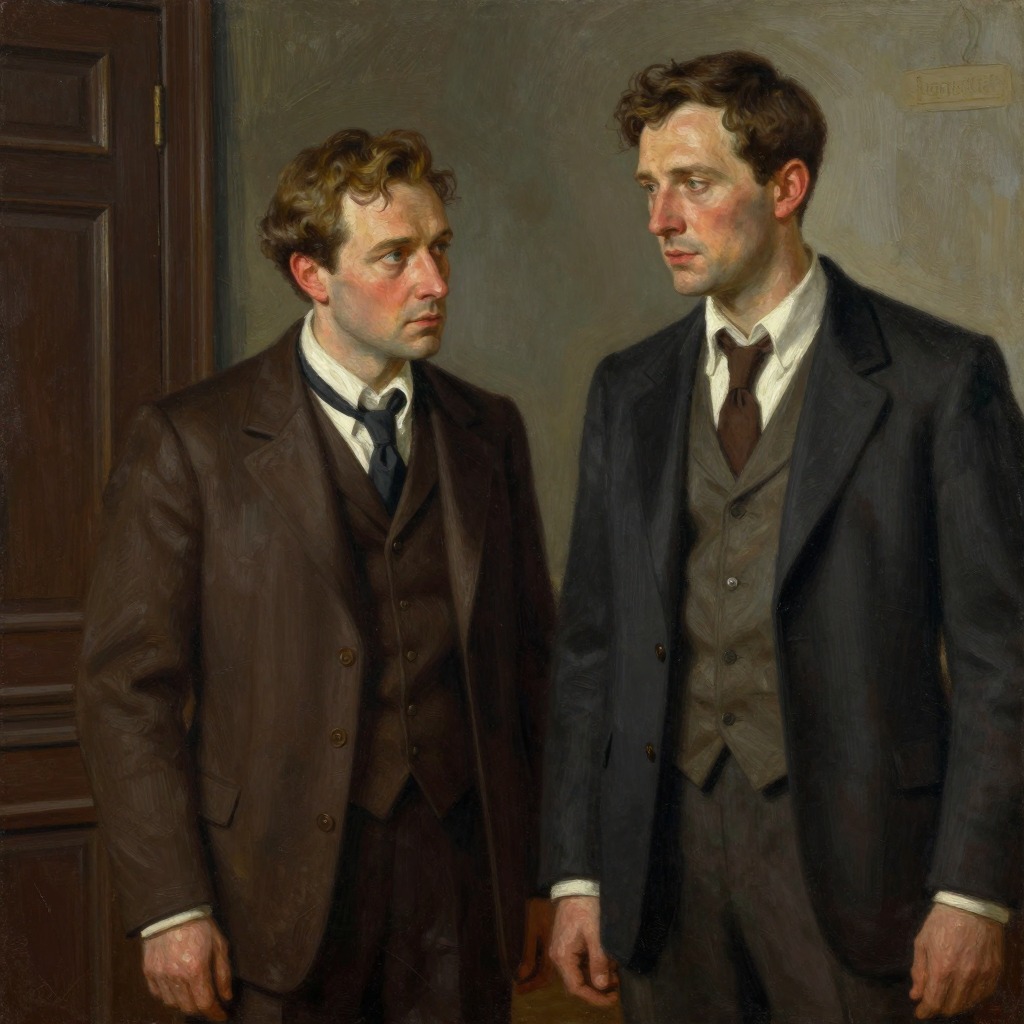
On the evening before K.'s thirty-first birthday, at about nine o'clock, two men in frock coats, pale and fat, wearing top hats, come to K.'s flat and escort him through the streets. They form a single unit with K., holding his arms in a formal, experienced grasp that cannot be resisted. After passing through several streets where policemen stand, K. drives the group forward, and they begin to run, quickly leaving the built-up area and entering the fields. At the quarry, the men stop, release their hold on K., and take off their top hats, wiping sweat from their brows. One of them removes K.'s coat, waistcoat, and shirt, then carefully folds the clothes. The other gentleman looks for a suitable place near the rockface, where a broken stone lies. They sit K. down on the ground, lean him against the stone, and settle his head on top of it, though his position remains forced and hard to believe. One of the gentlemen draws a long, thin, double-edged butcher's knife from a sheath on his belt and tests its sharpness in the light. The two men pass the knife over K. in repulsive courtesies, expecting him to take it and thrust it into himself, but he does not. Instead, he twists his neck and looks around, seeing a light flicker on in the top floor of the building next to the quarry, where a figure leans out and stretches out its arms. K. raises both hands and spreads out all his fingers. The hands of one gentleman are laid on K.'s throat while the other pushes the knife deep into his heart and twists it twice. As his eyesight fails, K. sees the two men cheek by cheek, close in front of his face, watching the result. He says, "Like a dog!" as if the shame of it should outlive him.
Narrative Significance
The quarry is the final, irreducible setting of the novel, a place where the abstract, labyrinthine machinery of the court culminates in a concrete, brutal act. It is a space of exposure and abandonment, far from the domestic interiors, bank offices, and attic courtrooms that have defined K.'s experience. The natural peace of the moonlight contrasts starkly with the violence of the execution, and the quarry's isolation—empty, abandoned, on the edge of the city—mirrors K.'s complete isolation from any human community or legal recourse. The site also recalls the earlier, more hopeful moments of K.'s life, as the nearby river and island with benches evoke summer days when he had stretched out there, making the quarry a place where memory and finality converge. The quarry is not merely a backdrop but an active participant in the novel's meaning: it is the place where the court's power, which has been diffuse and bureaucratic, becomes physically immediate and lethal, and where K.'s long struggle ends not with a verdict but with a shameful, dog-like death.