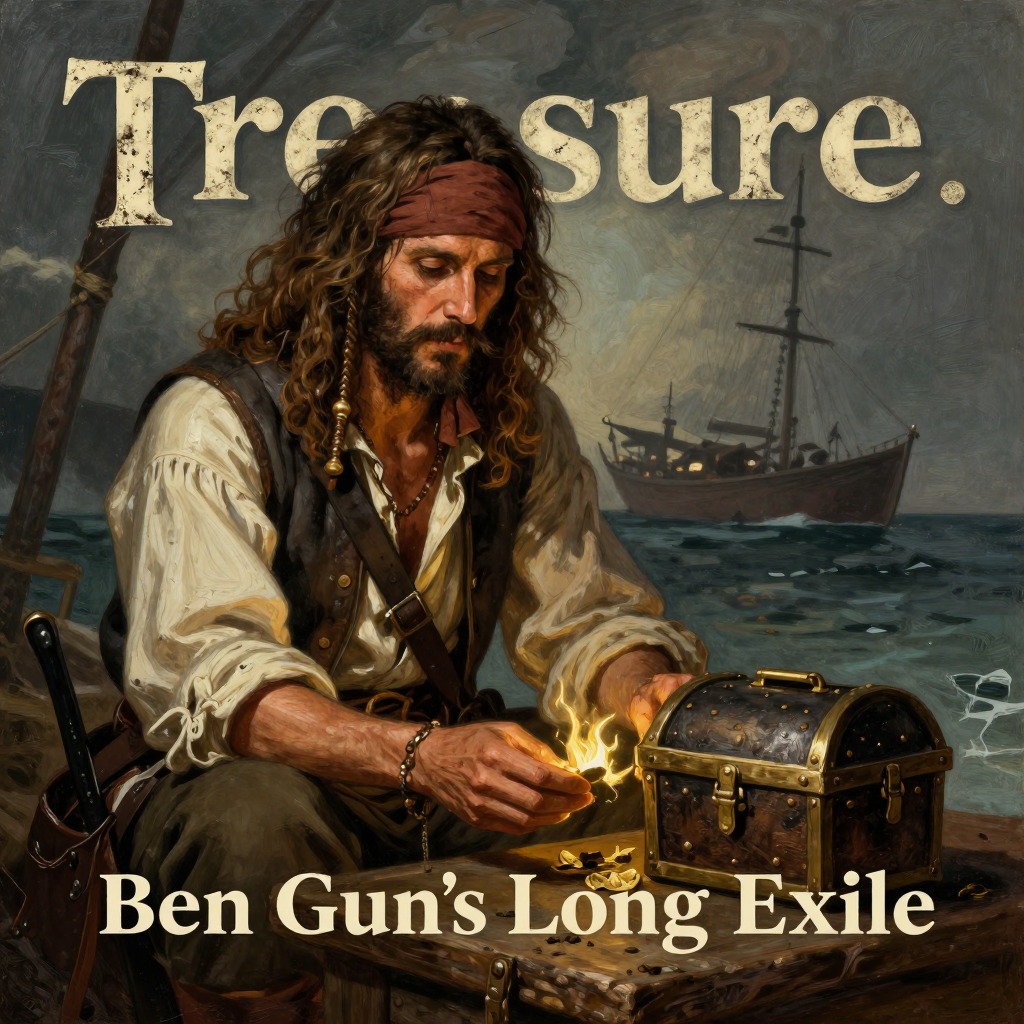
Marooning of Ben Gunn
Treasure IslandThe Marooning of Ben Gunn is the pivotal act of abandonment in Treasure Island, in which the sailor Benjamin Gunn is left alone on Treasure Island by his shipmates after a failed treasure hunt, an event that transforms him into the island's solitary, half-crazed inhabitant and ultimately becomes the key to the novel's resolution. This marooning, a brutal form of pirate punishment, sets the stage for Gunn's crucial alliance with Jim Hawkins and the loyal party, as his three years of isolation and his secret removal of Flint's treasure prove decisive in the final confrontation with the mutineers.
The Act of Marooning
Ben Gunn was marooned on Treasure Island three years before the Hispaniola arrives, as he himself tells Jim Hawkins when they first meet in the island's woods. The word "marooned" carries a specific and horrible meaning among buccaneers: the offender is put ashore with a little powder and shot and left behind on some desolate and distant island, a punishment common enough in pirate practice. Gunn's own account of his abandonment is precise: he had been in another ship three years back, and when they sighted this island, he urged his messmates to land and find Flint's treasure. The captain was displeased, but the crew were all of a mind and landed. For twelve days they searched, and every day they had the worse word for him, until one fine morning all hands went aboard. Their parting words were a cruel sentence: "As for you, Benjamin Gunn," they said, "here's a musket, and a spade, and pick-axe. You can stay here and find Flint's money for yourself." Thus he was left, with only the barest tools and no promise of return.
The island itself, as Gunn experiences it, is a place of harsh extremes. The grey-coloured woods cover a large part of the surface, broken by streaks of yellow sand and tall pines, while the hills run up in spires of naked rock, the Spy-glass towering three or four hundred feet above the rest. The anchorage where the Hispaniola later lies is land-locked and buried in woods, with a peculiar stagnant smell of sodden leaves and rotting tree trunks, which Dr. Livesey immediately diagnoses as fever-laden. The sea around the island is never quiet; great rollers thunder along the external coast by day and night, so that no spot is out of earshot of their noise. For Gunn, this environment becomes his entire world, a world of goats, berries, and oysters, and the constant roar of the surf.
Life in Isolation
Gunn's three years of solitude have left him physically and mentally transformed. When Jim first sees him, he is a figure of terror, dark and shaggy, leaping behind a pine trunk, and Jim cannot tell whether it is bear, man, or monkey. But Gunn is a white man, his features even pleasing, though his skin is burnt by the sun, his lips black, and his fair eyes startling in so dark a face. He is clothed in tatters of old ship's canvas and sea-cloth, held together by brass buttons, bits of stick, and loops of tarry gaskin, with an old brass-buckled leather belt as the one solid thing about him. His voice is hoarse and awkward, like a rusty lock, and he speaks with a childlike pleasure in the presence of a fellow creature, feeling Jim's jacket, smoothing his hands, and looking at his boots. He has lived on goats, berries, and oysters, and his heart is sore for Christian diet; he confesses that many's the long night he has dreamed of cheese, toasted mostly, and woke up again to find himself still on the island.
His isolation has also driven him to a kind of religious fervour. He tells Jim that he had a pious mother and was a civil, pious boy who could rattle off his catechism, but that he went wrong, beginning with chuck-farthen on the blessed grave-stones. Yet he insists that Providence put him on the island, that he has thought it all out in his lonely exile, and that he is back on piety. He claims he no longer tastes rum except a thimbleful for luck, and he is bound to be good. This piety, however, is mixed with a shrewd and calculating cunning, for he has also discovered the island's greatest secret.
The Secret of the Treasure
During his long wanderings, Gunn found the skeleton of one of Flint's victims, which he rifled, and more importantly, he found Flint's treasure. He dug it up, using a pick-axe whose haft later lies broken in the empty excavation, and carried it on his back in many weary journeys from the foot of the tall pine to a cave he had on the two-pointed hill at the north-east angle of the island. There it has lain stored in safety since two months before the arrival of the Hispaniola. This secret is the source of his repeated, cryptic assertions to Jim that he is "rich," and his elaborate instructions for Jim to convey to the squire: that Gunn is a good man, that he puts a precious sight more confidence in a gentleman born than in these gentlemen of fortune, having been one himself. He also insists on the phrase "reasons of his own" as the mainstay of his proposal, and he extracts from Jim a promise not to sell him to Silver.
Gunn's knowledge of the treasure and his fear of Long John Silver shape his behaviour. When Jim tells him that Silver is the cook and ringleader, Gunn wrings Jim's wrist and declares that if Jim were sent by Long John, he would be as good as pork. He knows Silver's reputation from the old days, when Silver was quartermaster on Flint's ship, and he is terrified of him. Yet he is also a man of resource, having built a coracle with his own hands, a rude, lop-sided framework of tough wood covered with goatskin, which he keeps under the white rock. This boat, though "queer to handle till you knew her way," becomes Jim's means of reaching the Hispaniola and cutting her adrift.
The Turning Point
Gunn's marooning becomes the turning point of the novel when Dr. Livesey worms the secret of the treasure from him on the afternoon of the attack on the stockade. The doctor, seeing the anchorage deserted the next morning, goes to Silver, gives him the now-useless chart and the stores, and does everything to get a chance of moving in safety from the stockade to the two-pointed hill, where Ben Gunn's cave is well supplied with salted goat's meat and where they can keep a guard upon the money. This strategic retreat, made possible by Gunn's secret, leaves the mutineers to pursue a treasure that is already gone. On the day of the treasure hunt, Gunn, being fleet of foot, is dispatched ahead to work upon the superstitions of his former shipmates, and his voice, imitating Flint's, so terrifies the pirates that they are easy prey for the ambush. When the treasure pit is found empty, the mutineers turn on Silver, but the doctor, Gray, and Gunn emerge from the nutmeg-trees with smoking muskets, and the tide of the battle turns.
Aftermath and Significance
After the treasure is recovered, Gunn's role is not yet over. He is given a thousand pounds as his share, but he spends or loses it in three weeks, or to be more exact, in nineteen days, for he is back begging on the twentieth. He is then given a lodge to keep, exactly as he had feared upon the island, and he still lives, a great favourite, though something of a butt, with the country boys, and a notable singer in church on Sundays and saints' days. His final act of consequence is to connive at Silver's escape, providing him with a shore boat and thus preserving the lives of the loyal party, who would certainly have been forfeit if "that man with the one leg had stayed aboard." Silver also steals a sack of coin worth three or four hundred guineas, and the party is pleased to be so cheaply quit of him.
The marooning of Ben Gunn is thus not merely a cruel punishment but the engine of the novel's resolution. It creates a character who, in his isolation, becomes both a victim and a saviour, a figure of comic pathos and unexpected agency. His three years on the island, which he describes as a time of piety and poverty, enable him to outwit the pirates who once abandoned him, and his secret hoard of treasure, moved to his cave, becomes the very means by which the loyal party survives and triumphs. In the end, Gunn's marooning is a testament to the novel's theme that even the most desperate circumstances can produce resourcefulness and redemption, and that the cast-off can become the key to the whole adventure.