Spy-glass
Treasure IslandSpy-glass is the dominant geographical feature of Treasure Island, a towering hill that rises three or four hundred feet above the surrounding terrain and serves as the island's primary landmark for navigation, orientation, and the search for buried treasure. Its distinctive shape, running up sheer from almost every side and then suddenly cut off at the top like a pedestal for a statue, makes it instantly recognizable from sea and land alike. The hill gives its name to the Spy-glass Tavern in Bristol, the public house kept by Long John Silver, whose sign is a large brass telescope—a direct visual echo of the hill's function as a lookout point. The mountain is central to the treasure map found in Billy Bones's sea-chest, where it is marked as "The Spy-glass" and used as a reference for the final bearings that lead to Flint's cache. Its prominence and strategic value are established early in the narrative, and it remains a constant presence throughout the island adventure, shaping the characters' movements and the story's geography.
Geography and Appearance
The Spy-glass is the tallest hill on Treasure Island, standing three to four hundred feet above the sea. Its configuration is described as the strangest on the island: it rises sheer from almost every side and is abruptly cut off at the top, forming a flat summit that resembles a pedestal. The hill is located in the centre of the island, and its peak is often shrouded in fog or haze. From the anchorage, it appears as a tall, conical figure, and its slopes are covered with grey-coloured woods, interspersed with tall pines and spires of naked rock. The hill's shoulder, a sloping southern extension, adjoins a plateau that bounds the anchorage to the north. The terrain around the Spy-glass includes a marshy tract, a sandy country dotted with contorted trees, and a broad, reedy fen through which a small river soaks its way into the anchorage. The hill's summit offers a wide prospect, commanding views of the Cape of the Woods, the anchorage, Skeleton Island, and the open sea to the east.
Role in the Treasure Hunt
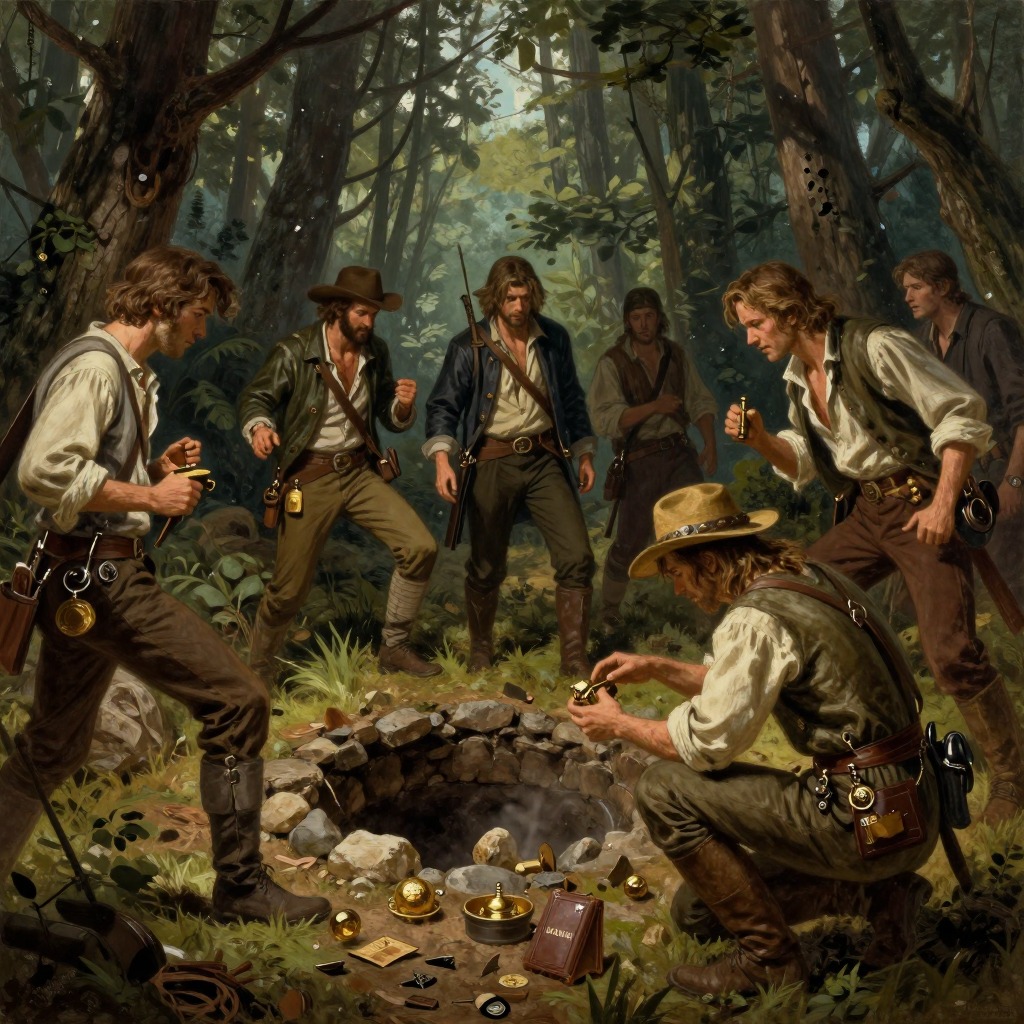
The Spy-glass is the key orienting feature in the treasure hunt. The map's instructions specify "Tall tree, Spy-glass shoulder, bearing a point to the N. of N.N.E.," making the hill's shoulder the primary reference point for locating the treasure. When the mutineers and the loyal party set out to find the gold, they use the Spy-glass as a landmark, with Silver taking bearings from its shoulder. The hill's distinctive shape and height make it visible from both the eastern and western sides of the island, and it is used as a sailing mark on the chart. The treasure itself is buried near a tall pine tree that stands on the plateau adjoining the Spy-glass's southern shoulder, and the hill's shadow falls over the excavation site. The Spy-glass thus functions as the geographical anchor for the entire treasure hunt, its presence guiding the characters' movements and their ultimate discovery of the empty pit.
Narrative and Symbolic Significance
The Spy-glass is more than a mere geographical feature; it is a symbol of the island's allure and danger. Its name, evoking a telescope, suggests observation, surveillance, and the promise of discovery—themes that permeate the novel. The hill is first mentioned in the treasure map, and its appearance in the narrative is accompanied by a sense of foreboding and excitement. When Jim Hawkins first sees the island, he notes the Spy-glass's strange configuration and its role as a lookout post for pirates who once used the anchorage to clean their ships. The hill's height and isolation make it a place of both refuge and peril: it is where Ben Gunn, the marooned sailor, has his cave, and where the final ambush of the mutineers takes place. The Spy-glass thus embodies the dual nature of Treasure Island itself—a place of hidden treasure and deadly violence, of beauty and terror. Its enduring presence in the story, from the map to the final departure, underscores its centrality to the novel's geography and its symbolic resonance as a marker of adventure and danger.