Grandmother
White NightsGrandmother is the blind, elderly guardian of Nastenka, a figure of domestic authority whose physical disability and rigid rules shape the entire emotional landscape of the story. She is the sole surviving relative of the orphaned Nastenka, having taken her in after the death of her parents, and she lives with her in a small wooden house with three windows, which belongs to them. The household's income depends on Grandmother's pension and the rent from a lodger, a financial reality that makes the presence of a young male tenant both necessary and, in Grandmother's eyes, dangerous.
Identity and Domestic Rule
Grandmother is defined by her blindness and her obsessive need to control Nastenka's movements. When Nastenka was fifteen, Grandmother, unable to watch her, took a pin and pinned Nastenka's dress to her own, declaring that they would sit like that for the rest of their lives unless Nastenka became a better girl. This pin rule confines Nastenka to Grandmother's side for all activities—working, reading, and studying—and makes any independent movement a physical act of rebellion. Grandmother's blindness also makes her dependent on Nastenka for descriptions of the world, yet she remains suspicious and vigilant, particularly about the lodger. When the new lodger first arrives, Grandmother asks Nastenka whether he is young or old and whether he is pleasant-looking, and upon hearing that he is, she exclaims, "Oh, what a nuisance, what a nuisance!" She immediately warns Nastenka not to look after him, revealing her fear that a young man's attractiveness could lead to impropriety.
Moral Surveillance and the Lodger
Grandmother's control extends to intellectual and moral matters. When the lodger offers to lend French books to Nastenka, Grandmother agrees only after inquiring whether they are moral books, explaining that immoral books describe how young men seduce virtuous girls, carry them off, and abandon them. She specifically warns Nastenka to check under the bindings for love letters, a suspicion that reveals her own experience with clandestine reading. Despite her vigilance, Grandmother is also a creature of nostalgia who regrets the old days—when she was younger, the sun was warmer, and cream did not turn sour. This nostalgia makes her susceptible to the lodger's manipulation: when he mentions that he has a ticket for The Barber of Seville, Grandmother recalls having played Rosina in a private performance in her youth and eagerly agrees to go, unwittingly facilitating the very contact she fears. She attends the opera not for herself—she is blind and can only hear the music—but to amuse Nastenka, showing a genuine, if misguided, affection beneath her strictness.
The Pin as Instrument of Power
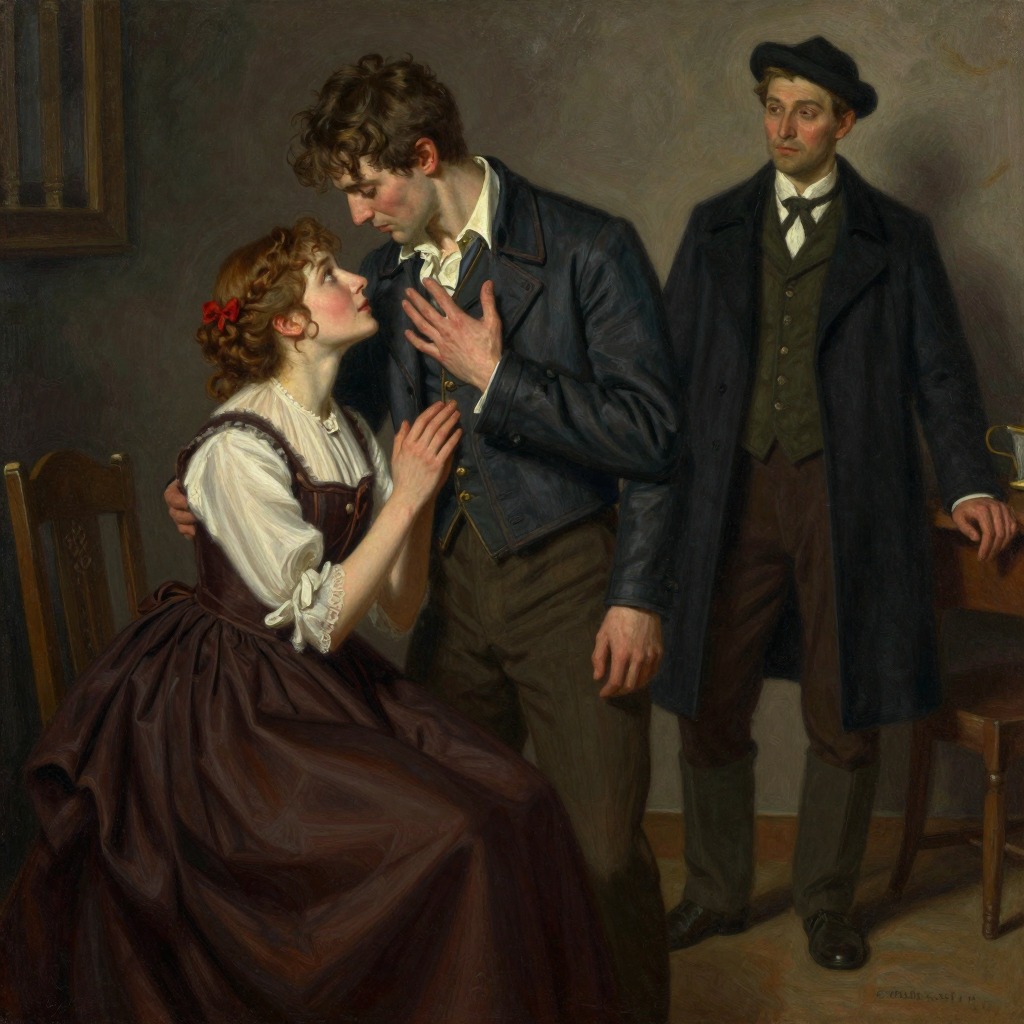
The pin is the central symbol of Grandmother's authority and its limitations. Nastenka's one attempt to deceive Grandmother—persuading the deaf charwoman Fyokla to sit in her place while she visits a friend—ends in disaster when Grandmother wakes, asks questions, and Fyokla, unable to understand, undoes the pin and runs away. The deception is discovered, and Nastenka is forced back into her place. Yet the pin also creates the very conditions for romance: when the lodger first visits, Nastenka, forgetting she is pinned, jumps up so abruptly that Grandmother's chair moves, exposing her predicament and making the lodger aware of her confinement. This moment of shame becomes the foundation of their secret understanding. The pin thus both imprisons Nastenka and, paradoxically, makes her vulnerability visible to the one person who might rescue her.
Role in the Romance and Its Limits
Grandmother is the obstacle that the romance must circumvent, but she is also, unwittingly, its enabler. The lodger's year-long absence is framed as a necessary delay because he is poor and cannot marry; Nastenka's plan to run away from Grandmother is the extreme measure she contemplates. When the lodger finally returns and fails to appear, Nastenka's despair is compounded by her inability to leave Grandmother to seek him out. In the story's resolution, Nastenka's letter to the Dreamer mentions that she is to be married to the lodger the following week, implying that Grandmother has been told and has consented—though the narrative never shows this moment. Grandmother's final function is thus to be the domestic authority whose blessing, once obtained, allows the romance to conclude, but her perspective remains entirely absent from the story's emotional climax.
Thematic Significance
Grandmother represents the oppressive, yet not malicious, structure of domestic life in mid-nineteenth-century Petersburg. Her blindness is both literal and metaphorical: she cannot see Nastenka's actions, but she also cannot see the emotional reality of her granddaughter's desires. Her rules—the pin, the moral books, the prohibition on looking at the lodger—are attempts to protect Nastenka from a world Grandmother herself experienced as dangerous, but they create the very isolation and longing that drive Nastenka into the lodger's arms. Grandmother is never a villain; she is a lonely old woman whose love takes the form of control, and whose own past—the private theatricals, the reading of novels—suggests that she was once a girl like Nastenka. Her presence haunts the story as the immovable weight of tradition, against which the brief, luminous freedom of the white nights is measured.