The Islands
White NightsThe Islands — a collective name for the archipelago of summer retreats beyond central Petersburg — function in Dostoevsky's White Nights as a geographical and emotional counterpoint to the solitary, dream-bound existence of the narrator. They represent the social world of light, movement, and belonging from which the Dreamer feels permanently excluded, and their annual summer exodus is the catalyst that drives him into the streets in a state of despondency, ultimately leading to his fateful meeting with Nastenka on the Canal Embankment.
Geography and Social Hierarchy
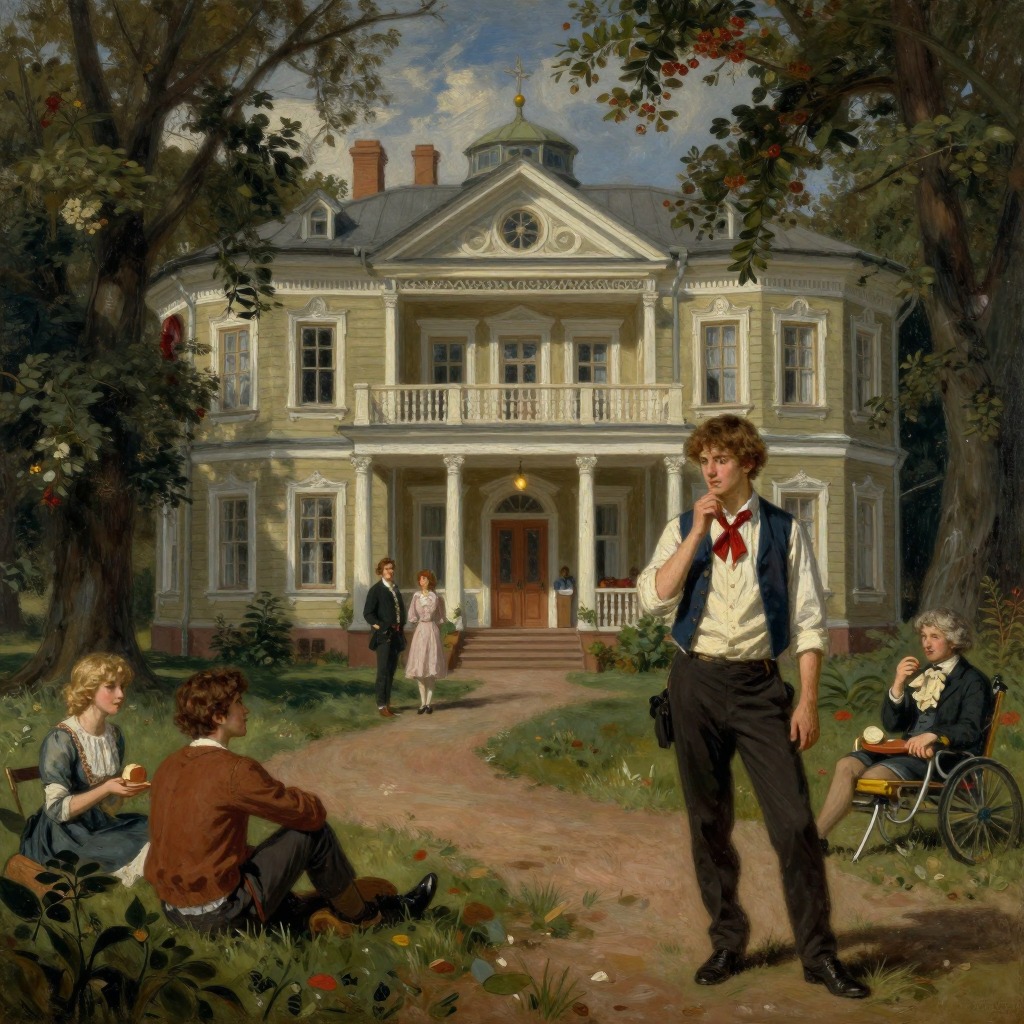
The Islands are not a single location but a constellation of distinct summer colonies, each with its own social character. The Dreamer, in his obsessive observation of the summer migration, has learned to read a person's destination from their appearance alone. Visitors to Kamenny Island and Aptekarsky Island, or those heading along the Peterhof Road, are marked by "the studied elegance of their manner, their fashionable summer suits, and the fine carriages in which they drove to town." Those bound for Pargolovo and more distant places impress "by their reasonable and dignified air," while the tripper to Krestovsky Island is recognizable "by his look of irrepressible gaiety." This finely graded taxonomy reveals that the Islands are not merely a rural escape but a stage for the display of social rank and taste, a world of visible hierarchies that the Dreamer can observe but never enter.
The Summer Exodus and the Dreamer's Isolation
The annual departure for the Islands is the event that precipitates the Dreamer's crisis of loneliness. For three days before he understands the cause of his unease, he wanders Petersburg in "profound dejection," feeling as though everyone is deserting him. The city itself seems to empty: he imagines boats heavily loaded with household goods crawling along the Neva and the Fontanka toward the Black River and the Islands, and fancies that "Petersburg threatened to become a wilderness." He is ready to go away with every waggon, to drive off with every gentleman of respectable appearance who takes a cab, "but no one — absolutely no one — invited me; it seemed they had forgotten me, as though really I were a stranger to them!" The Islands thus become the emblem of a social belonging that is denied to him, a collective happiness from which he is excluded by his own rootlessness and poverty.
The Islands as a Contrast to the Dreamer's World
The Dreamer's own life is defined by the opposite of the Islands' sociability: he lives in a remote part of town, in a room with grimy green walls and a spider's web that Matrona has "so successfully encouraged." His only companions are the houses he personifies and the old man he meets daily on the Fontanka. The Islands, by contrast, represent real life — the life of families, of carriages, of laughter and love — which the Dreamer can only observe from a distance. When he finally escapes the city walls and walks through cultivated fields and meadows, he feels "as though a burden were falling off my soul" and compares the sensation to suddenly finding himself in Italy. This momentary release, however, only underscores the depth of his usual confinement. The Islands remain a world he can glimpse but never inhabit, a summer paradise that exists for others.
The Islands in the Romance Plot
The Islands also appear in the background of Nastenka's story. Her beloved Lodger, after a year in Moscow, returns to Petersburg, and the lovers' reunion — which shatters the Dreamer's hopes — takes place on the same Canal Embankment where the Dreamer first met her. The Islands, as the destination of the summer crowd, are the world from which the Dreamer is excluded, and the romance he witnesses is the ultimate form of that exclusion. In the letter Nastenka sends the next morning, she asks for his forgiveness and promises that he will always be a friend and brother, but the Dreamer is left alone in his room, watching the rain fall and imagining his future as a continuation of the same solitude. The Islands, with their promise of joy and connection, remain forever out of reach.
Thematic Significance
The Islands thus serve as a spatial symbol of the central tension in White Nights: the gap between the Dreamer's rich inner world of fantasy and the impoverished reality of his social existence. They are the place where life is lived fully, in the company of others, under the sun — everything the Dreamer's "dingily prosaic" corner is not. Their seasonal rhythm, the annual migration that leaves Petersburg a wilderness, mirrors the cyclical nature of the Dreamer's own hopes and disappointments. In the end, the Islands stand for the happiness that belongs to others, a happiness the Dreamer can witness, describe, and bless, but never possess.