Control, perfection, and loss of control in artistic creation
Winter in SokchoControl, perfection, and loss of control in artistic creation are central to Yan Kerrand’s work and to his difficulty completing the final volume of his comic series. His drawings move between painstaking control and abrupt erasure: a line is corrected until it becomes distortion, a finished image is blacked out, and a carefully composed world threatens to continue beyond the artist’s command. The sketchbook he leaves behind carries this tension into its form, opening toward images that seem to dissolve rather than settle into a conclusive story.
Method and the demand for control
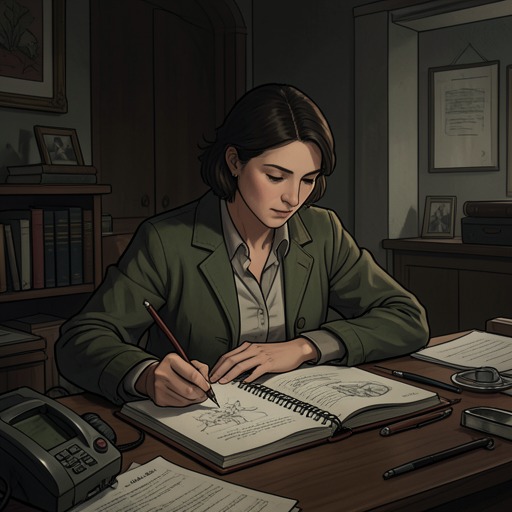
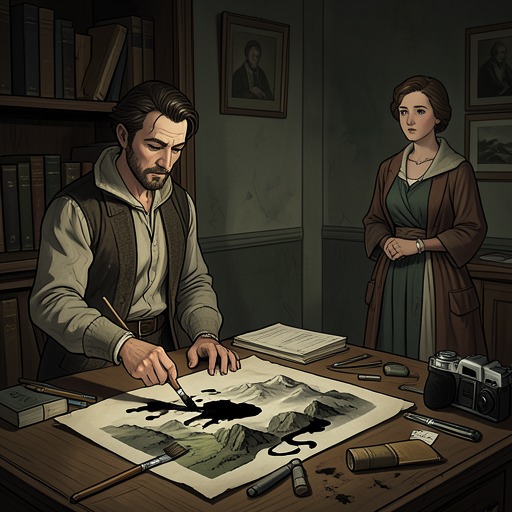
The narrator first sees Kerrand drawing through the ajar door of his room. Seated on the edge of the bed, he balances a sheet of paper on a box on his lap; his pencil hesitates, searches, and moves back and forth before the image becomes legible. What emerges is a woman with enlarged eyes and a tiny mouth. Rather than stop at this completed figure, Kerrand repeatedly reworks her features, twisting her lips and distorting her chin. He then takes up a pen and covers the drawing in ink until the woman is a misshapen black shape. Ink drips onto the floor, but he does not brush away a spider that runs up his leg. Instead, he tears a corner from the page and chews it. The sequence makes creation look at once deliberate and difficult to contain: correction does not bring the image closer to a stable ideal but carries it toward obliteration.
A later scene repeats the movement from construction to disappearance. Kerrand sketches a bare-breasted woman curled on a futon, giving sustained attention to the floor and the futon’s details before turning to the faceless body. As he draws her eyes and mouth, her expression seems to come alive on the page; then he knocks over the inkpot, and the ink runs between her lips until she vanishes. The narrator witnesses the image’s destruction but cannot establish its cause. In both scenes, the female figure appears briefly as a possible finished image, only to be altered or blotted out. The recurrence links the artist’s pursuit of a controlled, complete drawing to the instability of the act that produces it.
The account of Kerrand’s published work supplies a contrasting picture of control. The narrator finds that his best-known series follows a globe-trotting archaeologist, with a different location in each volume, rendered in monochrome ink wash with almost no words and no dialogue. The solitary hero resembles the author and can loom over the other figures as a giant, or appear in miniature with only his features distinct. Other figures are often obscured by details such as a chair, stone, or leaf. These deliberate contrasts of scale and visibility make the series’ visual order conspicuous: the hero is sharply defined while surrounding figures may remain shadow-like or concealed. The tenth and final volume is due the following year, but Kerrand has not yet found how its story should develop.
Line, light, and the unfinished image
Kerrand’s technique does not treat a drawing as a disposable preliminary to a fixed story. When the narrator asks whether he makes rough drafts, he rejects the distinction: the story evolves constantly, and each drawing matters as much as the next. That principle complicates the idea of a controlled progression from early sketch to finished page. A drawing may remain part of the work even as the story changes around it, rather than serving merely as a step toward a predetermined result.
The narrator sees this process directly when Kerrand shows drawings in pencil and ink. His recurring hero arrives in recognizable Sokcho settings, including hotels, a frontier marked by barbed wire, and a cave with Buddhas. The familiar places have been transferred into the comic’s monochrome world, where a few assured strokes can render a figure or location. Kerrand explains his refusal of color by saying that light shapes what is seen. In a panel of a snowy mountaintop beneath a high sun, only a few lines describe the rocks; most of the page remains blank. Once the narrator attends to that empty space, the snow seems to emerge from the paper itself. The frames around other panels appear to blur and distort, as if the hero were pressing against their limits, while time seems to expand. Here, restraint is not simply a means of keeping the image under control: blankness and the loosened frame allow the scene to exceed what the lines explicitly draw.
Kerrand describes completion through the moment when his character acquires a life of his own and can be let go. Yet his account of ink emphasizes the opposite impulse: once a mark is made in ink, it is fixed, so he wants it to be perfect. These statements define a tension rather than a settled method. The work needs a point at which the artist releases the character, but each irreversible mark invites further caution. When he cannot convey everything in a single stroke, he gathers up his drawing boards; the movement gives physical form to the distance between the ideal of a decisive line and the difficulty of achieving it.
The final volume and the fear of release
The pressure intensifies because this is the last book in the series. Kerrand has sketches but nothing final, and the earlier volumes, he says, followed on naturally from one another. Now he fears losing the world he has made once the book is finished, because he will no longer control it. His explanation is not that readers’ trust would solve the problem. Rather, the story keeps moving away from him and eventually seems to tell itself; even while he works on it, another story begins to form in his imagination. The unfinished work remains active as the next one beckons, making completion less like a final act of mastery than a necessary relinquishment.
His proposed solution is itself paradoxical: the hero needs a story that never ends, an all-encompassing and complete fable. The desire for a perfect, complete form meets the desire for endless continuation. If the story never ends, it cannot be finally fixed; if it is to be complete, it must reach some form of closure. That conflict gives Kerrand’s block its particular shape. He must finish the last volume, yet finishing means surrendering the very world he fears losing. The drawings’ repeated crossings-out and dissolutions echo this impasse without supplying a simple answer to it.
The sketchbook’s open ending
The sketchbook left behind offers a final sequence rather than a clear account of how Kerrand resolved the problem. Its opening image shows the hero and a heron standing together on a winter shore, with the snow-covered mountain behind them. The frames are enlarged and there are no words. The aged, one-legged, silver-feathered bird is presented as beautiful; water streams from its beak like a river flowing toward the ocean. The image retains the series’ spare visual language while making the bird, water, and landscape carry what dialogue does not say.
As the pages turn, the imagery changes. Faceless, ageless people leave faint yellow and blue traces in wet sand. They pass out of the frames as the sea spreads beyond the beach and into the sky. The place takes shape and dissolves in the same movement, its edge defined less by drawn lines than by the page itself. Snowfall meets sea spray; snowflakes either evaporate or reach the water. The pages thus loosen the boundaries that had helped organize the earlier images, turning frame and landscape into thresholds rather than stable containers.
The sequence then fades further: the bird’s eyes are closed, the pages become blue, and the hero moves passively beneath the waves. A woman’s shoulder, belly, breast, and lower back appear as an afterimage; their contours taper into a fine line, and the visible description ends with a scar on a thigh, carved with a brush. The sketchbook does not establish whether this is a completed ending, a new beginning, or an image the story cannot hold. Its shift from the series’ monochrome ink wash toward traces of color, its vanishing figures, and its movement beyond the frame make release visible without explaining it away. The final pages leave control unresolved: the drawing persists, but not as a perfectly sealed story.