Korean border observation area
Winter in SokchoThe Korean border observation area brings the peninsula’s division into view as both a regulated tourist experience and a condition that continues to shape life on the coast. For the narrator and Yan Kerrand, reaching the lookout means negotiating transport rules and military controls; arriving there offers little to see through the fog. The visit’s sharpest impressions come instead from what interrupts the sightseeing: a woman beside the road, the cold that numbs the narrator’s fingers, and the museum’s account of a war that has no peace treaty.
Location and Access
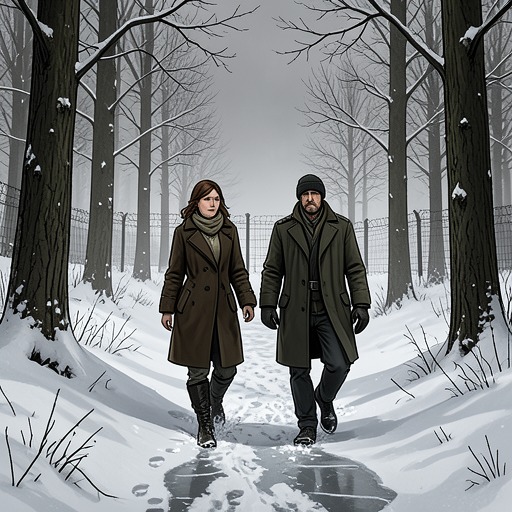
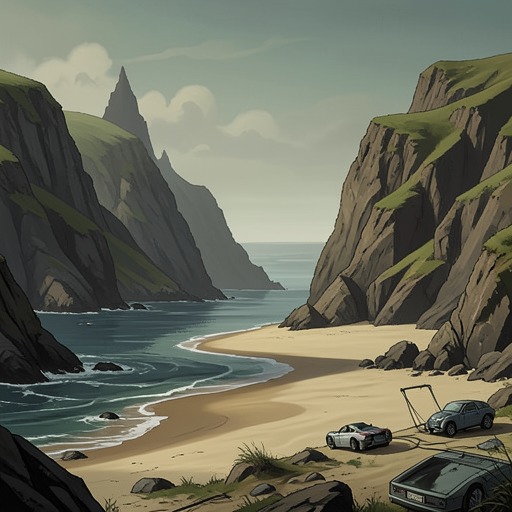
The border is a physical presence in the landscape around Sokcho before the visit begins. Walking along the town’s beach, the narrator sees electrified barbed wire running beside the shore and recalls that North Korea is barely sixty kilometres away. The coast is at once a local landscape and a boundary zone: the fencing makes division visible in an ordinary setting, while the harbor’s building works and the beach’s winter openness belong to the same scene.
The observation point is not freely accessible by ordinary public transport. When Yan Kerrand asks how to reach the border, the narrator explains that the bus can take him only as far as a vehicle checkpoint; reaching the observation point in no man’s land requires a private car. Renting one proves impossible because he lacks an international licence, and his French licence is not accepted. The narrator offers to drive him, although she dislikes driving and had not intended to take him. Once they set off, she hands him the keys, and he drives while she translates the road signs. Access depends on a chain of permissions and practical arrangements, not simply on the distance to the border.
Checkpoints and the Road Through No Man’s Land
The approach is marked by the damaged, sparsely built landscape of Gangwon Province. In late-afternoon light, the road passes skeletal village remains, cardboard boxes, plastic waste, and blue metal sheets. The narrator describes the province as having been left to rot since the war. This landscape gives the journey a history before the visitors enter the controlled zone: the border is not an isolated attraction but part of a region whose built environment bears the effects of conflict and neglect.
At the checkpoint, a young soldier makes them fill in forms while a loudspeaker repeats the rules: no photography, no filming, no leaving the marked pathway, no loud voices, and no laughing. After the narrator returns the papers, the soldier salutes and the fence opens onto no man’s land. The passage is tightly managed, with conduct specified as carefully as movement. An armed convoy escorts them at first, then turns away, leaving them alone on a road running two kilometres to the observation point. The separation between escorted access and solitude makes the visitors’ limited freedom palpable: they can proceed, but only through a prescribed route and under restrictions that remain in force even after their convoy is gone.
On the road, Yan Kerrand suddenly brakes because he thinks a woman is about to cross. Hunched beneath a pink jacket, she stands by the roadside with her hands crossed behind her back; when he signals for her to cross, she does not move. They continue carefully, and the narrator sees the woman watching them in the wing mirror until the car disappears around a bend. The encounter does not explain who the woman is or why she is there. Its unanswered stillness contrasts with the rules’ emphatic instructions, making the road feel inhabited by lives that the visitors’ official passage cannot interpret.
The Lookout and Museum
At the observation-point car park, the wind whips their coats against their legs, and the smell of cold oil drifts from a rice-cake stall. Yan Kerrand’s sketchbook protrudes from his pocket as they climb to a line of binoculars. For five hundred won, visitors can look toward North Korea. The narrator inserts a coin, but the cold is so severe that their eyelids stick to the metal frames. To the right lies the ocean, to the left a wall of mountains, and ahead, fog. The paid instrument promises a view, yet the weather withholds it; the border is available as a tourist spectacle in principle, but not as a clear image on this visit.
Back at the car park, the woman from the road is speaking with the stall’s vendor. When she sees the narrator, she comes close, talks to her, and strokes her cheek with a rough hand. The narrator pushes her away, and the woman whimpers. Yan Kerrand calmly puts an arm around the narrator’s shoulders. The unexpected encounter shifts the visit from looking at a distant border to an uncomfortable contact with someone encountered within its restricted landscape. The narrator’s reaction and the woman’s distress remain in the scene without being resolved into an explanation.
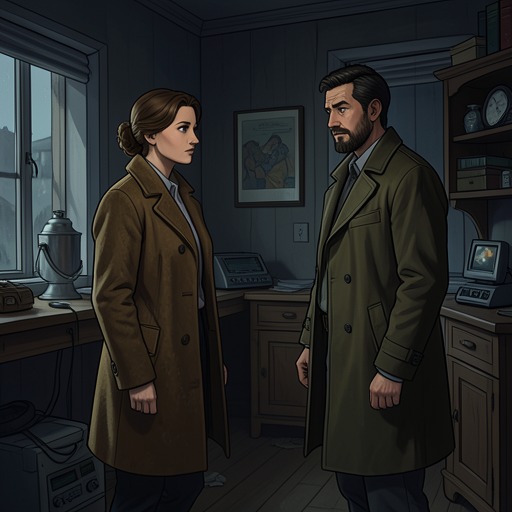
The museum offers a different kind of access, one organized around exhibits and historical narration. At its entrance, a woman speaks through a microphone from inside a sterile box and says in English that admission costs five thousand won for two people. The narrator chokes back the humiliation of not being addressed in her own language in front of Yan Kerrand. Inside, the marble floors echo beneath their shoes; the narrator finds the museum too big, too cold, and too empty, while Yan Kerrand wanders distractedly. At a display of leather helmets, he asks her to translate a sign.
The sign recounts the conflict that began in 1950, naming Soviet and Chinese support for the North and US and United Nations support for the South. It states that the Korean Armistice Agreement was signed on 27 July 1953 and that the frontier was created along the 38th parallel, within a no man’s land four kilometres wide and 238 kilometres long. It gives a death toll of two to four million, civilian and military, and notes that no peace treaty was ever signed. The museum turns the border into measurable history—dates, distances, alignments, and deaths—while the lookout had offered only fog. The figures establish the scale of the conflict, but the absent peace treaty leaves the division unresolved rather than safely confined to the past.
The narrator’s attention settles on a display of schoolchildren’s shoes from the North and Choco Pie packages in blue rather than their trademark purple. She wonders whether the sweets are real or specially made for the museum. These small objects give the exhibition a different register from its military summary: the border’s history is encountered not only as a line and a death toll, but through the ordinary things associated with children and food. The narrator’s uncertainty about the cakes also exposes how an exhibit can make familiar objects strange by placing them across a division.
A Border Still in the Present
The museum’s account and the lookout’s blocked view do not exhaust what the border means to the narrator. Her finger turns white in the cold, and ten minutes later its blood has still not returned. Yan Kerrand takes her hand in his warm one, says it is not normal for her to be so cold, and tucks it into his pocket after she says she is always cold. The physical numbness makes the cold more than atmosphere: it enters the visitors’ bodies, even as they stand at a site designed to observe a distant political division.
Later, the narrator rejects the idea that the war belongs entirely to the past. She contrasts beaches scarred by earlier wars with beaches that are still waiting for this war to end, describing a life lived in limbo and a winter that never ends. She supports that insistence with the recent death of a tourist from Seoul, shot by a North Korean soldier while swimming after unknowingly crossing the border. The incident connects the exposed coastal setting to lethal consequences: an ordinary act in the sea can become a fatal crossing when the border is misjudged.
The observation area therefore holds two experiences together. Its forms, fences, rules, binoculars, entrance fees, and museum displays make the division legible and consumable for visitors. Yet the fog frustrates the promised view, the woman’s presence resists easy interpretation, and the narrator’s account of the shooting refuses to let the conflict become a completed historical exhibit. The site is a destination for looking, but it also reveals the limits of looking: the visible boundary can be toured, while the unresolved danger and the people living within its reach remain more difficult to see.