The narrator opens the sketchbook Kerrand left behind
Winter in SokchoThe narrator’s opening of Yan Kerrand’s sketchbook turns his absence into a final encounter with his art. In the quiet of his room, the book first recalls the deliberate monochrome drawings she has already seen; as she turns its pages, however, its images loosen into a wordless, unstable landscape. What remains is less a closed story than a passage between snow, sea, memory, and the marks of a body.
The Room and the Book
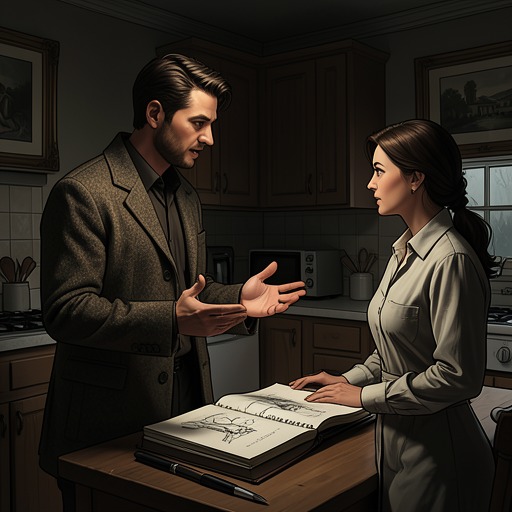
The curtains are drawn, the quilt is carefully folded, and the smell of Kerrand’s breath still lingers with incense. In the mirror, a beam of light catches dust drifting from the ceiling and settling on the desk. The room preserves small traces of someone who is no longer there, but offers no explanation for his absence. On the desk lies his frayed canvas sketchbook.
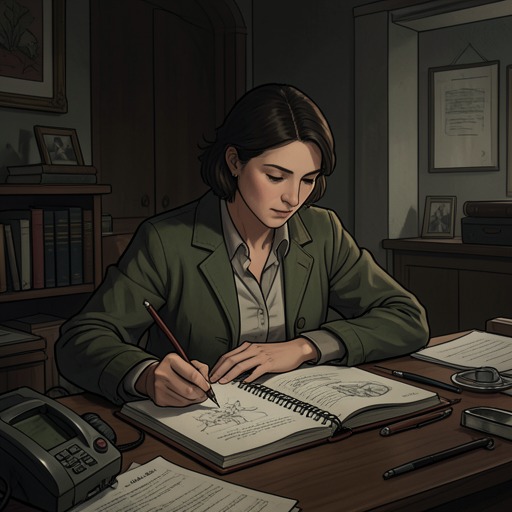
The narrator has brought a platter of fish. She sets it on the ground, walks to the window, and notices the dust on the sill. Sitting carefully on the bed so as not to wrinkle the sheets, she listens to the buzzing in her ears as the light dims and the room’s contours blur. Her attention shifts between the fish and an ink stain at the foot of the bed, which she imagines will fade in time. Only then does she pick up the sketchbook and open it. The careful sequence makes the act of looking feel suspended: the room, the food, and the stain remain present as the drawings begin to carry her elsewhere.
From Familiar Places to Open Space
The first image shows Kerrand’s hero standing with a heron on a winter shore. Snow covers the mountain behind them; the enlarged frames contain no words. The bird appears old and beautiful, with one leg and silver feathers. Water spurts from its beak, becoming a river that runs toward the ocean. The image offers a striking transformation: a small detail of the bird becomes a flow of water, connecting figure, landscape, and sea without explanatory text.
The sketchbook also recalls Kerrand’s established way of drawing. Online, the narrator had learned that his best-known series followed a globe-trotting archaeologist, with a different setting in each volume, little dialogue, and a lone hero resembling the author. In the drawings she had previously seen, he rendered recognizable places in Sokcho—the hotels, a frontier reduced to barbed wire, and a cave with Buddhas—as scenes in shades of grey. His practiced lines made the hero’s forms seem effortless. When asked about his lack of colour, he had said that light mattered more than colour; looking at a nearly blank drawing of a snowy peak, the narrator came to see the paper’s white space as the snow itself. The sketchbook’s opening image keeps that economy, but its great frames and silent figures make the landscape feel less contained.
A Landscape That Will Not Hold Still
As the narrator turns the pages, people appear walking through the scene, ageless and faceless. Faint traces of colour remain in the wet sand behind them: yellow and blue, blended unevenly, as if the hand making them were discovering its own power. The figures move one after another into the wind and slowly step beyond the frames. Meanwhile, the sea spreads past the beach and rises into the sky. The image has no internal lines to contain it; only the page edges provide a boundary.
The place seems to exist only as it is being imagined, taking shape and then dissolving. Snowfall and sea spray meet at a threshold, where snowflakes may evaporate or join the water. This shift distinguishes the final pages from the recognizable Sokcho settings in the earlier drawings: the town’s concrete landmarks give way to a setting that is neither wholly a place nor simply an abstraction. The page still frames the image, but the image appears to exceed its frame.
The Story Fades
Further turns make the story harder to grasp rather than bringing it to a clear conclusion. The bird closes its eyes; blue spreads across the paper until only azure pages remain. A man feels his way through winter on the waves and slips beneath them, leaving an afterimage: a woman’s shoulder, belly, breast, and lower back. The lines taper until one becomes a fine thread of ink on a thigh, then a long, fine scar on a fish’s scales.
The sequence does not explain who the woman is or what the images mean, and it supplies no verbal ending. Instead, it leaves the narrator with transformations—bird into river, shore into sky, figure into afterimage, and ink line into scar. The act of reading therefore ends in a kind of fading: the story slips from view even as its last marks sharpen into a bodily trace. By opening Kerrand’s sketchbook, the narrator encounters not a finished account but a fragile visual passage whose images gather meaning through what they leave unstated.