Tteokguk
Winter in SokchoTteokguk, the rice-cake soup associated with Seollal, is both a customary holiday food and a practical expression of the narrator’s care. She makes it ahead for the guest house, serves it at her family’s gathering, and later offers her cooking to Yan Kerrand. Across these scenes, the dish connects communal ritual to less secure forms of intimacy: food can be prepared and offered, but it cannot ensure that others will accept the care behind it.
Holiday Custom and Preparation
The narrator describes Seollal as a family occasion traditionally marked by Tteokguk, followed by a visit to the cemetery to place rice balls on the ancestors’ graves. Her mother expects her to attend. Rather than leave the guest house without food, the narrator arranges for Old Park to reheat a batch she has prepared in advance. The soup is intended for him and the bandaged girl, with Yan Kerrand included in the offer if he is willing to try her cooking.
That preparation gives the dish a place in two kinds of obligation. The family custom calls the narrator toward her mother and the cemetery; her work at the guest house makes her responsible for people who will remain there. Cooking in advance allows those commitments to coexist, at least practically. Tteokguk is not described through a recipe or an elaborate display. Its significance lies instead in the labor of anticipating who will eat, when the holiday will interrupt ordinary routines, and how a meal can be made available even when its cook is elsewhere.
A Meal Carried to the Guest House
When Seollal arrives, the narrator has made Tteokguk for the guest house and walks over to tell Yan Kerrand that it is a holiday and that everything will be closed. He says Old Park has already informed him, and thanks her. The exchange might have ended as a simple delivery of information, but the narrator is still hurt that Kerrand has repeatedly declined her cooking. She asks why he never tries it.
Kerrand explains that he does not like spicy food. The narrator responds that her Tteokguk is not spicy. He shrugs and says he will try it another time; she forces a smile. The detail matters because the refusal rests on a stated aversion that, in this instance, does not apply to the offered dish. Yet the correction does not immediately produce a shared meal. The future promise remains deferred, and the narrator’s restrained smile records the distance between preparing food and being received through it.
The soup’s presence at the guest house also contrasts with the more commercial food encounters around Sokcho. At a stall near the port, the narrator’s mother orders a vegetable and seafood pancake, while the narrator becomes absorbed in weighing each mouthful and then eats and drinks beyond her control. The episode makes eating an anxious bodily experience rather than uncomplicated pleasure. Tteokguk, prepared in advance for others, belongs to a different pattern: it is associated with planning and provision, even though the narrator’s own relations to food remain unsettled.
The Family Table
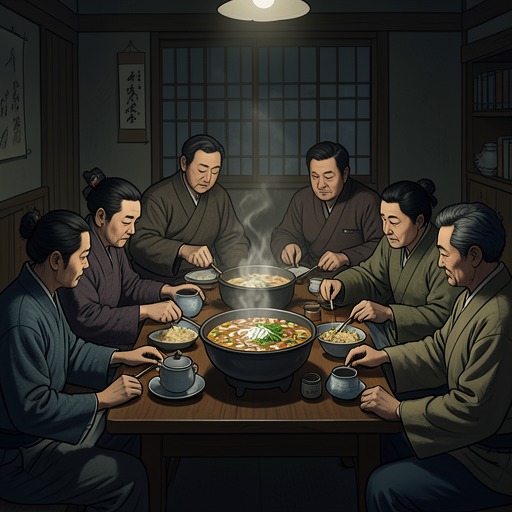
At the Seollal family gathering, Tteokguk moves from the narrator’s kitchen work to a shared table. Her mother fills the bowls and pours drinks. The narrator’s aunt calls the soup bland, while the narrator concentrates on eating it without attending to its taste. Her spoon sends ripples through the surface, distorting the reflection of her face; the act of eating becomes inseparable from how she sees her body and from the scrutiny of her relatives.
The family meal does not dissolve conflict into festive harmony. The aunt has already questioned the narrator’s sickly appearance and attributed it to the air in Sokcho. The narrator eats while the aunt judges the soup, and her mother adds soy sauce, splashing her sister’s silk clothing and provoking another complaint. The meal gathers ordinary acts of serving, seasoning, and eating alongside criticism and irritation. Tteokguk is customary and shared, but the gathering offers no simple resolution of the tensions among the women.
This scene also distinguishes the narrator’s everyday cooking from her mother’s specialized authority. During the same broader holiday preparations, the mother handles Fugu, carefully removing its poisonous organs and refusing to let her daughter handle it. The contrast is not that one dish matters more than the other, but that the mother’s expertise in a dangerous preparation is explicitly guarded, while the narrator’s Tteokguk is something she makes and carries between households. Food marks different forms of knowledge and responsibility within the family.
An Invitation Still Open
Later, in the guest house laundry room, the narrator tells Yan Kerrand that she would like him to taste her cooking. The request follows his earlier refusal and his promise to try the Tteokguk another time, linking the holiday offer to a more direct attempt at connection. Kerrand is looking toward the washing machine rather than attending to her; after a pause, he stands and says that he will, of course, try her cooking. His answer sounds like agreement, but the scene does not establish that a meal follows.
Tteokguk therefore belongs to a recurring pattern of care offered across a distance. The narrator cooks for the guest-house residents, prepares for the demands of Seollal, and seeks an opening with Kerrand through food. The dish carries the solidity of a holiday routine, yet its offers meet hesitation, distraction, or criticism. Its narrative importance rests in that tension: a meal can embody attention and make companionship possible, while leaving acceptance unresolved.