Unresolved division of Korea
Winter in SokchoUnresolved division of Korea is both a historical fact and a lived condition in the novel: the Korean War ended in an armistice, not a peace treaty, and the border remains a controlled, militarized space. Through the narrator’s journey with Yan Kerrand from the coast to the observation point and museum, that unfinished history appears at once as fencing, rules, tourist infrastructure, inherited loss, and a persistent sense of danger.
Historical Terms of the Division
At the museum, the narrator translates a display summarizing the conflict that began in 1950. North Korea had the support of the Soviet Union and China, while South Korea was supported by the United States and the United Nations. The armistice was signed on 27 July 1953, and the frontier was established along the 38th parallel. The display describes the border as the world’s most heavily militarized and places it within a no-man’s-land four kilometres wide and 238 kilometres long.
The same account gives the human scale of the conflict: between two and four million people, civilians and military personnel alike, died during the three years of war. Its most consequential qualification is that no peace treaty was ever signed. The Korean Armistice Agreement therefore marks a cessation of fighting, not a settled end to the conflict; the frontier and its restrictions remain material evidence of that distinction.
The Border in the Landscape
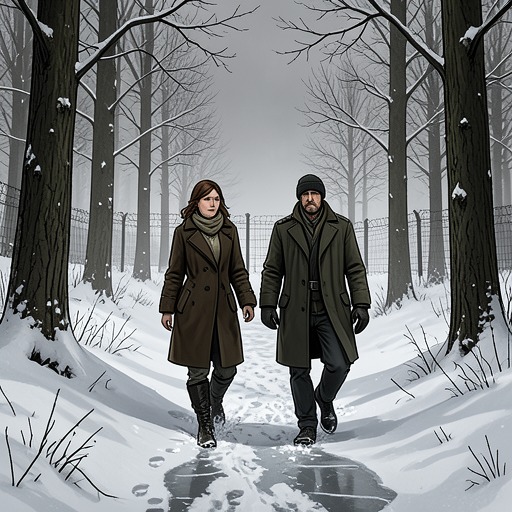
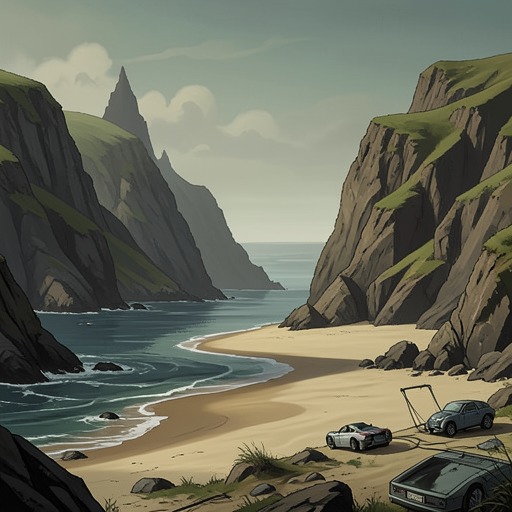
The division is visible before the narrator and Kerrand reach the official observation facilities. Walking along the beach in Sokcho, the narrator sees the coastline scarred by electrified barbed-wire fencing. The border with North Korea is less than sixty kilometres away, so the wire interrupts a familiar shore with the force of a nearby political limit. Kerrand approaches along the beach past harbour construction, a setting where the coast is at once inhabited, worked on, and guarded.
The drive inland makes the border’s controlled character more explicit. On the road through Gangwon Province, the narrator notes the skeletal remains of villages and scattered debris, describing the province as having been left to decay since the war. At the checkpoint, a young soldier requires the pair to complete forms while a loudspeaker repeats prohibitions: no photography or filming, no leaving the marked pathway, and no loud voices or laughter. The fence opens onto no-man’s-land, where an armed convoy initially escorts them. The landscape is not simply remote scenery; access to it is regulated, and even the route across it is conditional.
A woman in a pink jacket stands beside the road. Kerrand brakes, thinking she may cross, and signals for her to do so, but she remains still and watches the car pass. Later, at the observation point, the pair can pay 500 won to look toward North Korea through binoculars. The view is largely obscured by fog: ocean lies to one side, mountains to the other, and mist ahead. The paid instrument promises sight across the division, while the weather withholds it. The border is made available to visitors as a view, but neither the landscape nor the political situation resolves into a clear prospect.
Display, Tourism, and Unequal Proximity
The museum turns the conflict into an exhibit that visitors can enter for a fee. Its entrance is described as a sterile box, and inside the large, cold space Kerrand wanders before stopping at a display of leather helmets and asking the narrator to translate. The narrator, meanwhile, is drawn to schoolchildren’s shoes from the North and blue-packaged Choco Pies. Her attention settles on the ordinary objects and on the uncertainty of whether the displayed cakes are real or specially made for the museum. The contrast places intimate traces of everyday life beside an official summary of military history.
Tourism also shapes the pair’s encounter with the border. At the museum entrance, the narrator is addressed in English rather than in her own language, an interaction that humiliates her in front of Kerrand. She later observes that tourists are the only people who come to the area. The facilities make the frontier visitable, but the narrator’s experience is not reducible to a visitor’s itinerary: she translates the history, follows the rules, and brings a local and bodily awareness of what the border means. The display and the binoculars offer forms of access, yet they do not erase the difference between looking at the division and living near it.
A War Experienced as Present
The narrator challenges Kerrand’s suggestion that war belongs to the past. She distinguishes a historical scar from beaches still waiting for a war to end, describing local life as precarious and suspended beneath hotels and neon signs. Her language links the visible modernity of the coast to an unresolved danger that its tourist surface cannot make unreal. The recurring image of winter gives that suspension a duration: the conflict is not presented as an episode safely contained in the past, but as a condition with no settled conclusion.
To explain why the danger feels immediate, the narrator recounts that the previous summer a tourist from Seoul was shot by a North Korean soldier while swimming in the sea, after unknowingly crossing the border. Kerrand apologizes, and the narrator looks down. The reported shooting gives the coastline’s fencing and the checkpoint’s prohibitions a direct human consequence: a boundary that may be obscure to someone in the water can still determine life and death. Through the journey, museum visit, and account of the shooting, Unresolved division of Korea becomes the structure joining historical memory to present-day movement, vision, and vulnerability.