Winter
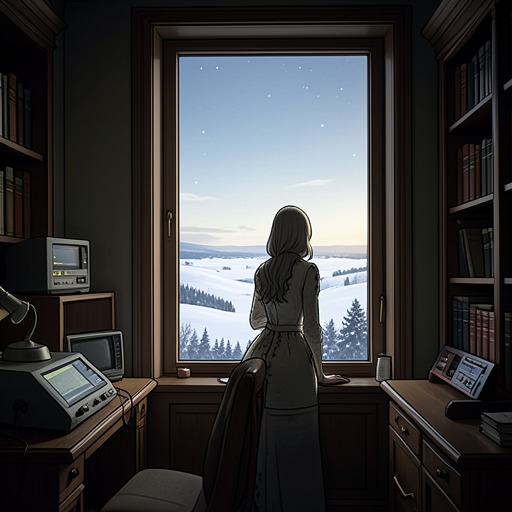
Winter in SokchoWinter is both the lived season of the story in Sokcho and its central image of suspension. It narrows daily life through cold, quiet, and breakdown: the guesthouse’s pipes freeze, waves seem to labor against ice, and the town offers little to do. Yet winter also gives the narrator a language for a history that remains unsettled. In Yan Kerrand’s final drawings, the snowy mountain, shore, and sea form a threshold where boundaries blur rather than disappear.
Seasonal Setting
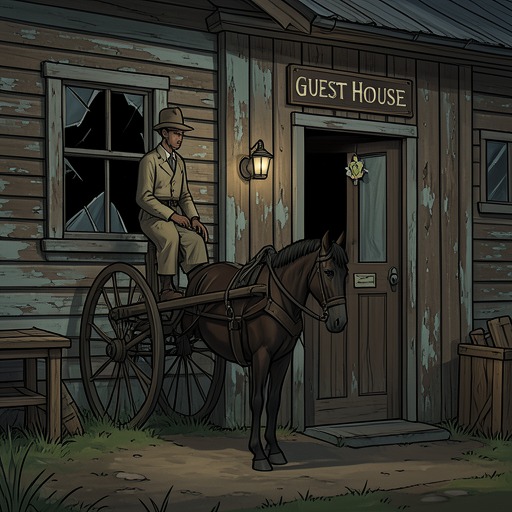
Winter establishes the conditions under which the guesthouse and its surroundings are encountered. Old Park’s Guest House occupies two buildings: a main structure with reception, kitchen, lounge, and rooms along orange and green corridors, and a traditional house on stilts behind it, reached by a long alley. The second building’s heated floors and paper dividing walls offer a different kind of shelter, but its courtyard fountain is frozen beneath a bare chestnut tree. The contrast between indoor accommodation and the exposed, frozen courtyard makes cold part of the place’s architecture, not merely weather outside it.
The season also defines Sokcho as a seaside resort temporarily emptied of much of its usual purpose. The narrator tells a newly arrived guest that there is not much to do in winter, and the quiet is reflected in the guesthouse’s sparse business. Its visitors include a Japanese climber and a young woman recovering from facial plastic surgery, joined for a short stay by her boyfriend. The upstairs rooms have been closed, and the remaining occupants fill the available rooms, while the French visitor is lodged in the separate building. Winter therefore means both vacancy and limited, temporary refuge: people arrive in a town with little activity, some of them seeking a place to wait.
Cold as Material Pressure
The season becomes physically severe when the temperature falls to minus twenty-seven degrees, the first such cold in years. The narrator curls beneath the covers, blows on her hands, and rubs them between her thighs; even bundled in her overcoat, she struggles to sleep. Outside, the waves move more slowly and heavily under the ice, then crack as they collapse on the shoreline. The description makes the cold felt through bodily effort and the altered motion of the sea, rather than treating it as a distant view.
By morning, the cold has entered the guesthouse’s systems. The radiators in the narrator’s room and in the room previously occupied by the Japanese guest no longer work because the water in the pipes has frozen. Old Park offers a portable heater from reception while waiting for repairs, but the proposed alternative, an old stove, has already proved useless. Blocked sewage pipes make the narrator’s room impossible to breathe in, and she asks to move into the room next to Kerrand’s. The failures accumulate: heating, plumbing, and the old building’s ability to provide basic comfort all falter together. Winter thus intensifies the guesthouse’s existing decline into an immediate problem of where the narrator can sleep.
A Season of Suspension
The narrator gives winter a historical and political meaning while speaking with Kerrand. She distinguishes France’s past wars from the unresolved conflict on the Korean peninsula: hotels and neon signs may suggest ordinary tourism, she explains, but beneath that surface the country remains on a knife-edge, as though the apparent stability could give way. She describes life there as limbo and invokes a winter that never ends. The image does not equate cold weather with war; it expresses the persistence of a conflict whose ending remains absent from daily life.
A remembered incident makes that suspended danger concrete. The narrator recalls that the previous summer a tourist from Seoul was shot by a North Korean soldier while swimming in the sea, having failed to realize that she had crossed the border. The violence belongs to summer, not winter, but its presence in this conversation unsettles any simple division between a safe present and a finished past. Winter’s meaning expands from a season of cold and quiet into a condition in which the end of danger cannot be assumed. The narrator’s account gives Kerrand a perspective on the peninsula distinct from his own experience of past wars, leaving the two histories in conversation without making them interchangeable.
Snow and the Unfinished Image
Winter returns at the end through the sketchbook Kerrand leaves behind. In one large, wordless sequence, his hero stands with a heron on a winter shore, gazing toward the sea. A mountain covered by its snow carapace watches over them. The heron is old, one-legged, and silver-feathered; water spurts from its beak like a river flowing toward the ocean. Instead of providing a written explanation, the drawing enlarges the figures and landscape, asking the reader to encounter winter as an image and a relation between land and water.
The pages that follow loosen the scene further. Faceless, ageless people walk through the pictures, leaving faint traces of yellow and blue in wet sand. The sea spreads beyond the beach and into the sky, while snow joins the spray; snowflakes either evaporate or meet the water. The place takes shape and dissolves, held between the edges of the page. These images do not depict winter giving way to spring or promise a clear resolution. They return to the book’s recurring condition of waiting: a threshold where forms and borders remain perceptible but unstable. The season’s decisive significance lies in that doubleness. It is a concrete hardship endured in Sokcho and a form for the unresolved time in which the story’s people and histories remain suspended.