Yan Kerrand’s creative block
Winter in SokchoYan Kerrand’s creative block is the struggle to finish the last book in his comic series without losing his sense of control over the world he has created. It emerges not as an inability to begin, but as a more unsettling problem: the story keeps developing beyond his intention, while he remains responsible for bringing it to a conclusion. His difficulty links artistic control to the fear of completion, and becomes visible in both his unfinished sketches and the ink that spills across a drawing when the narrator tells him that his hero has nowhere to find the woman he seeks.
Identity and Introduction
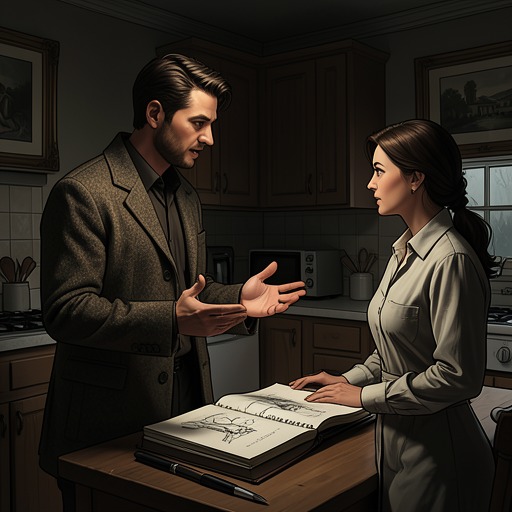
Kerrand is a comic-book creator with work available online and a forthcoming book whose release his publisher has announced. The narrator has searched for his work online and tells him she is interested in comics, though she does not read them often. Her question about whether he is stuck for inspiration prompts a wry laugh, but his response distinguishes the visible symptom from the larger difficulty: inspiration accounts for only a small part of what is wrong. The exchange establishes that his block is not readily explained as an empty imagination. The problem lies in how to shape, control, and finish a story that already exists in some form.
The Final Book and the Fear of Completion
Kerrand has sketches, but none is final. He explains that the earlier books in the series followed naturally from one another; the last book does not offer him the same clear continuation. Its position at the end of the series makes the creative problem structural as well as practical: he must decide how the story should develop while also making this the point at which it ends.
That ending threatens something beyond the completion of a manuscript. Kerrand fears losing the world of the story because, once the book is finished, he will no longer have control over it. When the narrator asks whether he trusts his readers, he rejects that as the point. His concern is not reduced to confidence in an audience or a wish to dictate what readers think. He is attached to the world while it is still in the process of being made, and completion means surrendering his immediate hold on it.
A Story That Moves Beyond Its Maker
Kerrand describes the creative process as a repeated separation between maker and work. The story moves away from him and eventually seems to tell itself. He begins imagining another story before the present one is finished, yet the unfinished work continues to draw itself in parallel. He does not know how that process works, but feels he has to complete the book before he can properly turn to the next one. Then, when he does start something new, the cycle begins again.
This account makes the block more complicated than simple delay. Kerrand is neither wholly directing the story nor free of it: he experiences it as autonomous, but remains bound to the task of finishing it. His fear of losing control coexists with an admission that control is already incomplete. The work continues to develop beyond his conscious design, while his responsibility to complete it persists. His worry that he may never convey what he really wants to say adds another pressure: even finishing the story may not guarantee that his intention will reach the page as intended.
Work at the Guest House
The strain is also present in the physical circumstances of Kerrand’s work. On the fourth evening, the narrator knocks at his door after hearing him work through the night. Before he answers, she hears him replace the lid on an ink bottle. He is barefoot, his eyes ringed with fatigue, and his shirt is wrinkled beneath his sweater. Boards and sketches are piled on his desk beside a bowl of instant noodles. The scene offers no sign of a polished, settled project; it shows work continuing amid unfinished material and exhaustion.
The narrator tries to explain that the boy she had encountered earlier was not what Kerrand might have thought. He seems at first unable to recall the incident, then looks taken aback. When she asks if he needs anything, he declines and says he has to get on with his work. Their brief exchange does not resolve his difficulty, and his attention returns to the task that has kept him occupied.
The Hero, the Woman, and the Spilled Ink
As she leaves, the narrator opens the door again and tells Kerrand that his hero will not find the woman there, because there is nothing there for him if he is anything like Kerrand. The remark gives the creative problem a pointed dramatic form: it addresses the relationship between the creator and his hero, while challenging the possibility that the hero’s search can succeed in the world available to him. The scene does not establish what the woman means to Kerrand or how he will develop the story, leaving the content of the unfinished book unresolved.
Kerrand is about to make a brushstroke when he stops. Ink swells at the brush tip; the narrator thinks she sees pain cross his face, and then the drop splashes onto the paper, flooding part of the landscape. The gesture turns the tension between intention and loss of control into a concrete image. A deliberate stroke is interrupted, and ink spreads beyond the point where it was meant to go. The scene does not show whether this accident becomes part of the drawing or changes the story, but it leaves his block suspended between interruption and creation: the page has been altered, while the final book remains unfinished.