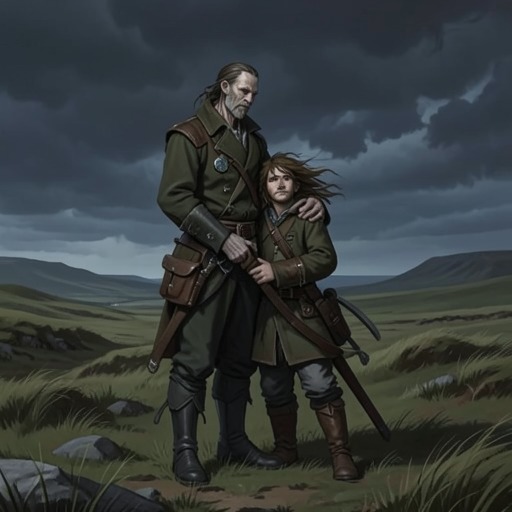
Catherine Earnshaw and Heathcliff's relationship
Wuthering HeightsThe relationship between Catherine Earnshaw and Heathcliff is the emotional and thematic core of Emily Brontë's novel, a bond of such absolute identification that Catherine declares 'I am Heathcliff.' Their connection, forged in childhood and severed by Catherine's marriage to Edgar Linton, drives the novel's central tragedy, shaping Heathcliff's revenge, the haunting of Wuthering Heights, and the fates of the next generation.
Origins and Childhood Bond
Heathcliff's first introduction to the family came when Mr. Earnshaw brought him home from Liverpool, a 'sullen, patient child' who was christened with the name of a son who had died in childhood. From the very beginning, he bred bad feeling in the house. Miss Cathy and he were now 'very thick,' but Hindley hated him, and Ellen Dean confessed she did the same, plaguing and going on with him shamefully. The mistress never put in a word on his behalf when she saw him wronged. This early persecution forged an intense alliance between Catherine and Heathcliff, two children united against a hostile household. The depth of their childhood connection is inscribed in the very fabric of Wuthering Heights: on the ledge of the oak-panelled bed where Mr. Lockwood later sleeps, Catherine's name is scratched in all kinds of characters, large and small—'Catherine Earnshaw,' varied to 'Catherine Heathcliff,' and then again to 'Catherine Linton.' This inscription, a kind of diary of her identity, reveals that even as a child she was already imagining herself bound to Heathcliff by name.
The Declaration of Unity
Catherine's most explicit articulation of her bond with Heathcliff comes in her confession to Ellen Dean, when she is contemplating Edgar Linton's marriage proposal. She explains that her love for Edgar is 'like the foliage in the woods: time will change it,' but her love for Heathcliff 'resembles the eternal rocks beneath: a source of little visible delight, but necessary.' She then makes her famous declaration: 'Nelly, I am Heathcliff! He's always, always in my mind: not as a pleasure, any more than I am always a pleasure to myself, but as my own being.' This is not merely a statement of love but of ontological fusion; Catherine cannot conceive of her existence as separate from his. She elaborates that if all else perished and he remained, she should still continue to be, but if all else remained and he were annihilated, the universe would turn to a mighty stranger. This speech establishes the metaphysical nature of their connection, one that transcends the social and romantic conventions that ultimately tear them apart.
The Fracture and Its Consequences
Despite this declaration, Catherine chooses to marry Edgar Linton, a decision that fractures her bond with Heathcliff and sets the tragedy in motion. When Heathcliff returns after his mysterious three-year disappearance, he finds Catherine married and installed at Thrushcross Grange. Their final meeting is a scene of mutual torment. Catherine, her mind already unhinged by brain fever, accuses him: 'You have killed me—and thriven on it, I think.' She seizes his hair and keeps him down, bitterly wishing she could hold him 'till we were both dead!' She tortures him with the prospect of his future happiness, asking if he will say twenty years hence that he loved her long ago but that it is past. Heathcliff, wrenching his head free and grinding his teeth, cries out, 'Don't torture me till I'm as mad as yourself.' The scene is a strange and fearful picture: Catherine's white cheek has a wild vindictiveness, and she retains in her closed fingers a portion of the locks she had been grasping, while Heathcliff's inadequate gentleness leaves four distinct blue impressions on her colorless skin. This encounter reveals the destructive intensity of their love, which has become a source of mutual agony rather than comfort.
Death and Haunting
Catherine's death does not end the relationship; it transforms it into a haunting. When Ellen Dean tells Heathcliff that Catherine's senses never returned and that she lies with a sweet smile on her face, he erupts in a paroxysm of ungovernable passion. He cries out, 'May she wake in torment! Why, she's a liar to the end!' and prays a single prayer: 'Catherine Earnshaw, may you not rest as long as I am living; you said I killed you—haunt me, then!' He begs her to be with him always, to take any form, to drive him mad, only not to leave him in the abyss where he cannot find her. He dashes his head against a knotted trunk and howls like a savage beast. This curse becomes the engine of the novel's supernatural elements. Heathcliff's obsession with Catherine's ghost is later witnessed by Mr. Lockwood, who, after his nightmare encounter with the child-ghost at the window, sees Heathcliff wrench open the lattice and sob, 'Come in! come in! Cathy, do come. Oh, do—once more! Oh! my heart's darling! hear me this time, Catherine, at last!' The spectre gives no sign of being, but the snow and wind whirl wildly through, blowing out the light. This scene confirms that Catherine's haunting of Heathcliff is not merely a psychological projection but a presence that others can sense, and it reveals the depth of Heathcliff's grief and his desperate, unending desire for reunion.
Legacy and the Next Generation
The relationship's legacy extends to the next generation, shaping the lives of Catherine's daughter and Heathcliff's son. Heathcliff's plan to unite the two cousins, Catherine Linton and Linton Heathcliff, is explicitly designed to secure the property of Thrushcross Grange for himself. He tells Ellen Dean that his design is 'as honest as possible,' that the two cousins may fall in love and get married, and that Catherine will be provided for as joint successor with Linton. This scheme, born of his desire for revenge against the Lintons, is a direct consequence of his broken relationship with Catherine. The forced marriage of Catherine Linton to the sickly Linton Heathcliff is a cruel parody of the union Catherine Earnshaw might have had with Heathcliff. Yet the relationship also leaves a more hopeful trace. Catherine's daughter, Catherine Linton, eventually finds a kind of redemption with Hareton Earnshaw, and Ellen Dean observes that their eyes are 'precisely similar' to those of Catherine Earnshaw. This resemblance, which disarms Heathcliff when he sees them together, suggests that the spirit of the original Catherine lives on, not in the destructive passion of her relationship with Heathcliff, but in the possibility of a gentler, more healing love. The union of Catherine Linton and Hareton Earnshaw, which Ellen Dean calls 'the crown of all my wishes,' represents a reconciliation of the Earnshaw and Linton lines that the first generation's tragedy made impossible.
The End of the Bond
Heathcliff's death marks the final, ambiguous resolution of his bond with Catherine. He dies in the oak-panelled bed, his eyes open and 'keen and fierce,' seeming to sneer at Ellen Dean's attempts to close them. Joseph declares, 'Th' divil's harried off his soul,' and returns thanks that the lawful master and the ancient stock are restored to their rights. Heathcliff's death is not a peaceful release but a final, mysterious consummation of his obsession. Ellen Dean conceals the fact that he swallowed nothing for four days, persuaded that he did not abstain on purpose but that it was the consequence of his strange illness. The novel's ending, with the headstones in Gimmerton kirkyard, suggests that Catherine and Heathcliff are finally united in death, their tumultuous relationship finding its only possible peace in the earth. The relationship between Catherine Earnshaw and Heathcliff thus remains the novel's central enigma: a love so absolute it destroys everything it touches, yet so powerful it transcends even death itself.