Catherine Heathcliff's widowhood
Wuthering HeightsCatherine Heathcliff's widowhood is the legal and emotional condition imposed on Catherine Linton (younger) after the death of her husband, Linton Heathcliff, leaving her a destitute, captive young widow at Wuthering Heights, stripped of her inheritance and personal property by her father-in-law, Heathcliff, and reduced to a state of dependence that paradoxically becomes the precondition for her eventual reconciliation with Hareton Earnshaw and her reclamation of a life beyond Heathcliff's tyranny. The state is defined less by grief than by dispossession: within days of her father's death, the girl who had been the cherished daughter of Thrushcross Grange finds herself a prisoner in the grim farmhouse, her fortune seized, her will overborne, and her very name rewritten as Mrs. Heathcliff. Yet it is precisely from this nadir of legal and personal annihilation that the novel's second-generation redemption begins to take shape, as the widow's enforced proximity to Hareton Earnshaw transforms mutual antipathy into the affection that will ultimately restore both of them to the human community Heathcliff sought to destroy.
The Legal Machinery of Widowhood
The widowhood of Catherine Linton (younger) is engineered through the very legal instruments that were meant to protect her. Her father, Edgar Linton, had divined that one of Heathcliff's purposes was to secure the personal property, as well as the estate, to his son Linton Heathcliff, or rather to himself; yet he remained ignorant of how nearly he and his nephew would quit the world together. In response, Edgar determined to alter his will, resolving to put Catherine's fortune in the hands of trustees for her use during life, and for her children, if she had any, after her, so that it could not fall to Heathcliff should Linton die. This precaution proved futile. The lawyer Mr. Green, who had been summoned to execute Edgar's revised intentions, had already sold himself to Heathcliff, and his delay in obeying the summons allowed the scheme to unfold unchecked. After Edgar's death, Mr. Green took upon himself to order everything and everybody about the place, giving all the servants but Ellen Dean notice to quit, and even attempting to insist that Edgar Linton should not be buried beside his wife, but in the chapel with his family, a violation prevented only by the existing will and Ellen's loud protestations. The funeral was hurried over, and Catherine, now Mrs. Linton Heathcliff, was suffered to stay at the Grange only until her father's corpse had quitted it.
The full extent of her dispossession is revealed when Heathcliff goes up to her once, to show her Linton's will. Linton Heathcliff had bequeathed the whole of his, and what had been her, moveable property to his father, having been threatened or coaxed into that act during her week's absence, when his uncle died. The lands, being a minor's, Linton could not meddle with; however, Heathcliff has claimed and kept them in his wife's right and his also, supposedly legally. Catherine, destitute of cash and friends, cannot disturb his possession. The widowhood thus strips her of every material resource: her father's fortune is diverted into trusteeship that proves hollow, her husband's will is coerced into surrendering her moveables, and the land itself passes under Heathcliff's control through the double claim of his son's right and his own. She is left with nothing but her person, and even that is held captive.
Captivity and Isolation at Wuthering Heights
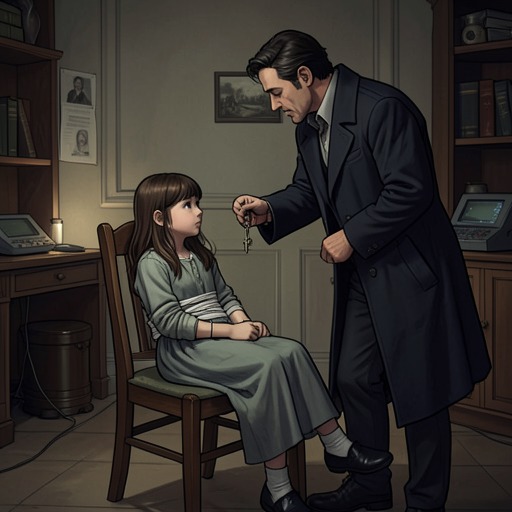
In the immediate aftermath of her father's death, Catherine's widowhood is indistinguishable from imprisonment. She stays upstairs a fortnight, according to Zillah, who visits her twice a day and would have been rather more friendly, but her attempts at increasing kindness are proudly and promptly repelled. Heathcliff sends word that she must come down to breakfast, but she undresses, appears going to sleep, and says she is ill, a claim at which Ellen hardly wonders. Heathcliff's response is coldly practical: "Well, let her be till after the funeral; and go up now and then to get her what is needful; and, as soon as she seems better, tell me." Nobody ever approaches her door, except that once, but Zillah; and nobody asks anything about her. The first occasion of her coming down into the house is on a Sunday afternoon, when she cries out that she cannot bear any longer being in the cold, and Zillah tells her the master is going to Thrushcross Grange, and that Earnshaw and she needn't hinder her from descending. As soon as she hears Heathcliff's horse trot off, she makes her appearance, donned in black, her yellow curls combed back behind her ears as plain as a Quaker, for she couldn't comb them out. The image is striking: the once-vivacious girl, reduced to a plain, black-clad figure, her beauty subdued by grief and captivity, emerging only when her jailer is safely away.
This isolation is the deliberate product of Heathcliff's design. He had earlier imprisoned her at Wuthering Heights to force her marriage to his dying son, and the widowhood extends that captivity into a permanent condition. The girl who had been a perfect recluse at Thrushcross Grange, never once beyond the range of the park by herself until she reached thirteen, is now a recluse of a different kind, confined not by her father's protective solicitude but by her father-in-law's malevolent possession. Her high spirit, which Ellen Dean had described as "high, though not rough, and qualified by a heart sensitive and lively to excess in its affections," is now subjected to the daily reality of a household where she is at once the mistress by name and a prisoner in fact. The widowhood thus represents the culmination of Heathcliff's revenge against the Linton line: he has not only taken the Grange's wealth and the girl's freedom, but has reduced the daughter of his rival to a state of dependence on his charity, a dependence he withholds as a form of torture.
The Emergence of Hareton Earnshaw
Within this bleak condition, the figure of Hareton Earnshaw begins to emerge as an unexpected counterforce. Hareton, who should now be the first gentleman in the neighbourhood, had been reduced to a state of complete dependence on his father's inveterate enemy, living in his own house as a servant, deprived of the advantage of wages, quite unable to right himself because of his friendlessness and his ignorance that he has been wronged. Heathcliff had bent his malevolence on making him a brute: Hareton was never taught to read or write, never rebuked for any bad habit which did not annoy his keeper, never led a single step towards virtue, or guarded by a single precept against vice. Yet Ellen Dean could detect in his physiognomy a mind owning better qualities than his father ever possessed, good things lost amid a wilderness of weeds, evidence of a wealthy soil that might yield luxuriant crops under other and favourable circumstances. The widow and the degraded heir are thus paired by their common subjection to Heathcliff, though at first they regard each other with mutual antipathy.
Their relationship develops through a series of small, telling encounters. When Catherine first meets Hareton, she mistakes him for a servant, and he recovers from his disgust at being taken for one, seeming moved by her distress, fetching a fine crooked-legged terrier whelp from the kennel and putting it into her hand, bidding her whist, for he meant nought. She surveys him with a glance of awe and horror, then bursts forth anew, unable to accept this rough cousin as kin. The antipathy is mutual and persistent, yet the enforced intimacy of the widow's captivity gradually erodes it. Hareton, with all his bashfulness, is not a model of nice behaviour, but when Zillah lets him know that his cousin would very likely sit with them, and that she had been always used to see the Sabbath respected, he colours up at the news, casts his eyes over his hands and clothes, and shoves the train-oil and gunpowder out of sight in a minute, meaning to give her his company and wanting to be presentable. The widow's presence begins to civilize him, even as his rough kindness begins to thaw her pride.
The Turn Toward Reconciliation
The widowhood, which seemed designed to crush Catherine, becomes instead the crucible of her redemption. The intimacy thus commenced grows rapidly, though it encounters temporary interruptions. Hareton Earnshaw is not to be civilized with a wish, and Catherine is no philosopher and no paragon of patience; but both their minds tending to the same point, one loving and desiring to esteem, and the other loving and desiring to be esteemed, they contrive in the end to reach it. Ellen Dean, watching them, reflects that it was easy enough to win Mrs. Heathcliff's heart, and declares that the crown of all her wishes will be the union of those two, envying no one on their wedding day, for there won't be a happier woman than herself in England. The widow's heart, so recently broken by her father's death and her husband's cruelty, proves capable of new attachment, and the object of that attachment is the very man Heathcliff had sought to degrade into a brute.
A crucial test of this emerging bond comes when Catherine offers to reveal to Hareton the details of her father-in-law's conduct toward his father. Hareton sternly checks her, saying he wouldn't suffer a word to be uttered in his disparagement: if Heathcliff were the devil, it didn't signify; he would stand by him; and he'd rather she would abuse himself, as she used to, than begin on Mr. Heathcliff. When Catherine waxes cross at this, he finds means to make her hold her tongue by asking how she would like him to speak ill of her father. She then comprehends that Hareton takes the master's reputation home to himself, and is attached by ties stronger than reason could break, chains forged by habit which it would be cruel to attempt to loosen. She shows a good heart thenceforth, avoiding both complaints and expressions of antipathy concerning Heathcliff, and confesses to Ellen her sorrow that she had endeavoured to raise a bad spirit between him and Hareton. The widow thus learns, through Hareton's stubborn loyalty, a lesson in forbearance that her own suffering had not taught her.
The Widow's Transformation and Its Significance
As the widowhood continues, Catherine's role shifts from captive to teacher. When the slight disagreement with Hareton is over, they are friends again, as busy as possible in their several occupations of pupil and teacher. Ellen comes in to sit with them after her work, feeling so soothed and comforted to watch them that she does not notice how time gets on. They both appear in a measure her children: she had long been proud of one, and now she is sure the other would be a source of equal satisfaction. Hareton's honest, warm, and intelligent nature shakes off rapidly the clouds of ignorance and degradation in which it had been bred, and Catherine's sincere commendations act as a spur to his industry. His brightening mind brightens his features, adding spirit and nobility to their aspect, so that Ellen can hardly fancy it the same individual she had beheld on the day she discovered her little lady at Wuthering Heights after her expedition to the Crags. The widow, who had been stripped of everything, discovers in herself the power to give: her teaching, her esteem, her affection become the instruments of Hareton's restoration.
The significance of this transformation is underscored by a remarkable scene. When Heathcliff returns unexpectedly and enters by the front way, he has a full view of the whole three, ere they can raise their heads to glance at him. The red fire-light glows on their two bonny heads, revealing their faces animated with the eager interest of children; for, though Hareton is twenty-three and Catherine eighteen, each has so much of novelty to feel and learn that neither experiences nor evinces the sentiments of sober disenchanted maturity. They lift their eyes together to encounter Heathcliff, and Ellen notes that their eyes are precisely similar, and they are those of Catherine Earnshaw. The present Catherine has no other likeness to her, except a breadth of forehead and a certain arch of the nostril that makes her appear rather haughty, whether she will or not. With Hareton the resemblance is carried farther: it is singular at all times, then it was particularly striking, because his senses were alert and his mental faculties wakened to unwonted activity. This resemblance disarms Heathcliff: he walks to the hearth in evident agitation, but it quickly subsides as he looks at the young man, or rather alters its character, for it was there yet. He takes the book from Hareton's hand, glances at the open page, then returns it without any observation. The widow's teaching has not only redeemed Hareton but has confronted Heathcliff with the living image of the woman he loved and lost, a confrontation that hastens his own dissolution.
Catherine Heathcliff's widowhood thus ends not in permanent desolation but in the promise of a new life. The state that began as the ultimate act of Heathcliff's revenge becomes the ground of the novel's reconciliation, as the widow and the degraded heir, both victims of the same tyranny, find in each other the affection and esteem that Heathcliff himself could never attain. Ellen Dean's hope for their union, her certainty that she shall envy no one on their wedding day, points toward a future in which the name Heathcliff, with all its associations of cruelty and usurpation, will be superseded by the restored name of Earnshaw. The widowhood, in the end, is not the final word on Catherine's life but the dark passage through which she must travel to reach the light, a testament to the novel's conviction that even the most complete dispossession cannot extinguish the capacity for love and renewal.