Catherine and Hareton's Reconciliation
Wuthering HeightsCatherine and Hareton's Reconciliation marks the novel's decisive turn from the destructive passions of the first generation toward a hopeful, healing future. After years of mutual suspicion, contempt, and outright hostility, the young Catherine Linton (younger) and Hareton Earnshaw forge a bond that not only rescues Hareton from the brutal degradation imposed by Heathcliff but also lifts Catherine from her own bitter captivity. Their growing intimacy, culminating in a promise of marriage on New Year's Day, stands as the novel's great counter-movement to the revenge and ruin that preceded it, offering the only genuine prospect of peace for the tormented houses of Wuthering Heights and Thrushcross Grange.
Origins of the Antipathy
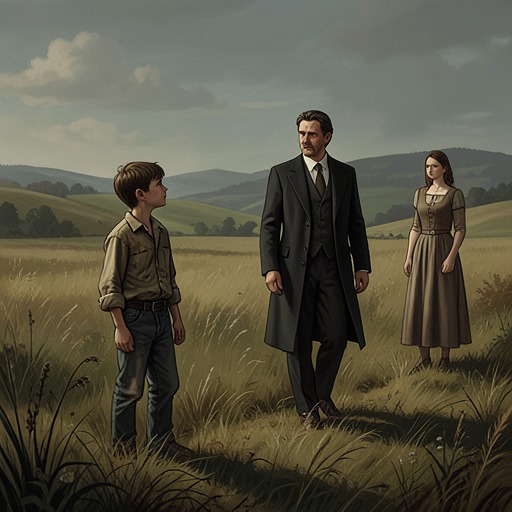
The seeds of the conflict between Catherine and Hareton were sown long before they ever met as adults. Hareton, the son of Hindley Earnshaw, had been reduced to a state of complete dependence on his father's inveterate enemy, Heathcliff, who proved that Earnshaw had mortgaged every yard of his land to feed a mania for gaming. As the mortgagee, Heathcliff took firm possession of Wuthering Heights, and Hareton, who should have been the first gentleman in the neighbourhood, was left to live in his own house as a servant, deprived of wages and ignorant that he had been wronged. Heathcliff's malevolence was bent on making Hareton a brute: the boy was never taught to read or write, never rebuked for any bad habit that did not annoy his keeper, and never led a single step towards virtue. Joseph contributed to this deterioration with a narrow-minded partiality, flattering and petting the boy as the head of the old family while laying the burden of his faults on the usurper. The result was a well-made, athletic youth, good-looking and stout, but attired in garments fit only for working on the farm and lounging among the moors after rabbits and game. Ellen Dean, however, could detect in his physiognomy a mind owning better qualities than his father ever possessed—good things lost amid a wilderness of weeds, evidence of a wealthy soil that might yield luxuriant crops under favourable circumstances.
Catherine, by contrast, had been raised as a perfect recluse at Thrushcross Grange. Until she reached the age of thirteen she had not once been beyond the range of the park by herself, and Wuthering Heights and Mr. Heathcliff did not exist for her. Her father, Edgar Linton, took her education entirely on himself, making it an amusement, and she grew like a larch, a real beauty with the Earnshaws' handsome dark eyes but the Lintons' fair skin, small features, and yellow curling hair. Her spirit was high, though not rough, qualified by a heart sensitive and lively to excess in its affections—a capacity for intense attachments that reminded Ellen of her mother, though she could be soft and mild as a dove. When the two cousins finally met, the contrast could hardly have been sharper: the polished, educated young lady and the rough, illiterate farmhand who was, in fact, the rightful heir to the Heights.
The First Encounters and the Kiss
The reconciliation began in earnest after Catherine's forced marriage to Linton Heathcliff and her subsequent captivity at Wuthering Heights. Following Linton's death, Catherine stayed upstairs for a fortnight, repelling Zillah's attempts at kindness, until she finally descended on a Sunday afternoon, donned in black with her yellow curls combed back as plain as a Quaker. Hareton, who had been told that his cousin would likely sit with them, coloured up at the news and hastily shoved his train-oil and gunpowder out of sight, clearly meaning to give her his company and wanting to be presentable. The early rapport was fragile, however, and when Catherine, miserable and bitter at everybody, accused Hareton of having made Heathcliff angry by taking her part, he retorted that he had taken her part a hundred times while she sneered at and despised him. She dried her eyes, thanked him, and begged his forgiveness, asking what else she could do.
What she did next became the turning point. She returned to the hearth and frankly extended her hand, but Hareton blackened and scowled like a thunder-cloud, keeping his fists resolutely clenched and his gaze fixed on the ground. Catherine, by instinct, divined that it was obdurate perversity, not dislike, that prompted this dogged conduct, and after a moment's hesitation she stooped and impressed on his cheek a gentle kiss. Drawing back, she took her former station by the window quite demurely, and when Ellen shook her head reprovingly, she blushed and whispered that he wouldn't shake hands and wouldn't look, so she had to show him some way that she liked him and wanted to be friends. Whether the kiss convinced Hareton, Ellen could not tell, but he was very careful for some minutes that his face should not be seen, and when he did raise it, he was sadly puzzled where to turn his eyes.
The Gift of the Book
Catherine followed her bold gesture with a carefully planned overture. She employed herself in wrapping a handsome book neatly in white paper, tied it with a bit of ribbon, and addressed it to 'Mr. Hareton Earnshaw,' desiring Ellen to be her ambassadress and convey the present to its destined recipient. Her message was precise and conditional: if he would take it, she would come and teach him to read it right; if he refused it, she would go upstairs and never tease him again. Ellen carried the book and repeated the message, anxiously watched by her employer. Hareton would not open his fingers, so Ellen laid it on his knee, and he did not strike it off either. Catherine leaned her head and arms on the table until she heard the slight rustle of the covering being removed, then stole away and quietly seated herself beside her cousin. He trembled, and his face glowed; all his rudeness and all his surly harshness had deserted him, and he could not summon courage at first to utter a syllable in reply to her questioning look and murmured petition. She begged him to say he forgave her, telling him he could make her so happy by speaking that little word, and he muttered something inaudible.
When she pressed him further, asking why he wouldn't be her friend, he answered that she would be ashamed of him every day of her life, and the more ashamed the more she knew him, and he could not bide it. But the treaty was already being ratified. Ellen, looking round again, perceived two such radiant countenances bent over the page of the accepted book that she did not doubt the enemies were thenceforth sworn allies. The work they studied was full of costly pictures, and those and their position had charm enough to keep them unmoved until Joseph came home. He was perfectly aghast at the spectacle of Catherine seated on the same bench with Hareton Earnshaw, leaning her hand on his shoulder, and confounded at his favourite's endurance of her proximity. His emotion was only revealed by the immense sighs he drew as he solemnly spread his large Bible on the table and overlaid it with dirty bank-notes from his pocket-book, before summoning Hareton away with a complaint that the hole was neither mensful nor seemly for them.
The Growth of Intimacy
The intimacy thus commenced grew rapidly, though it encountered temporary interruptions. Earnshaw was not to be civilized with a wish, and Catherine was no philosopher and no paragon of patience, but both their minds tending to the same point—one loving and desiring to esteem, and the other loving and desiring to be esteemed—they contrived in the end to reach it. Ellen, watching them, felt soothed and comforted, reflecting that they both appeared in a measure her children: she had long been proud of one, and now she was sure the other would be a source of equal satisfaction. Hareton's honest, warm, and intelligent nature shook off rapidly the clouds of ignorance and degradation in which it had been bred, and Catherine's sincere commendations acted as a spur to his industry. His brightening mind brightened his features, adding spirit and nobility to their aspect, so that Ellen could hardly fancy it the same individual she had beheld on the day she discovered her little lady at Wuthering Heights after her expedition to the Crags.
One evening, as they laboured together over their studies, Heathcliff returned unexpectedly and had a full view of the whole three before they could raise their heads. The red fire-light glowed on their two bonny heads and revealed their faces animated with the eager interest of children, for though Hareton was twenty-three and Catherine eighteen, each had so much of novelty to feel and learn that neither experienced the sentiments of sober disenchanted maturity. They lifted their eyes together to encounter Heathcliff, and Ellen remarked that their eyes were precisely similar—they were those of Catherine Earnshaw. With Hareton the resemblance was carried farther, particularly striking because his senses were alert and his mental faculties wakened to unwonted activity. This resemblance disarmed Heathcliff: he walked to the hearth in evident agitation, but it quickly subsided as he looked at the young man, or rather altered its character, for it was there yet. He took the book from Hareton's hand, glanced at the open page, and returned it without any observation.
The Promise of the Future
The reconciliation reached its full promise when Ellen Dean, speaking to Mr. Lockwood, revealed that Catherine and Hareton were to be married on New Year's Day. They would then leave Wuthering Heights and shift to the Grange, with Joseph taking care of the house and perhaps a lad to keep him company, living in the kitchen while the rest was shut up. Ellen declared that the crown of all her wishes would be the union of those two, and that she would envy no one on their wedding day, for there would not be a happier woman than herself in England. The relationship had also taught Catherine a profound lesson in loyalty: when she once offered to reveal Heathcliff's conduct to Hareton, he sternly checked her, saying he wouldn't suffer a word to be uttered in his disparagement—if Heathcliff were the devil, it didn't signify; he would stand by him. He asked how she would like him to speak ill of her father, and she comprehended that Earnshaw took the master's reputation home to himself, attached by ties stronger than reason could break, chains forged by habit. She showed a good heart thenceforth, avoiding both complaints and expressions of antipathy concerning Heathcliff, and confessed her sorrow that she had endeavoured to raise a bad spirit between him and Hareton.
Narrative Significance
The reconciliation of Catherine and Hareton stands as the novel's answer to the destructive unity proclaimed by Catherine Earnshaw when she declared that she was Heathcliff, that her love for him resembled the eternal rocks beneath. Where that first-generation love was consuming, possessive, and ultimately fatal, the second-generation bond is educative, patient, and life-giving. The kiss, the gift of the book, and the shared study sessions constitute a ritual of civilization in miniature, reversing the degradation Heathcliff had deliberately inflicted on Hareton and the captivity he had imposed on Catherine. The fact that their eyes are precisely those of Catherine Earnshaw—the dead woman who haunted Heathcliff to his grave—suggests that in their union the warring elements of the Earnshaw and Linton bloodlines are finally reconciled. Ellen Dean's framing of the story, her pride in both young people as her children, and her eager anticipation of their wedding day give the reconciliation an almost maternal blessing, presenting it as the moral and emotional culmination of the entire narrative. The promise that they will leave Wuthering Heights for Thrushcross Grange, abandoning the grim house to Joseph and the shadows, signals that the healing of the second generation requires a departure from the site of so much suffering—yet the novel's final image of the headstones in Gimmerton kirkyard, with Heathcliff's grave between those of Catherine and Edgar, suggests that the past is never entirely left behind.