Catherine's Ghost at Wuthering Heights
Wuthering HeightsCatherine's Ghost at Wuthering Heights is the novel's defining supernatural event, a haunting that begins as a nightmare in an oak-panelled bed and ends as the engine of Heathcliff's destruction. The ghost—a child's voice pleading 'Let me in—let me in!'—is the literal proof of Catherine's refusal to rest, the confirmation of Heathcliff's conviction that ghosts wander the earth, and the force that finally reunites the lovers in death. The event transforms the novel's Gothic atmosphere from mere setting into active plot, as the spectral Catherine's twenty-year vigil over the Heights culminates in Heathcliff's own death and the country folk's sworn testimony that he walks the moors and churchyard.
The Nightmare in the Oak-Panelled Bed
The haunting first manifests to Mr. Lockwood, the novel's frame narrator, during his second night at Wuthering Heights. Zillah, the housekeeper, warns him that her master 'had an odd notion about the chamber she would put me in, and never let anybody lodge there willingly,' but Lockwood, too stupefied to be curious, fastens his door and examines the room. The furniture consists of a chair, a clothes-press, and a large oak case with squares cut out near the top resembling coach windows—a singular old-fashioned couch that forms a little closet, with the ledge of an enclosed window serving as a table. Lockwood slides back the panelled sides, gets in with his light, and pulls them together again, feeling secure against the vigilance of Heathcliff and everyone else.
The ledge where he places his candle is covered with writing scratched on the paint: nothing but a name repeated in all kinds of characters, large and small—Catherine Earnshaw, here and there varied to Catherine Heathcliff, and then again to Catherine Linton. In vapid listlessness, Lockwood leans his head against the window and continues spelling over the three names till his eyes close, but within five minutes a glare of white letters starts from the dark, as vivid as spectres—the air swarms with Catherines. Rousing himself, he discovers his candle-wick reclining on one of the antique volumes, perfuming the place with an odour of roasted calf-skin. He spreads open the injured tome on his knee: it is a Testament in lean type, smelling dreadfully musty, its fly-leaf bearing the inscription 'Catherine Earnshaw, her book' and a date some quarter of a century back. Catherine's library is select, and its state reveals the obsessive repetition of a single identity across three married names.
The Spectral Encounter
Lockwood's first dream, of Jabez Branderham's sermon on 'Seventy times seven,' dissolves into a second, more terrible vision. This time he remembers he is lying in the oak closet, hears distinctly the gusty wind and the driving of the snow, and resolves to silence the fir bough that teases the lattice. He thinks he rises and endeavours to unhasp the casement, but the hook is soldered into the staple—a circumstance observed when awake, but forgotten. Knocking his knuckles through the glass, he stretches an arm out to seize the importunate branch; instead, his fingers close on the fingers of a little, ice-cold hand. The intense horror of nightmare comes over him: he tries to draw back his arm, but the hand clings to it, and a most melancholy voice sobs, 'Let me in—let me in!'
'Catherine Linton,' it replies, shiveringly—though Lockwood has read Earnshaw twenty times for Linton—'I'm come home: I'd lost my way on the moor!' As it speaks, he discerns obscurely a child's face looking through the window. Terror makes him cruel; finding it useless to attempt shaking the creature off, he pulls its wrist onto the broken pane and rubs it to and fro till the blood runs down and soaks the bedclothes. Still it wails 'Let me in!' and maintains its tenacious grip, almost maddening him with fear. When he finally demands to be released, the fingers relax; he snatches his hand through the hole, hurriedly piles the books up in a pyramid against it, and stops his ears to exclude the lamentable prayer. Yet the instant he listens again, the doleful cry moans on. 'Begone!' he shouts. 'I'll never let you in, not if you beg for twenty years.' 'It is twenty years,' mourns the voice: 'twenty years. I've been a waif for twenty years!' A feeble scratching begins outside, and the pile of books moves as if thrust forward. Lockwood tries to jump up but cannot stir a limb, and yells aloud in a frenzy of fright—a yell that proves not ideal, for hasty footsteps approach the chamber door and Heathcliff's voice demands to know who is there.
Heathcliff's Anguished Response
Lockwood's nightmare produces an agony in Heathcliff that belies his apparent sense. When Lockwood confesses his presence and relates the dream, Heathcliff gets onto the bed and wrenches open the lattice, bursting into an uncontrollable passion of tears. 'Come in! come in!' he sobs. 'Cathy, do come. Oh, do—once more! Oh! my heart's darling! hear me this time, Catherine, at last!' The spectre shows a spectre's ordinary caprice: it gives no sign of being, but the snow and wind whirl wildly through, even reaching Lockwood's station and blowing out the light. There is such anguish in the gush of grief that Lockwood's compassion makes him overlook its folly; he draws off, half angry to have listened at all, and vexed at having related his ridiculous nightmare, since it produced that agony—though why is beyond his comprehension.
The scene establishes the ghost's reality within the novel's frame: Lockwood, a stranger with no prior investment in the Earnshaw tragedy, independently encounters the spectral child, and Heathcliff's desperate prayer confirms that the visitation is neither dream nor delusion but the continuation of a twenty-year vigil. The child's claim to have been 'a waif for twenty years' dates the haunting precisely to Catherine's death, and her cry of being lost on the moor echoes the wild landscape that surrounds the Heights—the same moors where Catherine and Heathcliff roamed as children, and where Lockwood later finds the three headstones on the slope next to the moor.
The Haunting of Heathcliff
The ghost is not confined to Lockwood's nightmare; it becomes the governing obsession of Heathcliff's life after Catherine's death. When Ellen Dean tells Heathcliff that Catherine's senses never returned and that she lies with a sweet smile on her face, her latest ideas wandering back to pleasant early days, he cries out with frightful vehemence, stamping his foot and groaning in a sudden paroxysm of ungovernable passion: 'May she wake in torment! Why, she's a liar to the end! Where is she? Not there—not in heaven—not perished—where? Oh! you said you cared nothing for my sufferings! And I pray one prayer—I repeat it till my tongue stiffens—Catherine Earnshaw, may you not rest as long as I am living; you said I killed you—haunt me, then! The murdered do haunt their murderers, I believe. I know that ghosts have wandered on earth. Be with me always—take any form—drive me mad! only do not leave me in this abyss, where I cannot find you! Oh, God! it is unutterable! I cannot live without my life! I cannot live without my soul!' He dashes his head against the knotted trunk, and lifting up his eyes, howls not like a man but like a savage beast being goaded to death with knives and spears; several splashes of blood stain the bark of the tree, and his hand and forehead are both marked, probably the repetition of scenes acted during the night.
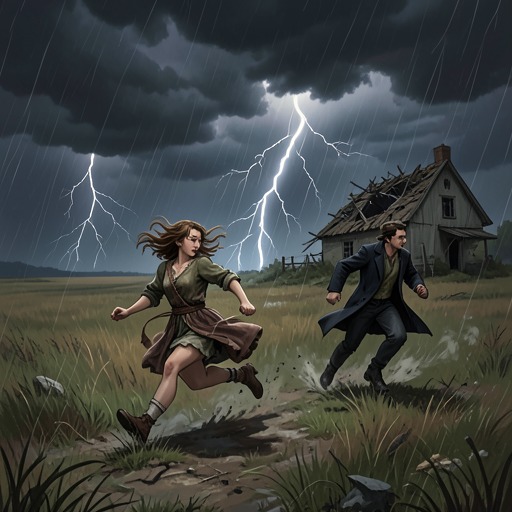
Heathcliff's prayer is answered with a vengeance. He describes to Ellen how, after Catherine's burial, he went to the churchyard on the evening of the day she was buried, when a fall of snow had come and it blew bleak as winter. Being alone, and conscious that two yards of loose earth were the sole barrier between them, he said to himself, 'I'll have her in my arms again! If she be cold, I'll think it is this north wind that chills me; and if she be motionless, it is sleep.' He got a spade from the tool-house and began to delve with all his might; it scraped the coffin, and he fell to work with his hands, the wood commencing to crack about the screws. He was on the point of attaining his object when he seemed to hear a sigh from someone above, close at the edge of the grave and bending down. 'If I can only get this off,' he muttered, 'I wish they may shovel in the earth over us both!' and he wrenched at it more desperately still. There was another sigh, close at his ear; he appeared to feel the warm breath of it displacing the sleet-laden wind. He knew no living thing in flesh and blood was by, but as certainly as one perceives the approach to some substantial body in the dark, so certainly he felt that Cathy was there—not under him, but on the earth. A sudden sense of relief flowed from his heart through every limb; he relinquished his labour of agony and turned consoled at once, unspeakably consoled. Her presence remained with him while he re-filled the grave and led him home.
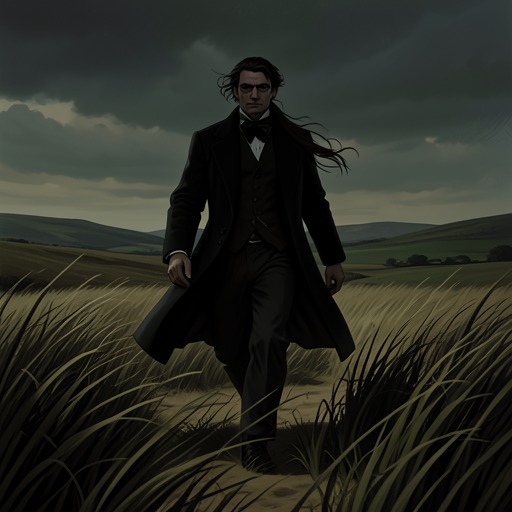
From that night, the haunting intensifies into a torture that Heathcliff describes as killing 'not by inches, but by fractions of hairbreadths.' When he sat in the house with Hareton, it seemed that on going out he should meet her; when he walked on the moors, she should be coming in. When he went from home he hastened to return; she must be somewhere at the Heights, he was certain. When he slept in her chamber, he was beaten out of that—he couldn't lie there, for the moment he closed his eyes, she was either outside the window, or sliding back the panels, or entering the room, or even resting her darling head on the same pillow as she did when a child, and he must open his lids to see. He opened and closed them a hundred times a night, to be always disappointed. It racked him; he often groaned aloud, till that old rascal Joseph no doubt believed that his conscience was playing the fiend inside of him. The haunting finally breaks him: he tells Ellen that a strange change is approaching, that he is in its shadow, that he takes so little interest in his daily life he hardly remembers to eat and drink. Hareton's startling likeness to Catherine connects him fearfully with her, for 'what is not connected with her to me? and what does not recall her? I cannot look down to this floor, but her features are shaped in the flags! In every cloud, in every tree—filling the air at night, and caught by glimpses in every object by day—I am surrounded with her image! The most ordinary faces of men and women—my own features—mock me with a resemblance. The entire world is a dreadful collection of memoranda that she did exist, and that I have lost her!'
Death and the Persistent Legend
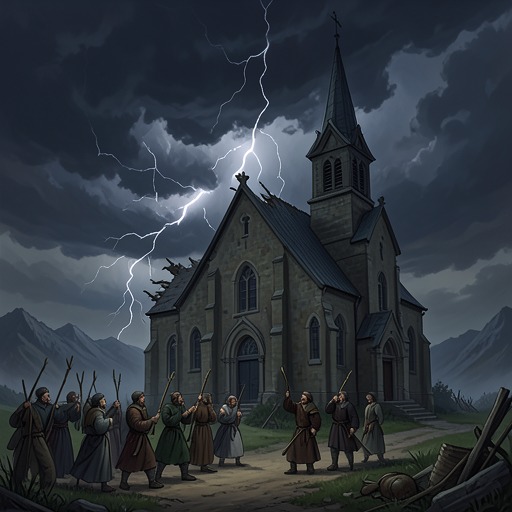
Heathcliff's death is the ghost's final victory. He swallows nothing for four days, though Ellen is persuaded he did not abstain on purpose—it was the consequence of his strange illness, not the cause. Mr. Kenneth is perplexed to pronounce of what disorder the master died. They bury him, to the scandal of the whole neighbourhood, as he wished: Earnshaw and Ellen, the sexton, and six men to carry the coffin comprehend the whole attendance. The six men depart when they have let it down into the grave; the others stay to see it covered. Hareton, with a streaming face, digs green sods and lays them over the brown mould himself. At present it is as smooth and verdant as its companion mounds—and Ellen hopes its tenant sleeps as soundly. But the country folks, if asked, would swear on the Bible that he walks: there are those who speak of having met him near the church, and on the moor, and even within this house. Idle tales, Ellen says, and so says the reader—yet that old man by the kitchen fire affirms he has seen two of them looking out of his chamber window on every rainy night since his death.
The haunting's final image is the three headstones on the slope next to the moor, which Lockwood discovers on his last visit to the kirk: the middle one grey and half buried in the heath; Edgar Linton's only harmonized by the turf and moss creeping up its foot; Heathcliff's still bare. Lockwood lingers round them under that benign sky, watches the moths fluttering among the heath and harebells, listens to the soft wind breathing through the grass, and wonders how anyone could ever imagine unquiet slumbers for the sleepers in that quiet earth. The irony is deliberate: the entire novel has demonstrated that the sleepers are not quiet, that Catherine's ghost has haunted the Heights for twenty years, and that Heathcliff's bare headstone—newest of the three—promises that his restless spirit now joins hers in the walks reported by the country folk. The ghost of Catherine, which began as a child's cry at a window, ends as the proof that the novel's love transcends death itself, and that the moors and the churchyard hold not one but two unquiet souls.
The event's significance lies in its fusion of the Gothic and the psychological. The ghost is simultaneously a literal supernatural presence—confirmed by Lockwood's independent encounter, Heathcliff's desperate prayer, and the country folk's testimony—and a projection of Heathcliff's monomania, the 'spectre of a hope' that beguiles him through eighteen years. Catherine's own words, spoken to Ellen years before her death, prefigure the haunting: 'I am Heathcliff! He's always, always in my mind: not as a pleasure, any more than I am always a pleasure to myself, but as my own being.' And her declaration that 'if all else perished, and he remained, I should still continue to be; and if all else remained, and he were annihilated, the universe would turn to a mighty stranger' finds its terrible fulfillment in Heathcliff's experience of a world that is 'a dreadful collection of memoranda that she did exist, and that I have lost her.' The ghost is the novel's answer to Catherine's question of whether such unity can survive death: it can, but only as torment—the waif who has been lost on the moor for twenty years, and the man who cannot live without his life or his soul.