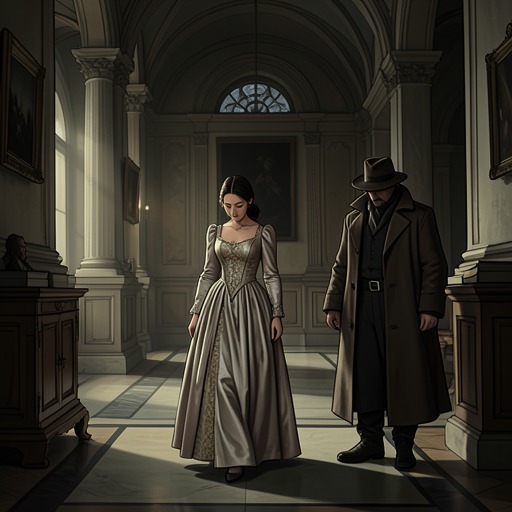
Catherine's coffin
Wuthering HeightsCatherine's coffin is the material anchor of Heathcliff's undying obsession with Catherine Earnshaw, the object he violates, rearranges, and ultimately plans to share for eternity. More than a mere receptacle for the dead, the coffin becomes the stage for Heathcliff's most extreme acts of transgression: he opens it, loosens one side, bribes the sexton to remove it when he is buried, and dreams of lying beside her with his heart stopped and his cheek frozen against hers. In a novel saturated with hauntings and restless spirits, the coffin is the one fixed point where the living and the dead are meant to be separated—and Heathcliff dedicates himself to undoing that separation with the same relentless energy he once devoted to revenge.
The Opening of the Coffin
Heathcliff's first recorded violation of Catherine's coffin occurs shortly after her burial, on the very day she was interred. A fall of snow marked her funeral, and that evening Heathcliff went alone to the churchyard, conscious that two yards of loose earth were the sole barrier between himself and her body. Speaking to himself, he declared, "I'll have her in my arms again!" and, fetching a spade from the tool-house, began to delve with all his might. The spade scraped the coffin; he fell to work with his hands; the wood commenced cracking about the screws. He was on the point of attaining his object when he seemed to hear a sigh from someone above, close at the edge of the grave. A second sigh came at his ear, and he felt the warm breath of it displacing the sleet-laden wind. Though he knew no living thing in flesh and blood was by, he felt certain that Cathy was there—not under him, but on the earth. A sudden sense of relief flowed from his heart through every limb; he relinquished his labour of agony, turned consoled at once, and re-filled the grave, with her presence remaining with him and leading him home.
The Desecration and the Plan
Years later, Heathcliff returned to the coffin with a colder, more calculated purpose. When Edgar Linton's grave was being dug, Heathcliff got the sexton to remove the earth off Catherine's coffin lid and opened it again. Seeing her face—"it is hers yet!"—he thought once he would have stayed there, and the sexton had hard work to stir him. But the sexton warned that her face would change if the air blew on it, and so Heathcliff struck one side of the coffin loose and covered it up—not Linton's side, which he wished had been soldered in lead. He then bribed the sexton to pull that side away when he himself was laid there, and to slide his own coffin out too, so that by the time Linton got to them he would not know which was which. The plan was not merely to lie beside Catherine but to erase Edgar Linton's claim on her entirely, ensuring that in death, as in life, Heathcliff would possess her exclusively.
The Confession to Nelly
Heathcliff revealed this desecration to Ellen Dean in a moment of strange triumph, after Catherine Linton had scornfully withdrawn from the room at Wuthering Heights. When Nelly exclaimed that he was very wicked and asked whether he was not ashamed to disturb the dead, Heathcliff replied, "I disturbed nobody, Nelly; and I gave some ease to myself." He explained that Catherine had disturbed him night and day through eighteen years—incessantly, remorselessly—until the night before, when he had been tranquil, dreaming he was sleeping the last sleep by that sleeper, with his heart stopped and his cheek frozen against hers. When Nelly asked what he would have dreamt if she had been dissolved into earth or worse, he answered, "Of dissolving with her, and being more happy still!" He confessed he had expected such a transformation on raising the lid but was better pleased that it should not commence until he shared it. The coffin, for Heathcliff, was not a place of decay but the threshold of a reunion he had been pursuing since the moment of her death.
The Final Instructions
Heathcliff's obsession with the coffin extended to the arrangements for his own burial. In his last days, when Nelly reminded him of the selfish, unchristian life he had lived and suggested sending for a minister, Heathcliff replied that he was rather obliged than angry, for she reminded him of the manner in which he desired to be buried. He instructed that he was to be carried to the churchyard in the evening, with Nelly and Hareton accompanying him if they pleased, and that the sexton must particularly be made to obey his directions concerning the two coffins. No minister need come, nor need anything be said over him, for he declared he had nearly attained his heaven, and that of others was altogether unvalued and uncoveted by him. When Nelly warned that if he died by his obstinate fast and they refused to bury him in the precincts of the kirk, he replied, "They won't do that: if they did, you must have me removed secretly; and if you neglect it you shall prove, practically, that the dead are not annihilated!"
The Burial and the Aftermath
Heathcliff was buried as he wished, to the scandal of the whole neighbourhood. The attendance comprised only Hareton Earnshaw, Nelly, the sexton, and six men to carry the coffin. The six men departed when they had let it down into the grave; the others stayed to see it covered. Hareton, with a streaming face, dug green sods and laid them over the brown mould himself. The grave became as smooth and verdant as its companion mounds. But the country folk, if asked, would swear on the Bible that Heathcliff walks: there are those who speak of having met him near the church, and on the moor, and even within the house. An old man by the kitchen fire affirms he has seen two of them looking out of the chamber window on every rainy night since his death. The coffin, which Heathcliff had so carefully arranged to unite him with Catherine, became the origin of a new haunting—the two restless spirits now wandering together, their graves indistinguishable, their union finally achieved in the very earth he had once dug with his bare hands.
The Coffin and the Haunting
The coffin also stands in oblique relation to the ghostly visitations that frame the novel. When Mr. Lockwood, sleeping in the oak-panelled bed at Wuthering Heights, dreamed of a child's face at the window crying "Let me in—let me in!" and identified herself as Catherine Linton, the terror of the nightmare was the terror of the dead refusing to stay buried. Heathcliff, roused by Lockwood's yell, went to the window and, in an uncontrollable passion of tears, sobbed, "Come in! come in! Cathy, do come. Oh, do—once more! Oh! my heart's darling! hear me this time, Catherine, at last!" The spectre gave no sign of being, but the snow and wind whirled wildly through. The coffin is the unspoken referent of this scene: the body that should be sealed within it is instead imagined as wandering the moors, lost, seeking entry. Heathcliff's opening of the coffin was not merely a desecration but an attempt to recall her spirit, to undo the finality that the coffin represents. His prayer at her death—"Catherine Earnshaw, may you not rest as long as I am living"—was answered in a way he could not have foreseen: she haunted him for eighteen years, and the coffin became the symbol of both his torment and his hope of release. In the end, the two coffins, side by side with one side removed, fulfilled his wish to be with her always, even as the neighbourhood whispered that the dead walked the moors together.