Catherine's Visit to Thrushcross Grange
Wuthering HeightsCatherine's Visit to Thrushcross Grange is the pivotal event in Emily Brontë's Wuthering Heights where the young Catherine Earnshaw and Heathcliff, having fled their home to spy on the Linton children, are discovered, leading to Catherine being attacked by the family's bulldog, Skulker, and taken into the Grange. This incident marks the first major rupture in Catherine and Heathcliff's childhood unity, exposing them to the civilized world of the Lintons and setting in motion the social and emotional divisions that will define the rest of their lives. The visit results in Catherine staying at Thrushcross Grange for five weeks, during which she is transformed into a lady, while Heathcliff is rejected and humiliated, deepening his resentment and his resolve for revenge.
The Escape and the Peeping
The event begins on a Sunday evening when Catherine and Heathcliff, banished from the sitting-room for making a noise, escape from the wash-house for a ramble at liberty. Their aimless wandering takes them toward the lights of Thrushcross Grange, and they decide to see whether the Linton children, Edgar and Isabella, spend their Sunday evenings in a state of misery. Heathcliff later recounts to Ellen Dean how they ran from the top of the Heights to the park without stopping, with Catherine completely beaten in the race because she was barefoot, her shoes lost in the bog. They crept through a broken hedge, groped their way up the path, and planted themselves on a flower-plot under the drawing-room window, standing on the basement and clinging to the ledge to look in.
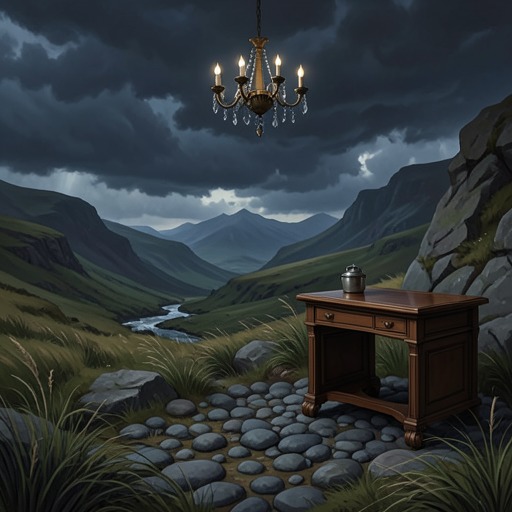
What they see is a vision of opulence and order that stands in stark contrast to their own wild existence. The room is a splendid place carpeted with crimson, with crimson-covered chairs and tables, a pure white ceiling bordered by gold, and a shower of glass-drops hanging in silver chains from the centre, shimmering with little soft tapers. Old Mr. and Mrs. Linton are not there; Edgar and his sisters have it entirely to themselves. Yet the scene is not one of peaceful contentment. Isabella, who is eleven, a year younger than Catherine, lies screaming at the farther end of the room, shrieking as if witches were running red-hot needles into her, while Edgar stands on the hearth weeping silently. In the middle of the table sits a little dog, shaking its paw and yelping, which, from their mutual accusations, the children had nearly pulled in two between them. The two outsiders laugh outright at the petted things, despising them for their foolish quarrel over a heap of warm hair. Heathcliff declares he would not exchange, for a thousand lives, his condition at Wuthering Heights for Edgar Linton's at Thrushcross Grange, not even for the privilege of flinging Joseph off the highest gable and painting the house-front with Hindley's blood.
The Bulldog's Attack and the Capture
The Lintons hear the laughter, and with one accord they shoot like arrows to the door, setting up a cry of "Oh, mamma, mamma! Oh, papa!" Heathcliff and Catherine make frightful noises to terrify them still more, then drop off the ledge as somebody draws the bars. Heathcliff has Catherine by the hand and is urging her on when she suddenly falls down. "Run, Heathcliff, run!" she whispers. "They have let the bull-dog loose, and he holds me!" The devil, a bulldog named Skulker, has seized her ankle. Catherine does not yell out, scorning to do so even if she had been spitted on the horns of a mad cow, but Heathcliff vociferates curses enough to annihilate any fiend in Christendom. He gets a stone and thrusts it between the dog's jaws, trying with all his might to cram it down its throat.
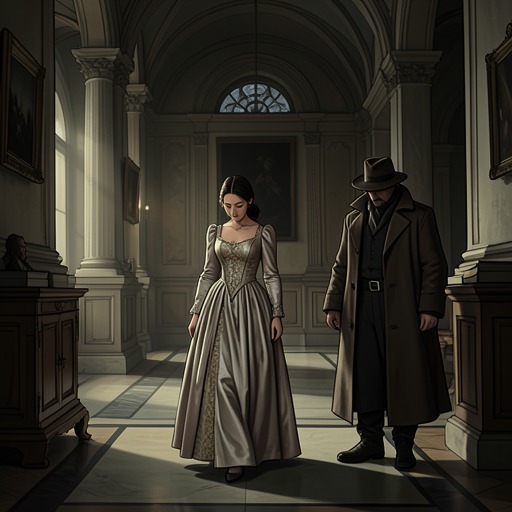
A servant comes up with a lantern, shouting "Keep fast, Skulker, keep fast!" but changes his note when he sees the dog's game. The dog is throttled off, its huge, purple tongue hanging half a foot out of its mouth, its pendent lips streaming with bloody slaver. The man takes Catherine up; she is sick, not from fear but from pain. He carries her in, with Heathcliff following, grumbling execrations and vengeance. Old Mr. Linton, a magistrate, mistakes the children for robbers, suspecting they were put through the window to open the doors to a gang. He pulls Heathcliff under the chandelier, and Mrs. Linton places her spectacles on her nose and raises her hands in horror. The cowardly children creep nearer, with Isabella lisping that Heathcliff is a frightful thing, exactly like the son of the fortune-teller that stole her tame pheasant.
The Five Weeks' Transformation
The immediate consequence is that Catherine stays at Thrushcross Grange for five weeks, until Christmas. By that time her ankle is thoroughly cured, and her manners much improved. The mistress of the Grange visits her often in the interval and commences a plan of reform, trying to raise her self-respect with fine clothes and flattery, which Catherine takes readily. When she returns, she is no longer a wild, hatless little savage jumping into the house and rushing to squeeze everyone breathless. Instead, there lights from a handsome black pony a very dignified person, with brown ringlets falling from the cover of a feathered beaver, and a long cloth habit which she is obliged to hold up with both hands that she might sail in. Hindley lifts her from her horse, exclaiming delightedly that she is quite a beauty and looks like a lady now, declaring that Isabella Linton is not to be compared with her. Beneath the habit shines a grand plaid silk frock, white trousers, and burnished shoes. While her eyes sparkle joyfully when the dogs come bounding up to welcome her, she dares hardly touch them lest they should fawn upon her splendid garments. She kisses Ellen gently, as Ellen is all flour making the Christmas cake, and then she looks round for Heathcliff. Mr. and Mrs. Earnshaw watch anxiously their meeting, thinking it will enable them to judge what grounds they have for hoping to succeed in separating the two friends.
The Divergence of Paths
The visit to Thrushcross Grange is the moment when Catherine and Heathcliff's paths begin to diverge irreparably. For Catherine, the exposure to the Lintons' world plants the seeds of her later ambition to become a lady and her eventual marriage to Edgar Linton. The transformation is not merely external; it introduces a new set of values and desires that will conflict with her profound, elemental bond with Heathcliff. For Heathcliff, the experience is one of humiliation and rejection. He is branded a villain and a thief, and the contrast between his own ragged, dark appearance and the polished, fair Lintons is made brutally explicit. The event also triggers a change in the household's discipline: the luckless adventure makes Hindley furious, and Mr. Linton pays a visit himself on the morrow, reading the young master such a lecture on the road he guides his family that he is stirred to look about him in earnest. Heathcliff receives no flogging, but he is told that the first word he speaks to Miss Catherine shall ensure a dismissal, and Mrs. Earnshaw undertakes to keep her sister-in-law in due restraint when she returns home, employing art, not force.
The Seeds of Revenge and the Gothic Echo
This early rejection plants the deep roots of Heathcliff's lifelong monomania. His response to the injustice is not forgiveness but a cold, calculating resolve. When Ellen later counsels him that it is for God to punish wicked people and that he should learn to forgive, he retorts, "No, God won't have the satisfaction that I shall. I only wish I knew the best way! Let me alone, and I'll plan it out: while I'm thinking of that I don't feel pain." This planning becomes his refuge from the pain of his separation from Catherine. The event also foreshadows the novel's Gothic and supernatural dimensions. The image of the child at the window, looking in on a world from which she is excluded, is inverted years later when Mr. Lockwood, in his nightmare at Wuthering Heights, sees a child's face at the window and hears the voice of Catherine Linton begging, "Let me in—let me in!" The trauma of the Grange visit, with its violence and its glimpse of a forbidden, beautiful world, becomes part of the haunting that defines the novel. Heathcliff's later desecration of Catherine's grave, his desperate prayer that she haunt him, and his final, restless death all trace back to this moment when the two children were first torn apart by the forces of civilization and class. The event's legacy is also visible in the next generation: the ruffianly child Hareton, with a look of Catherine in his eyes and about his mouth, and the young Catherine Linton's own captivity and suffering at Wuthering Heights are all consequences of the social rupture that began with a barefoot girl and a boy peeping through a window at Thrushcross Grange.